Applications of Quantum Computing for beginners
📖 11 min read | 8 July 2026 | Written by G Siva Prakash
I get asked a version of the same question all the time: “Okay, but what is quantum computing actually for?” It’s a fair question — qubits and superposition don’t mean much until you see them solving a real problem. In this guide, I’ll walk you through 11 areas where quantum computing is already being tested, piloted, or actively researched, and I’ll be upfront about which ones are live today versus which ones are still a few years out.
What Are the Applications of Quantum Computing?
Quantum computing applies qubits, superposition, and entanglement to problems that are too complex for classical computers to solve efficiently — mainly simulation, optimization, and cryptography. Today, that shows up as pilot projects and research rather than everyday products, spanning industries like healthcare, finance, and security.
- Drug Discovery
- Material Science
- Finance
- Cybersecurity
- AI & Machine Learning
- Climate Modeling
- Chemical Simulation
- Space Exploration
- Telecommunications
- Quantum Internet
- Scientific Research
Why Quantum Computing Is Important
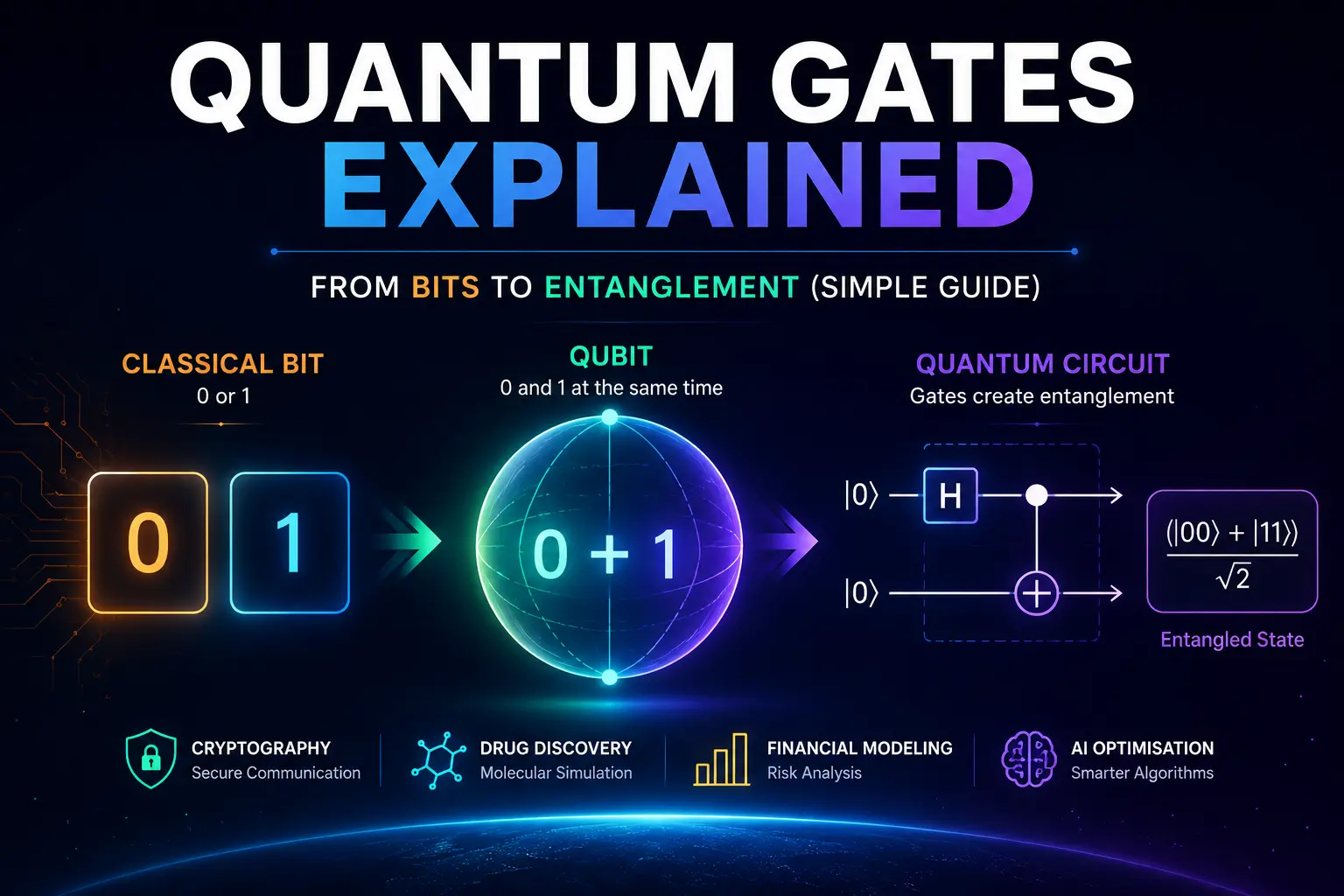
Classical computers process information as bits — a strict 0 or 1 — one sequence at a time. That works beautifully for spreadsheets and video streaming, but it breaks down when a problem has too many possible combinations to check one by one, like simulating how a new molecule folds or optimizing a logistics network with thousands of variables. Quantum computers use qubits, which can exist in superposition and become entangled with one another, letting them explore many possibilities at once for a specific class of problems.
That’s why governments and companies are investing billions: not because quantum computers will replace your laptop, but because a handful of narrow, high-value problems in chemistry, optimization, and cryptography may only be practically solvable this way. As of 2026, the field is still in the “noisy intermediate-scale quantum” (NISQ) era — real hardware exists, but it’s still limited by errors and qubit count.
Drug Discovery with Quantum Computing
Designing a new drug usually means testing thousands of molecular candidates in a lab, one at a time, over years. The bottleneck is that molecules are themselves quantum systems — electrons don’t behave the way classical physics predicts, so simulating them accurately on a classical computer gets exponentially harder as the molecule grows.
Quantum computers are naturally suited to this kind of simulation because they operate on the same quantum principles the molecules do. Companies like Google Quantum AI and academic labs have run early experiments simulating small molecules, and pharmaceutical firms are partnering with quantum hardware providers to explore whether this shortens the discovery timeline. The honest state of play: this is still research and pilot work, not a replacement for clinical trials, but it’s one of the most promising near-term use cases.
simulation
Related Blog: Quantum Computing
Quantum Applications in Material Science
Every battery, semiconductor, and superconductor starts as a materials problem: which atomic arrangement gives you the properties you want? Quantum simulation lets researchers model how atoms and electrons interact at a level of detail classical approximations can’t match, which matters for next-generation batteries, more efficient solar cells, and room-temperature superconductors.
IBM and academic partners have used quantum processors to simulate small battery-relevant molecules, and materials-focused startups are exploring quantum-assisted catalyst design. It’s early, but the direction is clear: better simulation could mean less physical trial-and-error in the lab.
Quantum Applications in Finance
Financial firms deal with optimization problems constantly — which mix of assets gives the best risk-adjusted return, how to price complex options, or how to flag fraudulent transactions in real time. Many of these are combinatorial optimization problems, exactly the kind of task quantum algorithms like QAOA (the Quantum Approximate Optimization Algorithm) are designed for.
Goldman Sachs, JPMorgan Chase, and HSBC have all run pilot projects with quantum hardware providers like IBM and IonQ, mostly around portfolio optimization and options pricing. The results so far are promising on small problem sizes, but current hardware isn’t yet large or stable enough to outperform classical methods on real-world portfolios — that crossover point is still ahead of us.
Quantum Applications in Cybersecurity
Most of today’s internet security — HTTPS, VPNs, digital signatures — relies on encryption schemes like RSA that are hard for classical computers to break. A large enough, error-corrected quantum computer running Shor’s Algorithm could break that same encryption efficiently. That hardware doesn’t exist yet, but the concern is real enough that “harvest now, decrypt later” attacks — where encrypted data is stolen today to be decrypted once quantum computers are capable — are already a documented risk.
In response, NIST finalized its first set of Post-Quantum Cryptography standards in 2024, and organizations are gradually migrating to quantum-resistant algorithms. On the other side of the coin, Quantum Key Distribution (QKD) uses quantum physics itself to detect eavesdropping on a communication line, and it’s already deployed in limited government and financial networks.
Related: Quantum Computing in Cybersecurity
Quantum Machine Learning Explained
Quantum Machine Learning (QML) explores whether quantum computers can speed up parts of machine learning — pattern recognition, optimization of model parameters, or handling certain types of high-dimensional data. It’s not a wholesale replacement for classical AI; think of it as a specialized accelerator for specific subroutines within a larger classical pipeline.
Right now, QML is mostly confined to small-scale research experiments, because today’s quantum hardware can’t yet handle the datasets that make modern AI useful. Google, IBM, and university labs are actively publishing QML research, but production use is still a way off.
Climate Modeling with Quantum Technology
Weather and climate systems involve enormous numbers of interacting variables — ocean currents, atmospheric chemistry, ice sheet dynamics — which makes them punishing to simulate with full accuracy. Researchers are exploring whether quantum algorithms can improve specific pieces of these models, such as simulating chemical reactions tied to carbon capture or refining probabilistic forecasting.
This is one of the more exploratory applications on this list: promising in theory, backed by early academic papers, but without large-scale deployment yet.
Molecular Simulation Using Quantum Computers
Chemistry is, at its core, a quantum phenomenon — electrons don’t follow neat classical orbits, they exist in probability clouds. That’s precisely why simulating chemical reactions, catalysts, and industrial processes is one of the applications researchers are most confident about long-term, spanning industrial chemistry, medicine, and energy production, like designing more efficient catalysts for fertilizer production or cleaner industrial processes.
Space Exploration with Quantum Computing
Mission planning, satellite constellation optimization, and spacecraft trajectory calculations are all optimization-heavy problems — deciding among enormous numbers of possible configurations under strict constraints. Space agencies including NASA and ESA have run early studies exploring quantum algorithms for trajectory optimization and secure deep-space communication.
It’s a natural fit conceptually, but like most items on this list, current experiments are small-scale proofs of concept rather than operational systems.
Quantum Applications in Telecommunications
Telecom networks constantly solve routing and resource-allocation problems — how to move traffic through a network with the lowest latency and the fewest bottlenecks. Quantum optimization algorithms are being tested by telecom research labs to see whether they can improve network routing at scale, especially as 5G and future 6G networks grow more complex.
What Is the Quantum Internet?
The quantum internet is a proposed network that transmits quantum information using entanglement rather than classical bits. Instead of copying data (which quantum physics forbids, via the no-cloning theorem), it would let distant locations share entangled particles, enabling ultra-secure communication and, eventually, networked quantum computers.
This isn’t a replacement for the internet you use daily. It’s a separate, specialized layer for tasks that need quantum-level security or coordination. Early testbeds exist including a metropolitan-scale quantum network in the Netherlands and fiber-based entanglement experiments in the US and China but quantum repeaters, the hardware needed to extend range, are still an active research challenge.
Quantum Technology in Scientific Research
Beyond any single industry, quantum computers are becoming research instruments in their own right — used to simulate quantum systems in physics, model protein folding in biology, explore reaction pathways in chemistry, and even test theories in astronomy and cosmology. Universities and national labs are among the biggest users of current quantum hardware precisely because fundamental research doesn’t need a commercial-scale system to produce useful results.
Major Challenges of Quantum Computing Applications
Every application above shares the same set of obstacles. Qubits are extremely fragile and lose their quantum state through decoherence in fractions of a second. Quantum noise introduces errors faster than most current systems can correct, and building reliable quantum error correction remains one of the field’s hardest open problems. On top of that: today’s qubits are expensive to build and maintain (many need near-absolute-zero temperatures), scaling to millions of qubits is unsolved, and there’s a global shortage of engineers trained in quantum hardware and algorithms.
Future of Quantum Computing Applications
Over the next decade, the most realistic path is incremental: quantum computers working alongside classical supercomputers as specialized accelerators, not standalone replacements. Healthcare and materials science are likely to see the earliest practical wins because chemistry simulation plays directly to quantum computing’s strengths. Finance and logistics will likely follow as hardware scales. Cybersecurity’s timeline is different — it’s driven less by when quantum computers become useful and more by when they become powerful enough to be a threat, which is why the migration to post-quantum cryptography is happening now, ahead of that milestone.
None of this means quantum computers will replace the computer you’re reading this on. The realistic future is a hybrid one, where quantum processors handle the narrow slice of problems classical computers genuinely struggle with.
Key Takeaways
- Quantum computing’s real-world value comes from simulation, optimization, and cryptography not general-purpose computing.
- Drug discovery and material science are among the most promising near-term applications because they lean on quantum simulation directly.
- Finance and telecom are testing quantum optimization for portfolio management and network routing.
- Cybersecurity faces a dual reality: a future threat to today’s encryption, and a new tool (QKD) for secure communication.
- Quantum machine learning and the quantum internet are earlier-stage, research-driven areas.
- Most applications today are pilots and research projects, not production deployments.
- The realistic future is hybrid quantum processors working alongside classical supercomputers