Wave Function in Quantum Mechanics: A Complete Beginner's Guide
“Where exactly is an electron right now?” Ask this question, and quantum mechanics will give you the strangest possible answer: it’s not really anywhere, until you look.
📖 09 min read | 18 Apr 2026 | Written by G Siva Prakash
That’s not a riddle. That’s physics. And the quantum wave function is the tool physicists use to make sense of it.
If you’ve ever been curious about quantum computers, Schrödinger’s cat, or why atoms behave so weirdly, you’ve already brushed up against this idea. Let’s unpack it together, step by step, no heavy math, just genuine understanding.
What Exactly Is a Wave Function in Simple Terms?
Think of a wave function as a possibility map.
When you flip a coin, before it lands, you can say there’s a 50% chance of heads and 50% chance of tails. You don’t know the outcome, but you can describe all the possible outcomes and how likely each one is.
The wave function in quantum mechanics does something similar, but for quantum particles like electrons. It describes every possible state a particle could be in, its position, energy, spin, along with the probability of each possibility.
Definition of Quantum Wave Function for beginners
The quantum wave function is a mathematical description of a quantum particle’s state. It tells you the probability of finding the particle in any particular place or condition when you measure it. Physicists write it using the Greek letter ψ (psi), which is why it’s often called the psi wave function.
The key insight: the particle doesn’t have one definite state. It exists in a superposition, a blend of all possible states, until someone measures it.
A Friendly Analogy: The Weather Forecast
Imagine you’re a meteorologist. You don’t know exactly what tomorrow’s weather will be, but you can say: “There’s a 70% chance of rain in the north, 20% in the center, and 10% in the south.” That’s your forecast, a map of probabilities across space.
The quantum mechanics wave function is like that forecast, but for a particle. It spreads out over space, assigning a probability to every possible location. The taller the wave in a region, the more likely the particle is to be found there
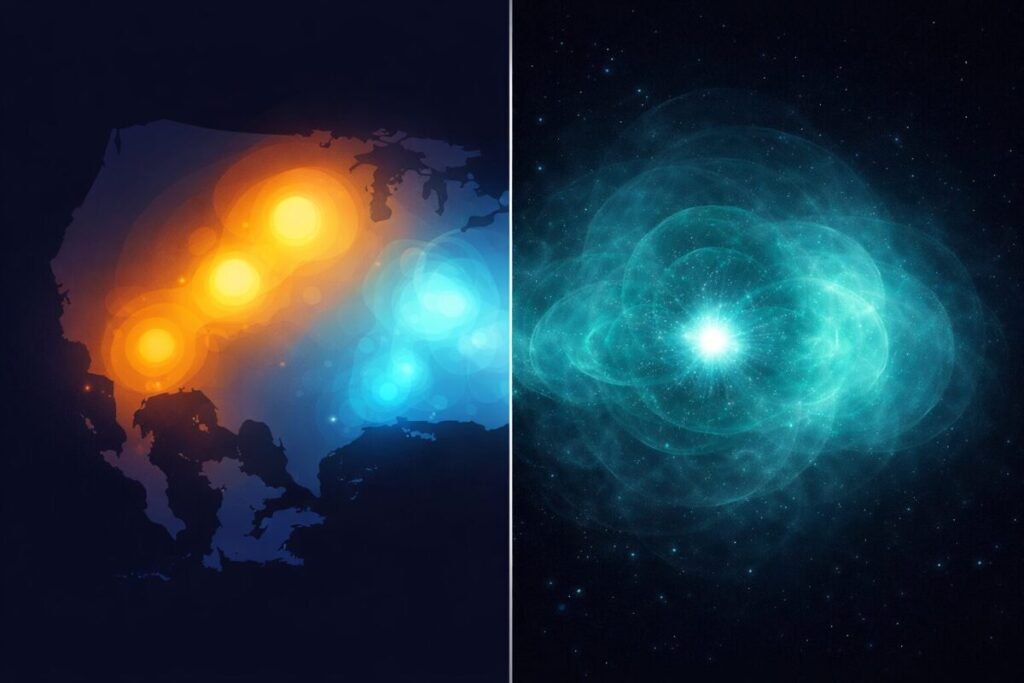
Visual 1 — Probability distribution of an electron
Where is the electron most likely to be found? The wave function assigns a probability to each region.
These are illustrative values showing how probability spreads over space. This pattern is what creates the famous electron probability cloud around an atom.
This spread-out cloud of probabilities is the electron’s wave function. It isn’t a fuzzy electron, it’s a precise mathematical description of all the places the electron could be.
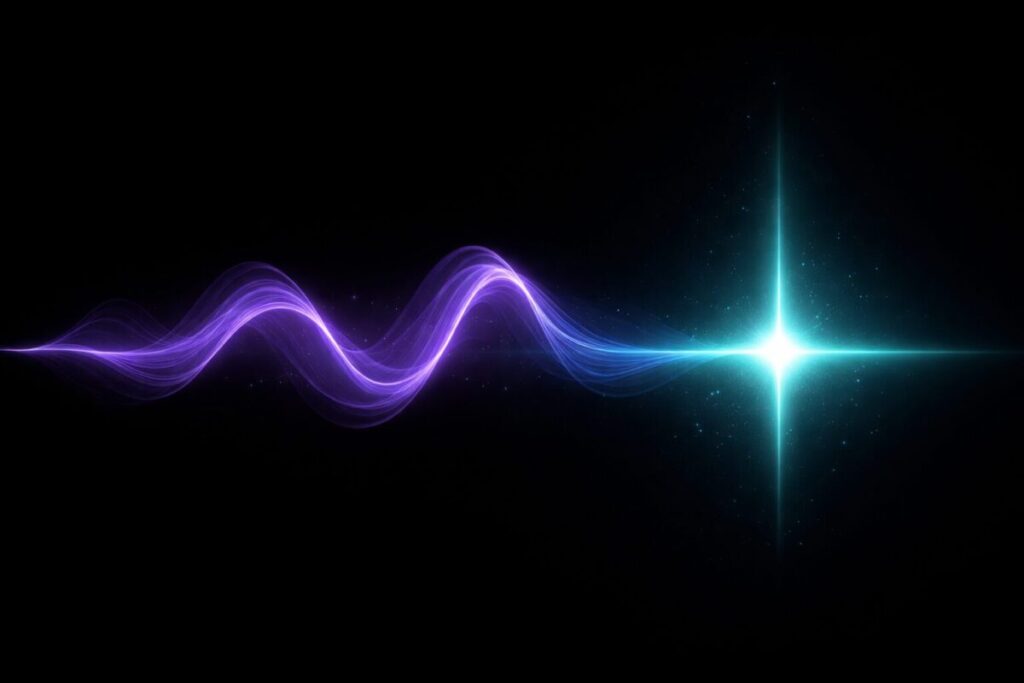
How Does the Wave Function Work? Step by Step
Step 1:
Step 2:
Step 3
Step 4
Step 5
The Wave Function Equation (Without the Scary Math)
The Schrödinger wave function equation, written in 1926 by Erwin Schrödinger, is the engine behind all of this. You don’t need to solve it to understand what it does.
In plain language, it says: “Given what a particle is doing right now, here is how its probability wave will change over the next moment.” It’s like a GPS for the quantum world, not tracking one fixed path, but calculating the entire landscape of where you might end up.
What does ψ² (psi squared) mean?
The wave function ψ is a complex-valued mathematical function that describes the quantum state of a system. However, the wave function itself does not directly give the probability of finding a particle at a specific location.
When you calculate its absolute square, |ψ|², you get the probability density, which tells you how likely the particle is to be found in a particular region. This step is crucial because it connects the abstract mathematical wave function to real, measurable predictions.
Visual Explainer: Superposition at a Glance
Visual 2 — Superposition vs. Measurement
Before measurement, a particle can be in multiple quantum states simultaneously. Measurement forces it to choose one.
∞
possible states in superposition
ψ²
1
This is why quantum measurement is so special, the act of observing a quantum system fundamentally changes it. This is the famous quantum measurement problem.
What Exactly Is a Wave Function in Simple Terms?
Superposition
A quantum particle can be in multiple states simultaneously. The wave function holds all these possibilities in one description. It’s only when measured that reality “picks” one outcome. This is the backbone of quantum computing — qubits exploit superposition to process many states at once.
The Uncertainty Principle
Heisenberg’s uncertainty principle says you can never know both a particle’s exact position and its exact momentum at the same time. The wave function makes this precise: a narrower wave (sharper position) means a broader spread of momenta — they are fundamentally linked.
Quantum Entanglement
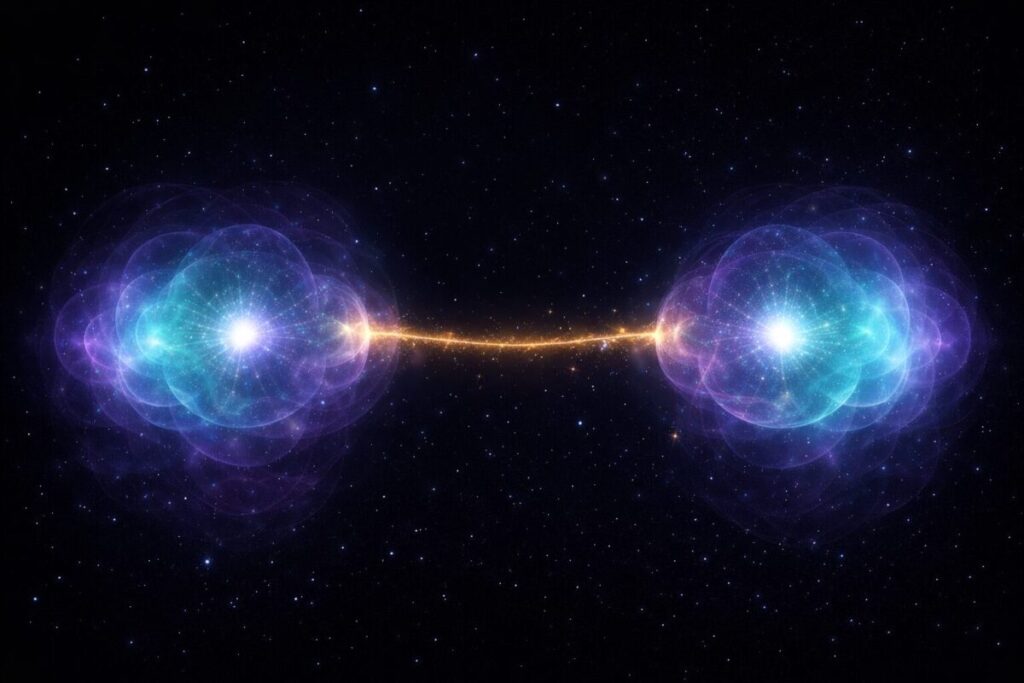
When two particles interact, their wave functions become linked. Measuring one instantly influences the wave function of the other — no matter how far apart they are. This is quantum entanglement, and it’s what makes quantum communication so powerful and so strange.
Common Misconceptions
MYTH
“The wave function is a physical wave, like a water wave.”
REALITY
The wave function is a mathematical object — it lives in abstract space, not physical space. It represents information about probabilities, not a literal ripple in any medium.
MYTH
“The particle is in multiple places physically at once.”
REALITY
The particle has multiple probable locations, described by the wave function. The particle itself isn’t smeared out, our knowledge of its location is.
MYTH
“Wave function collapse means something physically collapses.”
REALITY
Collapse means the probability distribution updates. It’s an update to our knowledge of the system, triggered by an interaction, not a physical implosion.
Why Does the Wave Function Actually Matter?
The wave function in quantum mechanics isn’t just an abstract curiosity, it’s the foundation of the technologies shaping our future.
Semiconductors and transistors, in your phone, laptop, and every chip on Earth, work because engineers understand the quantum behavior of electrons in materials. That understanding comes directly from solving wave function equations.
MRI machines use nuclear spin states, quantum states described by wave functions, to image soft tissue without radiation. Quantum mechanics saves lives in hospitals every day.

Quantum computers manipulate wave functions directly. By keeping qubits in superposition and entangling their wave functions, quantum computers can solve certain problems exponentially faster than classical machines.
Connected Topics Worth Exploring
The wave function is a gateway into a whole universe of ideas. Here are the concepts most tightly connected to it:
Here’s what I find most remarkable after years of working in quantum computing: the wave function isn’t just a calculation tool. It forces us to ask a deeper question, does reality even exist before we look at it?
Physicists still debate the answer. Some say the wave function is all that’s real. Others say it’s just a map of our ignorance. Either way, it works, and it works with breathtaking precision.
The next time you use your phone, remember: every electron flowing through that chip is dancing to the mathematics of a wave function. Quantum mechanics isn’t the future. It’s already everywhere around you.