Quantum Annealing Explained: A Beginner's Guide to Quantum Optimisation
📖 13 min read | 18 July 2026 | Written by G Siva Prakash
What Is Quantum Annealing?
Quantum annealing is a specialised form of quantum computing built only to solve optimisation problems, not general computation tasks.
It is optimisation-focused by design. Rather than running arbitrary programs, it searches for the lowest-cost, most efficient answer to one framed problem.
Instead of brute-force checking every option, it uses quantum mechanics, superposition and tunneling, to explore many possibilities at once.
This is the key distinction between searching and optimising. Searching finds any match. Optimising finds the single best match among countless options.
Simple analogy: Imagine dropping a marble into a bumpy bowl full of dips and dents. A classical approach nudges the marble step by step, checking each dip along the way. Quantum annealing lets the whole system settle naturally into the deepest dip, the best possible answer, using quantum effects instead of trial and error.
Why Do We Need Quantum Annealing?
Optimisation problems surround modern business. Routing trucks, scheduling flights, balancing portfolios, and planning factory floors all require choosing the best option among many.
Many of these are NP-hard problems. In simple terms, as the problem grows, the number of possible combinations grows explosively, not steadily.
A delivery route with 10 stops has over 3.6 million possible orderings. With 20 stops, the possibilities exceed the number of atoms in reach of ordinary computation.
This is the huge search space problem. Classical computers can approximate good answers, but proving the truly best one becomes impossibly slow at scale.
Classical optimisation tools, like linear programming and heuristics, work well for smaller problems but degrade as variables and constraints multiply.
Real-world examples show the stakes clearly:
- Delivery routes: Choosing the shortest, cheapest path across hundreds of stops daily.
- Airline scheduling: Assigning crews, gates, and aircraft while avoiding costly conflicts.
- Portfolio optimisation: Balancing risk and return across thousands of asset combinations.
- Manufacturing: Sequencing factory jobs to minimise downtime and wasted material.
Quantum annealing was built specifically to attack this class of problem, where classical methods hit diminishing returns.
The Physics Behind Quantum Annealing
Energy Landscapes
Physicists describe every optimisation problem as an energy landscape, a surface of mountains and valleys representing possible solutions.
Height on this landscape represents cost. Lower points mean better, cheaper, more efficient solutions. Higher points mean worse ones.
Ground State
The ground state is the lowest possible energy configuration a system can reach, the mathematical equivalent of the best solution available.
Local Minimum
A local minimum is a valley that looks like the bottom nearby, but is not the deepest point across the entire landscape.
Global Minimum
The global minimum is the single deepest valley across the whole landscape, representing the actual optimal answer to the problem.
Optimisation, at its core, means finding this global minimum. Classical methods often get trapped in local minimums that merely look good.
Quantum Tunneling: The Secret Behind Quantum Annealing
Classical hill climbing moves step by step across the landscape, always following the nearest downhill slope it can find.
This strategy gets stuck easily. Once trapped in a local minimum, a classical system needs to climb back uphill first, which it usually will not do.
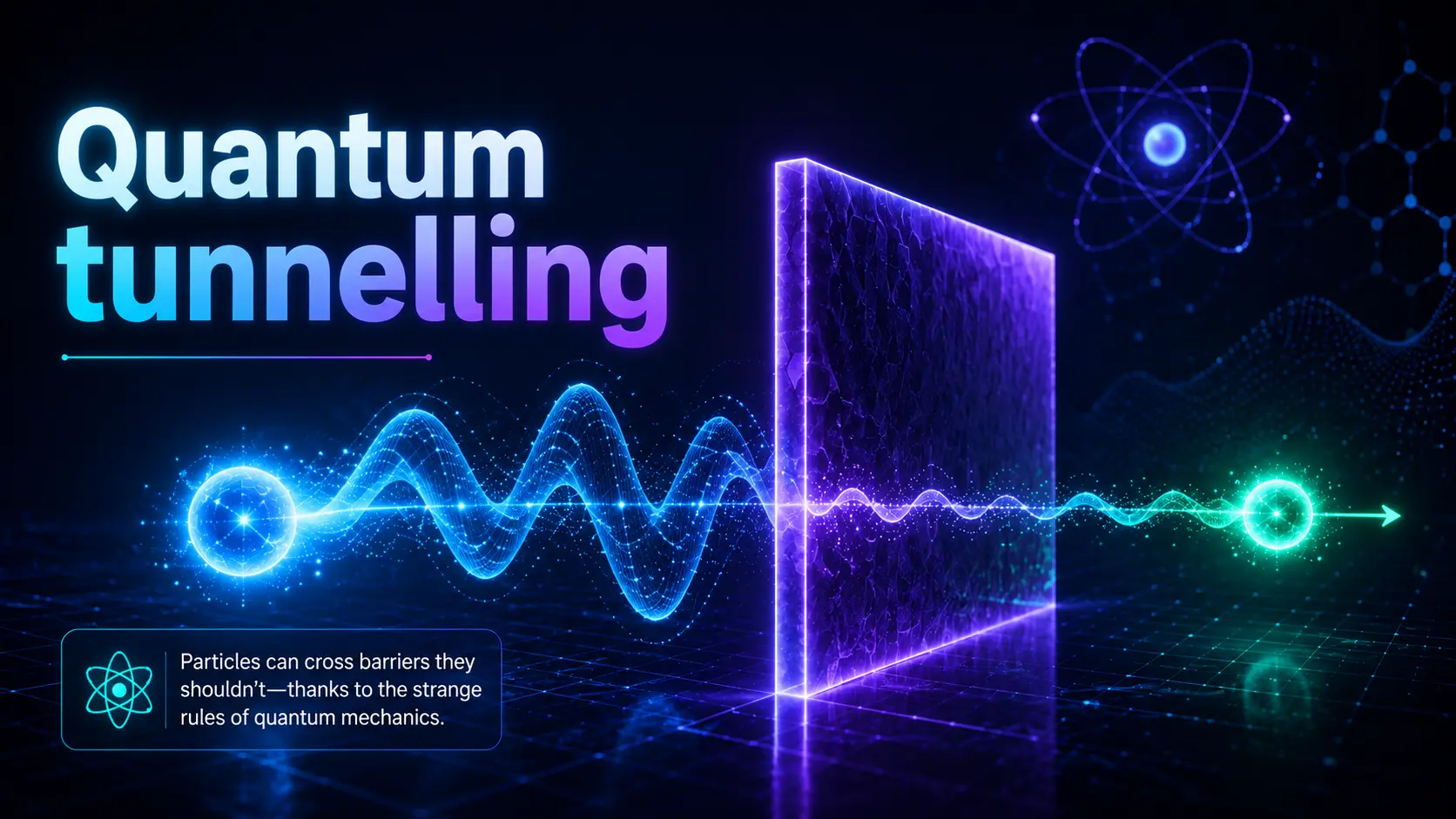
Quantum tunneling changes this entirely. Instead of climbing over a barrier, a quantum system can pass directly through it.
This is called barrier penetration. Quantum particles have a real, measurable probability of appearing on the other side of an energy wall.
Tunneling improves optimisation because it lets the system escape local minimums without needing extra energy to climb back uphill first.
How Quantum Annealing Works, Step by Step
1
Represent the optimisation problem
The real-world problem, routes, schedules, or portfolios, is translated into variables with costs and constraints.
2
Convert into an Ising Hamiltonian
Those variables are rewritten as a mathematical energy function. In simple terms, the problem becomes a landscape where the answer is the lowest point.
3
Initialise qubits
Every qubit starts in an equal superposition, representing all possible answers simultaneously before any evolution begins.
4
Begin quantum evolution
The system starts transitioning from this simple, well-understood state toward the more complex problem state.
5
Slow annealing process
The transition happens gradually. Moving too fast risks jumping past the correct answer entirely.
6
Quantum tunneling
Along the way, tunneling helps the system slip past local minimums that would otherwise trap a classical search.
7
Reach lowest energy
By the end of the anneal, the system has settled, ideally, into the global minimum, the best available answer.
8
Measure final state
Reading the qubits converts the physical result back into a usable, real-world answer, such as an optimal route or schedule.
The Ising Model in Quantum Annealing
The Ising model was originally created in physics to describe magnetism, but it turns out to fit optimisation problems remarkably well.
Each qubit acts like a spin, pointing either up or down, representing one of two possible states in the problem.
Interactions between qubits encode relationships in the real problem, such as two delivery stops being linked or two assets correlating.
Mapping an optimisation problem onto the Ising model means translating every rule and cost into these spin interactions and weights.
The Ising model is widely used because quantum annealing hardware is physically built to naturally minimise exactly this kind of energy function.
Quantum Annealing vs Adiabatic Quantum Computing
Quantum annealing and adiabatic quantum computing share the same theoretical root: the adiabatic theorem, formalised by Edward Farhi and colleagues around 2000.
Adiabatic quantum computing is the strict theoretical model, requiring extremely slow evolution and near-perfect isolation from noise to guarantee the correct answer.
Quantum annealing is the practical, engineered version. It relaxes some of those strict guarantees to run on real, noisy hardware today.
In short, adiabatic quantum computing is the proof; quantum annealing is the working implementation built to be commercially usable now.
| Aspect | Adiabatic Quantum Computing | Quantum Annealing |
|---|---|---|
| Nature | Theoretical, mathematically rigorous model | Practical, engineered implementation |
| Speed | Very slow evolution for guarantees | Faster, approximate annealing schedules |
| Hardware | Largely conceptual | D-Wave and similar systems |
| Optimum | Provable under ideal conditions | Near-optimal in practice |
| Foundation | Both rely on the adiabatic theorem. | |
Quantum Annealing vs Gate-Based Quantum Computing
Gate-based quantum computers, used by IBM, Google, and IonQ, are general-purpose machines programmed with sequences of quantum logic gates.
Quantum annealers are purpose-built for one job, optimisation, and cannot run arbitrary quantum algorithms like Shor’s or Grover’s.
| FACTOR | QUANTUM ANNEALING | GATE-BASED QUANTUM COMPUTING |
|---|---|---|
| Purpose | Optimisation problems only | General-purpose quantum computing |
| Hardware | Superconducting flux qubits, D-Wave | Superconducting, trapped ion, photonic qubits |
| Algorithms | Ising-based optimisation | Shor's, Grover's, VQE, and more |
| Flexibility | Low, single problem class | High, broad range of applications |
| Qubit count | Thousands, lower fidelity per qubit | Dozens to low hundreds, higher fidelity |
| Programming | QUBO or Ising formulation | Quantum circuits and gate sequences |
| Example | D-Wave Systems | IBM Quantum, Google Quantum AI, IonQ |
| Best fit | Routing, scheduling, resource allocation | Simulation, cryptography, research |
Real-World Applications of Quantum Annealing
Logistics: Vehicle Routing
Delivery fleets use quantum annealing pilots to shorten routes across hundreds of stops while respecting time and vehicle constraints.
Supply Chain: Warehouse Optimisation
Warehouse operators test annealing to optimise item placement and picking paths, reducing wasted movement across large facilities.
Finance: Portfolio Optimisation
Financial firms use annealing to balance risk and return across thousands of asset combinations faster than classical solvers.
Finance: Fraud Detection
Annealing-based clustering helps identify unusual transaction patterns that classical rule-based systems often miss.
Manufacturing: Factory Scheduling
DENSO, a major automotive parts manufacturer, has publicly tested D-Wave annealing to optimise factory job scheduling and reduce idle time.
Drug Discovery: Molecular Optimisation
Researchers explore annealing for narrowing molecular configuration searches before handing promising candidates to further simulation.
Artificial Intelligence: Machine Learning Optimisation
Annealing has been tested for optimising certain machine learning components, including feature selection and clustering tasks.
Telecommunications: Network Optimisation
Telecom operators explore annealing for optimising cell tower placement and network traffic routing under changing demand.
Energy: Power Grid Optimisation
Utility companies have piloted annealing for balancing power grid load distribution across variable renewable energy sources.
Documented case: Volkswagen publicly tested D-Wave quantum annealing to optimise taxi traffic flow in Beijing and Lisbon, aiming to reduce congestion by recalculating optimal routes for fleets in near real time.
Advantages of Quantum Annealing
- Better optimisation: Explores complex landscapes more effectively than many classical heuristics on suitable problems.
- Quantum tunneling: Escapes local minimums that trap classical hill-climbing methods.
- Near-optimal solutions: Delivers strong, usable answers quickly, even without proving absolute optimality.
- Commercial hardware exists: D-Wave systems are commercially available today, not theoretical.
- Energy efficiency: Specialised hardware can be more efficient for its narrow problem class than general classical clusters.
- Practical today: Unlike many gate-based applications, annealing is already being piloted in production settings.
Limitations of Quantum Annealing
- Only optimisation: Cannot run general algorithms like factoring or quantum simulation.
- Noise: Environmental interference can pull the system away from the true global minimum.
- Limited qubit connectivity: Not every qubit connects directly to every other qubit, constraining problem size.
- Embedding problems: Mapping real problems onto hardware topology can waste qubits and reduce efficiency.
- Doesn’t replace universal quantum computers: Gate-based machines remain necessary for cryptography and simulation tasks.
- Not every optimisation benefits: Some problems still solve faster and cheaper with classical methods today.
Quantum Annealing Hardware
D-Wave Systems is the leading commercial builder of quantum annealing hardware, and the only company selling annealers at scale.
Its Quantum Processing Unit, or QPU, uses superconducting loops of niobium wire as qubits, arranged in a fixed connectivity pattern.
These superconducting qubits require cryogenic temperatures near absolute zero, around 15 millikelvin, to maintain their fragile quantum states.
Cooling is required because heat introduces noise that instantly destroys the delicate quantum superposition needed for annealing to work correctly.
D-Wave’s early Chimera architecture connected each qubit to about 6 neighbours, limiting how large a single problem could be embedded directly.
The newer Pegasus architecture, used in the D-Wave Advantage system, increased connectivity to roughly 15 connections per qubit, improving embedding efficiency significantly.
D-Wave’s Zephyr architecture pushes connectivity even further, aiming for around 20 connections per qubit in newer generation Advantage2 systems.
The D-Wave Advantage system exceeds 5,000 qubits, and is accessible commercially through D-Wave’s Leap cloud platform.
Industries Using Quantum Annealing
- Automotive: Volkswagen and DENSO have both run public annealing pilots for logistics and scheduling.
- Aerospace: Explored for crew scheduling and complex maintenance planning optimisation.
- Healthcare: Tested for treatment scheduling and early-stage molecular optimisation research.
- Banking: Used for portfolio construction and fraud pattern detection research.
- Logistics: Widely tested for route optimisation and warehouse efficiency.
- Telecommunications: Applied to network routing and infrastructure placement problems.
- Government research: Los Alamos National Laboratory operates a D-Wave system for optimisation research.
- Scientific research: Universities use annealing hardware to study combinatorial optimisation theory.
The Future of Quantum Annealing
Larger quantum annealers, with more qubits and denser connectivity, should reduce embedding overhead and unlock bigger real-world problems.
Better connectivity, following the Pegasus-to-Zephyr trend, means fewer qubits are wasted representing artificial hardware constraints.
Hybrid quantum-classical systems, already offered by D-Wave’s Leap service, split problems between classical pre-processing and quantum annealing steps.
AI integration is growing, with machine learning increasingly used to tune annealing schedules and problem embeddings automatically.
Cloud quantum computing continues lowering the barrier to entry, letting companies test annealing without owning physical hardware.
Commercial adoption is expanding gradually across logistics, finance, and manufacturing, as pilot programs mature into production tools.
Research continues into whether annealing can achieve genuine, provable quantum advantage on specific, well-chosen optimisation problem classes.
Frequently Asked Questions
What is Quantum Annealing?
Quantum annealing is a specialised quantum computing method built to solve optimisation problems by settling into the lowest-energy, best possible solution using quantum tunneling and superposition.
How does Quantum Annealing work?
A problem is mapped onto an Ising Hamiltonian, qubits start in superposition, and the system slowly evolves while quantum tunneling helps it avoid getting stuck, eventually settling near the global minimum, which is then measured.
Is Quantum Annealing better than gate-based quantum computing?
Neither is universally better. Annealing suits optimisation problems specifically, while gate-based computing handles a far wider range of algorithms, including simulation and cryptography, but currently with fewer qubits.
What problems can Quantum Annealing solve?
It solves combinatorial optimisation problems such as vehicle routing, scheduling, portfolio balancing, and resource allocation, wherever a best combination must be found among many options.
Is D-Wave a real quantum computer?
Yes. D-Wave builds real superconducting quantum hardware operating at cryogenic temperatures, though it is a quantum annealer, not a general-purpose gate-based quantum computer.
What is quantum tunneling?
Quantum tunneling is a phenomenon where a quantum system passes through an energy barrier rather than climbing over it, helping annealers escape local minimums during optimisation.
What industries use Quantum Annealing?
Automotive, aerospace, finance, logistics, telecommunications, and government research labs have all publicly tested or deployed quantum annealing pilots.
Does Quantum Annealing provide quantum advantage?
Only in narrow cases so far. Some specific optimisation problems show promising results, but broad, proven quantum advantage over classical solvers remains an active research question.
Is Quantum Annealing the same as Adiabatic Quantum Computing?
They share the same theoretical foundation, the adiabatic theorem, but annealing is the practical, engineered version built to run on real, noisy commercial hardware today.
Can Quantum Annealing break encryption?
No. Breaking modern encryption requires algorithms like Shor’s algorithm, which run on gate-based quantum computers, not annealing hardware built only for optimisation problems.
Key Takeaways
- Quantum annealing is a specialised, optimisation-only form of quantum computing, not a general-purpose machine.
- It relies on quantum tunneling to escape local minimums that trap classical search methods.
- It solves real combinatorial optimisation problems: routing, scheduling, and resource allocation.
- It differs fundamentally from gate-based quantum computing, which is far more flexible but has fewer qubits today.
- D-Wave already sells commercial annealing hardware, tested by Volkswagen, DENSO, and national research labs.
- It represents a genuine, practical step toward useful quantum computing, even before universal quantum computers mature.
Keep Learning
→ What Is Quantum Computing?
→ What Is a Qubit?
→ Quantum Algorithms Explained
→ Quantum Gates for Beginners
→ Quantum Circuits for Beginners
→ Quantum Decoherence Explained
→ Quantum Error Correction
→ Quantum Noise Explained
→ Quantum Measurement
→ Quantum Entanglement
→ Quantum Superposition
→ Quantum Supremacy vs Quantum Advanced