Quantum Circuits for Beginners: A Simple Step-by-Step Guide
A Simple Quantum Circuit Example
📖 12 min read | 11 May 2026 | Written by G Siva Prakash
Imagine a computer that does not just check answers one by one. It explores thousands of possibilities at the same time. That’s the promise of the quantum computing, and quantum circuits are what make it possible. No prior physics or math needed.
What Are Quantum Circuits in Simple Words?
A quantum circuit is a sequence of operations applied to qubits to process quantum information. Think of it as the instruction manual for the quantum computer. It tells the machine what to do, step by step.
In a normal computer, circuits use wires and logic gates to process bits (0s and 1s). Quantum circuits do something similar, but with qubits and quantum gates that behave by completely different rules.
Classical circuit = A road with traffic lights. You follow one fixed path.
Quantum circuit = A map with probability pathways. Many routes exist simultaneously.
Quantum circuits are the foundational language of quantum computers — without them, there’s no way to give the hardware meaningful instructions.
Why Quantum Circuits Matter
Without quantum circuits, a quantum computer is just expensive hardware with no way to run. Researchers today use them across several critical fields:
Cryptography
Designing encryption that even the most powerful classical machines can’t crack.
Drug Discovery
Simulating molecular behavior to find new medicines faster than classical methods.
Optimization
Solving logistics, routing, and scheduling challenges with vast solution spaces.
AI Acceleration
Quantum machine learning circuits that train models on enormous datasets faster.
How Qubits Work in Quantum Circuits
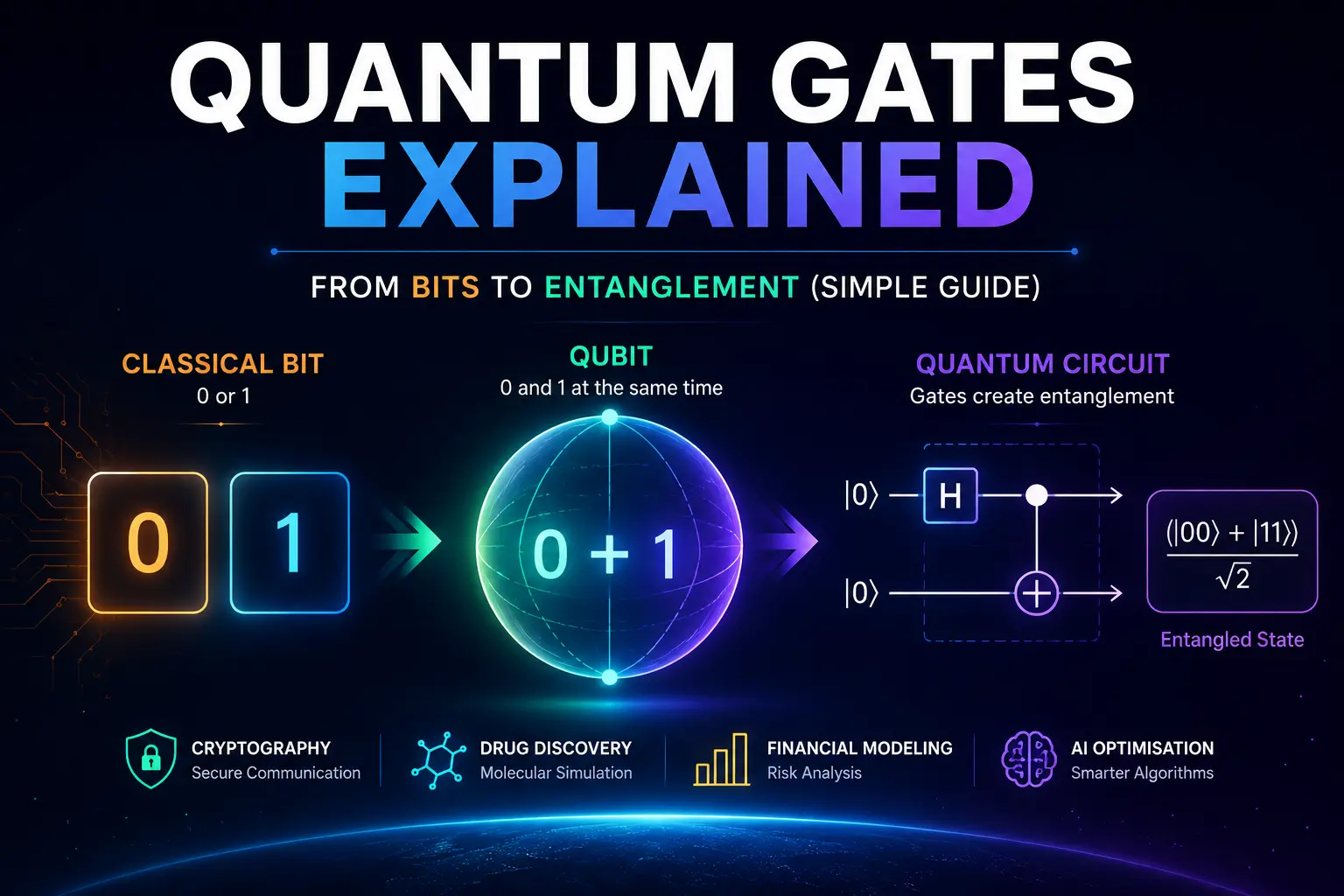
A qubit is the quantum version of a normal classical bit. A classical bit is always either 0 or 1. A qubit can be 0, 1, or this is called the surprising part is both at the same time until measured.
This “both at the same time” property is called superposition. It’s not a glitch — it’s how quantum systems naturally behave at very small scales.
The Math (Kept Simple)
α = probability of measuring 0 · β = probability of measuring 1 · Together they always sum to 100%
Quantum Gates Explained for Beginners
Quantum gates are the operations that transform qubits inside a quantum circuit. Just like logic gates manipulate bits in classical computers, quantum gates manipulate qubits, but in more sophisticated, reversible ways.
Creates superposition. Turns a definite |0⟩ into an equal 50/50 mix of 0 and 1.
The quantum NOT gate. Flips |0⟩ to |1⟩ and vice versa. The simplest quantum gate.
Two-qubit gate. Creates entanglement. Flips target only when control is |1⟩.
How Do Quantum Circuits Work Step by Step?
Initialize the Qubits
Every circuit starts with qubits in a known state — usually |0⟩. This is the blank page before computation begins.
Apply Quantum Gates
Gates are applied in sequence, left to right. Each gate modifies the qubit's state in a precisely defined way.
Create Superposition
A Hadamard gate puts qubits into superposition so the circuit can "explore" multiple computation paths at once.
Create Entanglement
A CNOT gate links qubits together. Now their outcomes are correlated — measuring one instantly tells you something about the other.
Measure the Result
Measurement collapses each qubit's superposition into a definite 0 or 1. The circuit is designed so the correct answer has the highest probability.
Reading a Quantum Circuit Diagram
A quantum circuit diagram is a visual map of operations performed on each qubit. Once you know the symbols, these diagrams become completely readable.
A Simple Quantum Circuit Example
Let’s walk through the simplest meaningful circuit: a single-qubit superposition circuit.
Start: Qubit in |0⟩
The qubit begins in a definite state — zero.
Apply Hadamard Gate
The H gate puts the qubit into an equal superposition of 0 and 1. Both possibilities now coexist.
Measure the Output
The qubit collapses to either 0 or 1 — each with exactly 50% probability. Like a perfect coin toss.
Classical Circuits vs. Quantum Circuits
Quantum circuits don’t replace classical circuits — they complement them. Here’s a clear side-by-side comparison:
| FEATURE | CLASSICAL CIRCUITS | QUANTUM CIRCUITS |
|---|---|---|
| Basic Unit | Bit | Qubit |
| Possible States | 0 or 1 | 0, 1, or both (superposition) |
| Gates Used | AND, OR, NOT | H, X, CNOT, Phase... |
| Processing Style | Sequential, step-by-step | Parallel probability exploration |
| Measurement | Deterministic | Probabilistic |
| Reversibility | Usually irreversible | Mostly reversible |
| Error Sensitivity | Tolerates noise well | Highly sensitive to interference |
Challenges of Quantum Circuits
Quantum circuits are powerful, but also extremely fragile.
Noise and Interference
Hardware Limitations
The Future of Quantum Circuits
The progress is accelerating rapidly. Within the next decade, we expect to see scalable quantum computers with thousands of error-corrected qubits, a quantum internet that uses entanglement for unbreakable secure communication, more powerful quantum algorithms for chemistry and optimization, and hybrid classical-quantum systems where each type of processor handles what it does best.
IBM’s quantum roadmap, Google’s research milestones, and Microsoft’s topological qubit approach are all converging on the same goal: practical, fault-tolerant quantum computing. Quantum circuits are the programming language of that future.
Common Beginner Mistakes
Frequently Asked Questions
What is a Quantum Circuit in simple words?
How do Quantum Circuits works?
What does the Hadamard Gate do?
What is the CNOT gate used for?
Are Quantum Circuits real hardware?
What is the simplest way to learny Quantum circuits?
Conclustion
Quantum circuits may sound futuristic but the logic is surprisingly clear once you break it down. Qubits hold quantum information. Gates transform that information. Measurements extract the result. That’s the entire framework.
The concepts covered here superposition, quantum gates, entanglement, and measurement are the foundation for everything in quantum computing. From Shor’s algorithm to quantum machine learning, it all starts with circuits exactly like the ones you just learned.
Quantum computing is genuinely coming. Understanding quantum circuits now puts you meaningfully ahead of the curve.