What is the Quantum Decoherence in Quantum Mechanics? A Beginner-Friendly Explanation
📖 12 min read | 16 May 2026 | Written by G Siva Prakash
Quantum computers promise to solve the problems that even the fastest supercomputers on Earth can not solve. But there’s a fundamental obstacle standing in the way, one that physicists lose sleep over. It’s called quantum decoherence, and understanding it is key to understanding why quantum computing is so incredibly difficult to build.
Understand the Quantum Coherence
Before we can talk about decoherence, we need to understand what coherence means, because decoherence is essentially coherence falling apart.
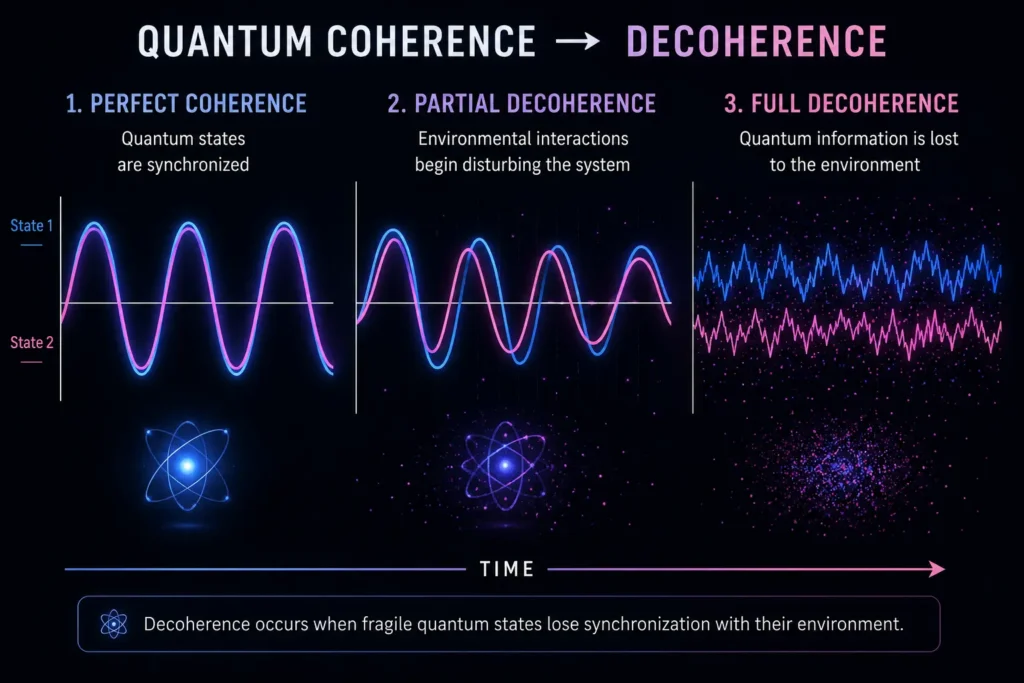
Think of a professional orchestra playing a symphony. Every musician follows the same tempo, the same rhythm, the same timing. The result is a rich, unified sound. That’s coherence. Now imagine half the musicians suddenly start playing at random speeds, out of sync with everyone else. The music collapses into noise. That is the decoherence.
In quantum mechanics, coherence refers to the ability of a quantum system to maintain a definite relationship between its possible states. A quantum system in a coherent state can exist in multiple states at the same time and interact with itself in meaningful ways, which is the whole point of quantum behaviour.
💡 Key Idea
Coherence is what allows quantum systems to do the “quantum things” like superposition and interference. Without it, a quantum system stops behaving quantum mechanically altogether.
This is closely linked to a concept called quantum superposition (more on that in a moment). The two ideas are deeply connected. As long as a quantum system remains coherent, it can retain its quantum properties. The moment that coherence breaks down, those properties vanish.
How Quantum Superposition Sets the Stage
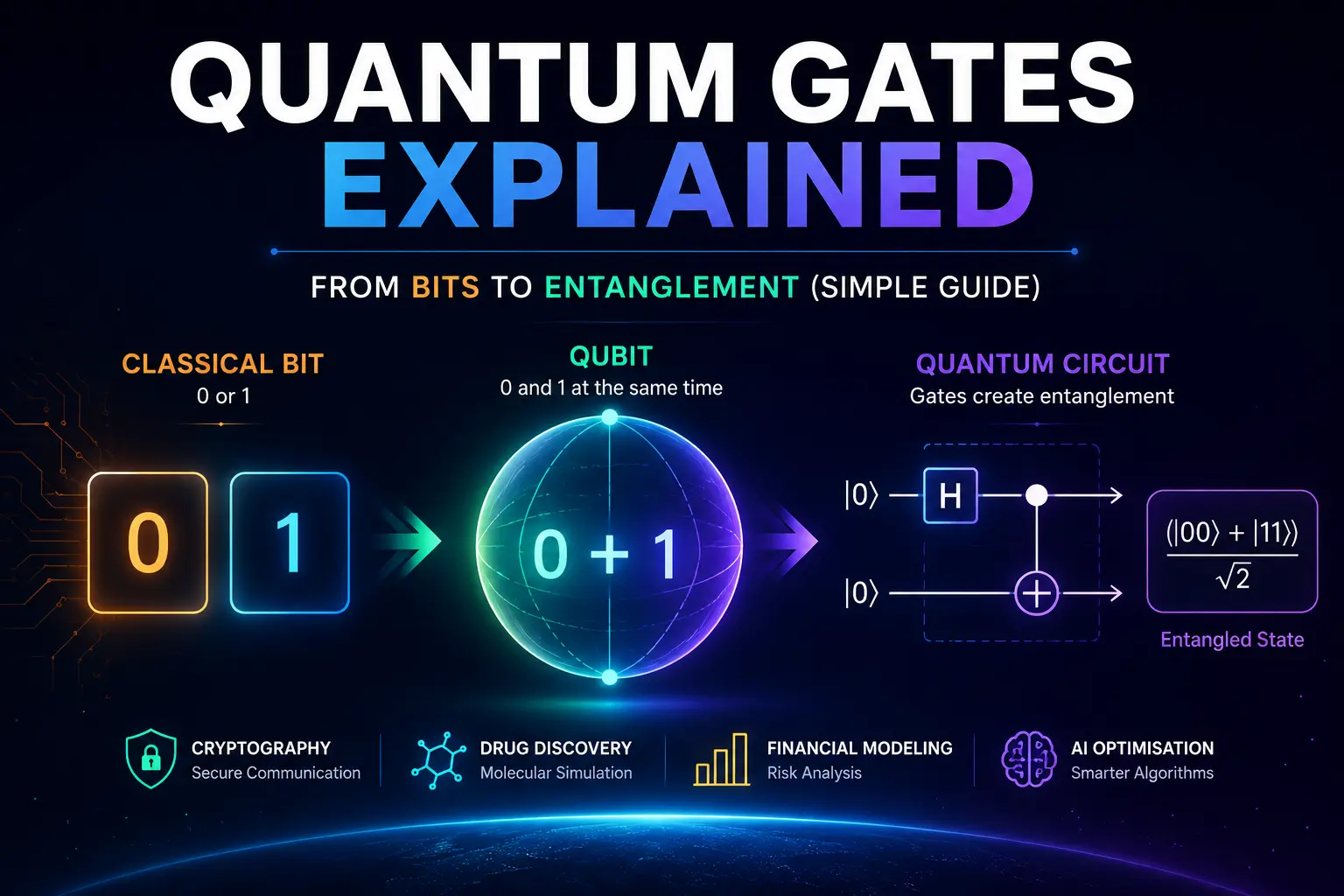
Here is where things are getting fascinating. Ordinary computers store information as bits, either a 0 or a 1. A quantum computer uses qubits, which can exist as 0, 1, or any combination of both at the same time. This is called superposition.
Mathematically, the state of a qubit looks something like this:
|ψ⟩ = α|0⟩ + β|1⟩
Where α and β represent the probability of the qubit being in state 0 or state 1 when measured.
You don’t need to understand the math deeply. The important takeaway is that a qubit can hold multiple possibilities at a time, and that’s what gives quantum computers their potential power. While a regular computer tries one answer at a time, a quantum computer can explore many possibilities in parallel.
Why Quantum States Are Extremely Fragile
Here’s the problem. That superposition state that delicate balance of α and β, only works as long as the qubit stays coherent. The moment anything disturbs it, the superposition collapses. The qubit picks a definite value, which is 0 or 1, and all the quantum advantage disappears in an instant.
This is exactly what sets the stage for decoherence. Superposition requires coherence to survive. And in the real world, coherence is almost impossible to maintain.
What Is Quantum Decoherence?
📖 Simple Definition
Decoherence happens when a quantum system loses its delicate quantum information because of interactions with its surroundings. It’s the process by which “quantum weirdness” fades away and ordinary, classical behavior takes over.
Imagine you’re blowing a soap bubble. While it’s floating, it’s a perfect sphere with beautiful iridescent colours and a clear, coherent structure. But the moment it touches any surface, or even a small gust of air hits it, it will pop. The structure is gone.
Quantum states are even more fragile than soap bubbles. They exist in a kind of delicate quantum isolation. The moment the quantum system “notices” its environment, through any kind of physical interaction, it starts to lose its quantum character.
How the Quantum Systems Lose Their Quantum Properties
When a quantum system interacts with the environment, the information about its quantum state leaks out into the surroundings. This leakage is irreversible. Once that quantum information is scattered into the environment, you can’t get it back.
The result is that the system starts behaving more and more like a classical (everyday) object, predictable, definite, and unsuperposed. The “quantumness” is gone.
Why the Decoherence Changes Everything
This matters enormously for quantum computing. A quantum computer only works because its qubits maintain superposition and interact with each other through quantum effects. The moment decoherence kicks in, the qubits lose those properties, and the calculation breaks down. You are left with garbage results.
What causes quantum decoherence?
Almost anything. That’s the frustrating answer. Quantum systems are extraordinarily sensitive to their environment, and the environment is everywhere.
Here are the main culprits:
- Heat and thermal vibrations: Even tiny amounts of warmth can disrupt quantum states, because heat is essentially random atomic motion.
- Electromagnetic radiation: Stray photons (light particles) can interact with qubits and destroy their coherence.
- Air molecules: Even a single air molecule bouncing into a quantum system can cause decoherence.
- Vibrations: Physical vibrations from the surrounding environment disturb the delicate quantum states.
- Cosmic rays: High-energy particles from space have actually been observed causing quantum computing errors.
- The act of measurement itself: Looking at a quantum system, even trying to check what state it’s in, can cause it to decohere.
Why Even Tiny Interactions Matter
In classical computers, they don’t have this kind of problem. A traditional transistor stores either a 0 or a 1. It’s robust, binary, and relatively immune to small disturbances. The quantum states are the opposite. They’re probabilistic, multi-valued, and extremely sensitive to any external influence.
⚠️ Reality Check
In practical quantum computers today, qubits can lose coherence in as little as a few microseconds millionths of a second. That’s barely enough time to run meaningful calculations before decoherence destroys the result.
How Quantum Decoherence Works: Step by Step
Let’s walk through exactly what happens when decoherence strikes. This sequence will help make the whole process click.
- A qubit (or group of qubits) is prepared in a superposition state that holds multiple possibilities simultaneously.
- The quantum system comes into contact with its environment, such as a stray photon or a vibration from the lab floor.
- The interaction disturbs the phase relationships between the qubit’s quantum states. Think of it like two ripples on a pond that were perfectly synchronized now being nudged out of sync.
- Quantum interference is the ability of states to amplify or cancel each other, a phenomenon that breaks down. This interference is what gives quantum computers their power.
- The system settles into a definite classical state. The quantum calculation has been corrupted or lost.
The Double-Slit Experiment: A Classic Example
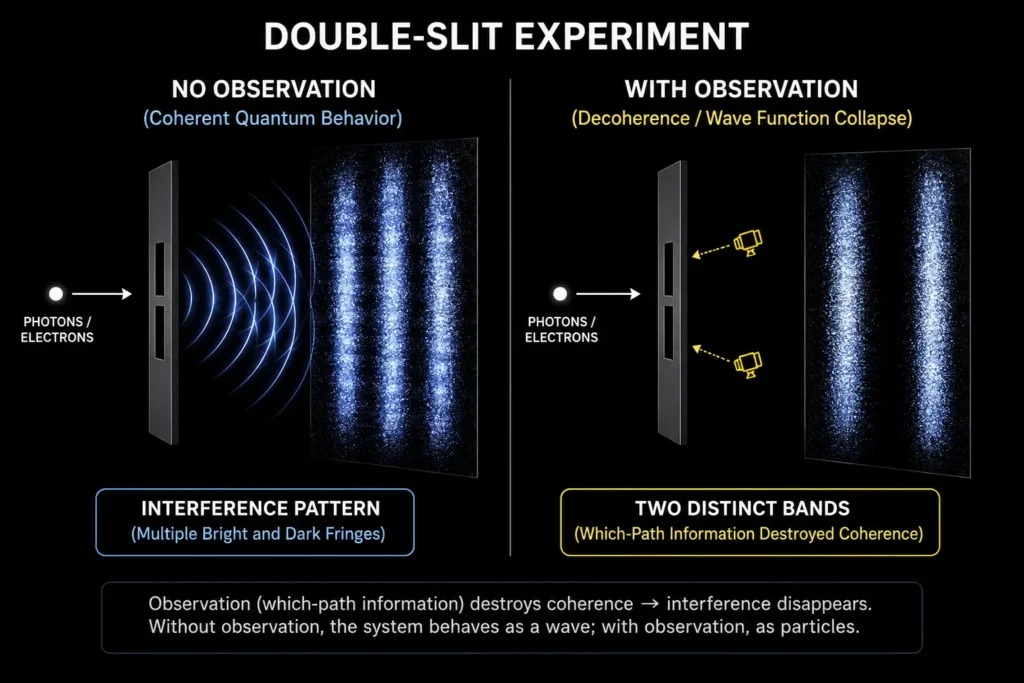
One of the most famous demonstrations of quantum behaviour is the double-slit experiment. When particles, like electrons, are shot through two narrow slits, they create an interference pattern on the screen behind them, as if each particle went through both slits at once.
But here’s the remarkable part: the moment you try to observe which slit the particle went through, the interference pattern disappears. The act of measurement causes decoherence. The particle is forced to “choose” a definite path, and the quantum behavior vanishes.
This is a clean, real-world demonstration of how observation — interaction with the environment — destroys quantum coherence
Why decoherence is the biggest challenge in quantum computing
Quantum computing is one of the most emerging and exciting technologies in development today. Companies like IBM, Google, and Microsoft are investing billions of dollars into building functional quantum hardware. And the biggest wall they keep running into is decoherence.
📎 Related reading on this site:
Why Qubits Are So Difficult to Protect
A useful quantum computer needs qubits that can stay coherent long enough to complete a meaningful calculation. But as we’ve seen, coherence is brutally short-lived in the real world.
The time a qubit can stay coherent before decoherence sets in is called the coherence time. Current state-of-the-art systems achieve coherence times ranging from microseconds to a few milliseconds. More complex calculations require much longer than that.
The Biggest Obstacle to Scalable Quantum Computers
It’s not just an individual qubits that suffer. As you add more qubits to build a more powerful quantum computer, the system becomes exponentially harder to protect from decoherence. More qubits means more opportunities for environmental interference and more errors accumulating in the calculation.
This is why building a fault-tolerant, large-scale quantum computer remains an unsolved engineering problem. The hardware exists. The math is proven. But keeping qubits coherent at scale is still the fundamental bottleneck.
How Scientists Are Reducing Quantum Decoherenceading Text Here
The good news is that researchers around the world are making serious progress on this problem. It’s not solved yet, but the approaches are clever, and the results are promising.
Keeping Quantum Systems Stable
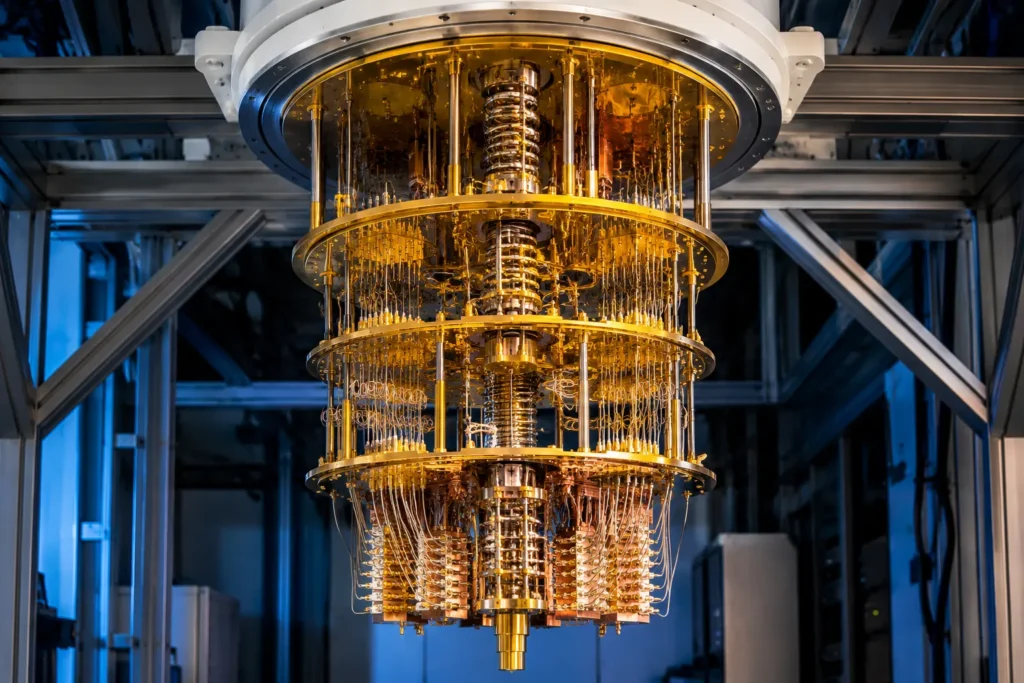
- Cryogenic cooling: Most of the quantum computers today operate at temperatures near absolute zero (-273°C), colder than outer space. This dramatically reduces thermal vibrations that cause decoherence.
- Vacuum chambers: By removing air molecules entirely, scientists eliminate one of the major sources of environmental interference.
- Electromagnetic shielding: Quantum processors are often surrounded by layers of shielding to block stray electromagnetic signals.
- Isolation systems: Vibration-damping platforms prevent the physical disturbances from reaching the quantum hardware.
Modern Techniques Used in Quantum Research
Beyond the physical isolation, researchers are developing sophisticated software-level solutions. Quantum error correction is a technique that spreads quantum information across multiple physical qubits to create a single, more reliable “logical qubit.” Even if a few physical qubits decohere, the logical qubit survives.
This is sometimes called fault-tolerant quantum computing. The idea is that by using enough redundancy and clever error-detecting codes, you can run calculations even in the presence of some decoherence. It’s a bit like sending an important message using error-correcting codes so that even if a few bits get corrupted in transmission, the receiver can still reconstruct the original.
Some researchers are also exploring entirely new types of qubits, like topological qubits, that are fundamentally more resistant to environmental noise by their physical nature, rather than relying purely on isolation or error correction.
Quantum Decoherence vs. Wave Function Collapse
These two concepts are often confused, and even professional physicists sometimes debate the relationship between them. Here’s a clear breakdown.
| Quantum Decoherence | Wave Function Collapse |
|---|---|
| Caused by environmental interactions | Caused by the act of measurement |
| A gradual, continuous process | An instantaneous event |
| Explains loss of quantum interference | Explains why we observe one definite outcome |
| Well-described by quantum mechanics equations | Still philosophically debated |
| Applies even without a conscious observer | Traditionally tied to the concept of observation |
Decoherence explains why the quantum systems stop showing interference effects, which is part of why the quantum world appears to become the classical world as systems get larger. But it doesn’t fully explain why we observe one specific outcome rather than another. That’s where wave function collapse and interpretations of quantum mechanics (like the Copenhagen interpretation or Many Worlds) come in.
In other words: decoherence is a real, measurable physical process. Wave function collapse is partly an interpretational question, one that physicists are still actively debating.
The Future of Quantum Decoherence Research
The quantum computing race is real, and decoherence sits at the center of it. Here’s what the next few years might bring.
- Better qubit designs: New materials and qubit architectures are being tested that are naturally more stable, requiring less extreme cooling and shielding.
- Advanced error correction: As algorithms improve, fewer physical qubits may be needed to create reliable logical qubits, making the practical quantum computers more achievable.
- Quantum networking and the quantum internet: Maintaining coherence across quantum networks is an active research area, with implications for ultra-secure communications.
- Room-temperature quantum computing: This is the long-shot moonshot, building quantum systems that don’t need to be cooled to near absolute zero. Some researchers are exploring photonic qubits and other approaches that may eventually make this feasible.
Can Scientists Fully Control Decoherence?
Probably not eliminates it entirely. But “control” is the right word. The goal isn’t a decoherence-free quantum computer. It’s a quantum computer that’s robust enough to produce reliable results despite some decoherence. With enough error correction and better hardware, that’s an achievable goal.
And the progress is real. Google’s 2023 quantum error correction experiments showed that increasing the number of error-correcting qubits actually reduces the logical error rate, a milestone that suggests practical fault-tolerant quantum computers are moving from theoretical possibility to engineering challenge.
🚀 Looking Ahead
Solving decoherence at scale won’t just enable faster computers. It could transform drug discovery, materials science, financial modelling, and cryptography areas, where the quantum advantage could be transformational.
Frequently Asked Questions About Quantum Decoherence
What is quantum decoherence in simple words?
Quantum decoherence is what happens when a quantum system, like a qubit, loses its quantum properties because it interacts with its environment. Think of it as a fragile quantum state being “disturbed” by the outside world until it behaves like an ordinary classical object.
Why is decoherence important?
It’s the main reason why building practical quantum computers is so difficult. Decoherence destroys the superposition and entanglement that quantum computers rely on, causing calculation errors. Controlling decoherence is essential for quantum computing to reach its potential.
What causes quantum decoherence?
Virtually any interaction with the environment, such as heat, electromagnetic fields, vibrations, air molecules, and even attempts to measure the system. Quantum states are extraordinarily sensitive to disturbance, which makes isolation extremely challenging.
Can decoherence be prevented?
It can be dramatically reduced but not eliminated entirely. Scientists use extreme cooling, vacuum chambers, shielding, and quantum error correction techniques to minimize decoherence and work around its effects.
How does decoherence affect quantum computers?
It causes qubits to lose their superposition and entanglement, which corrupts quantum calculations. In current hardware, this can happen in just microseconds, limiting the complexity of computations that can be performed before the results become unreliable.
Is decoherence the same as wave function collapse?
They’re related but different. Decoherence explains why quantum interference disappears when a system interacts with its environment. Wave function collapse refers to why we observe one specific outcome when we measure a quantum system. Decoherence is a physical process; collapse involves deeper interpretational questions about quantum mechanics.
What is coherence time?
Coherence time is how long a qubit can maintain its quantum state before decoherence sets in. Current quantum computers achieve coherence times ranging from microseconds to a few milliseconds. Extending this is one of the key engineering challenges in quantum hardware development.
Wrapping It All Up
Quantum decoherence is one of the most fascinating and frustrating problems in the modern physics. It’s the invisible wall between where quantum computing is today and where it needs to be to change the world.
Here’s what to remember: quantum systems are extraordinarily fragile. They can exist in multiple states at once, but only as long as they stay isolated from the noisy, messy environment around them. The moment anything disturbs them, that quantum magic disappears and ordinary classical behaviour takes over.
This isn’t just an abstract physics problem. It’s the engineering challenge of our time. Every major quantum computing effort from IBM’s quantum roadmap to Google’s error correction milestones is essentially a race against decoherence.
The researchers working on this aren’t just tinkering with lab equipment. They’re trying to figure out how to hold quantum reality still long enough to compute with it. And judging by the progress of the past decade, they’re slowly winning.