
Think you are trying to watch a soap bubble without popping it. The moment you touch it, it changes. That is roughly what happens in quantum measurement except the rules are far stranger, and the consequences reach into every smartphone, MRI scanner, and GPS satellite you rely on today.
I have spent years studying quantum systems, and I still find quantum measurement to be the most thought-provoking part of physics. It is not just a technical curiosity. It sits at the heart of what reality is and how we can know anything about it at the atomic level.
This guide to quantum measurement for beginners in 2026 walks you through the key concepts, from superposition and wave function collapse to real-world applications in quantum computing, MRI, and cryptography.
By the end, you will understand not just what quantum measurement is, but why it matters so much to science, technology, and human knowledge itself.
Quantum measurement is the process of extracting information from a quantum system, such as an electron, a photon, or an atom, by interacting with it using a detector or instrument.
In everyday life, measuring something means reading a number off a scale or a ruler. The object you measure your weight against, a length of wood, does not change because you look at it. Quantum measurement is fundamentally different. When you measure a quantum system, the very act of measuring changes the system’s state.
This is not because our instruments are clumsy. It is a basic feature of nature at the quantum scale. The information we get from a quantum system depends on how we choose to measure it, and once we measure it, the system is never quite the same again.
Key idea: In quantum mechanics, measurement is not a passive act of reading. It is an active interaction that changes what is being measured.
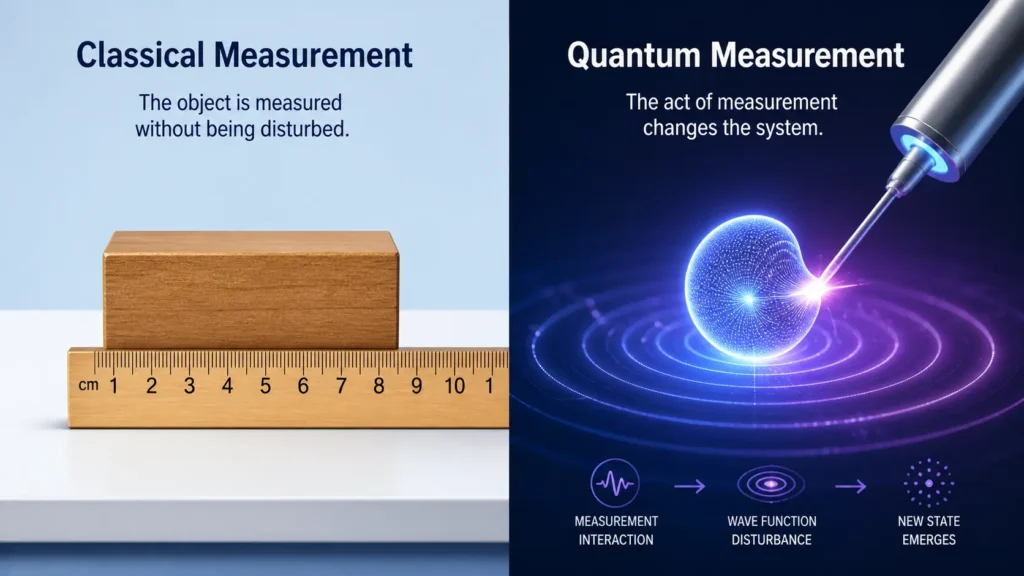
In classical physics, the physics of balls, planets, and cars, objects have definite properties at all times. A ball is either moving or still. A coin is either heads or tails. You can measure its position, speed, or orientation without disturbing it in any meaningful way.
Quantum objects do not work like that. A single electron, before you measure it, does not have a single definite spin direction. It exists in a mixture of possible states simultaneously. This mixture is called a superposition. When you measure the electron, one of those states appears as the result, but not because the electron was secretly in that state all along. It was genuinely in many states at once.
This is the core puzzle of quantum measurement explained for beginners: the rules that govern quantum objects before measurement are completely different from the rules that govern what you actually see when you look.
Before a quantum system is measured, it exists in what physicists call a superposition. Think of it as all possible answers being present at the same time, with each answer carrying a certain probability of being found when you look.
Take a simple coin analogy. If you spin a coin on a table, it is neither heads nor tails while it spins, it is in motion, carrying both possibilities. A quantum particle is similar, except its superposition is not just a lack of information on our part. The particle genuinely holds multiple states simultaneously, each described by a mathematical object called the wave function.
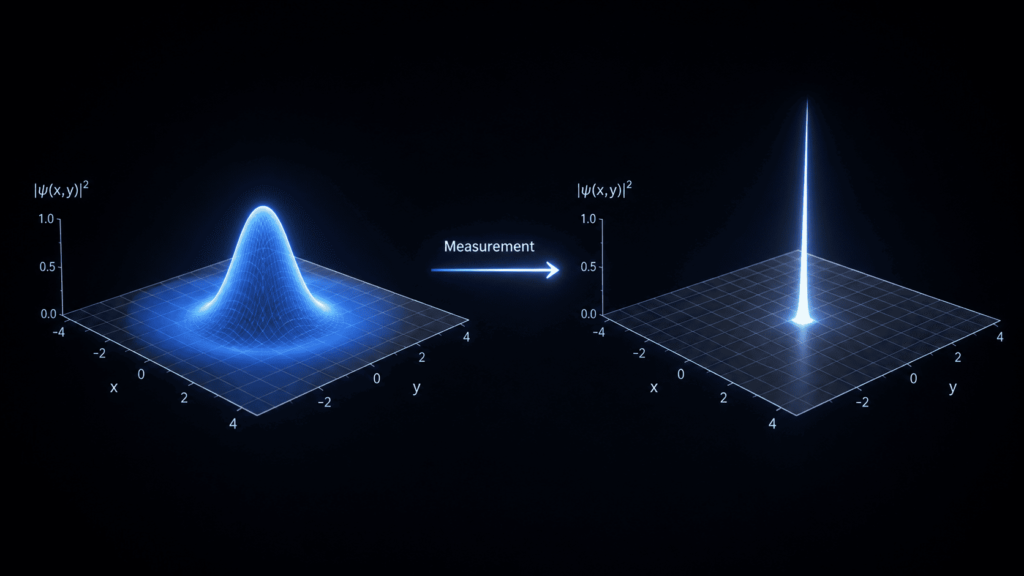
The wave function encodes the probabilities of finding each possible measurement result. Before measurement, the electron’s wave function might indicate a 50% chance of spin-up and a 50% chance of spin-down. After measurement, only one of those results appears, and the wave function changes completely.
This is what makes quantum mechanics so different from classical statistics. In classical statistics, uncertainty means we do not know which outcome is true. In quantum mechanics, there is genuinely no single true outcome until the measurement happens.
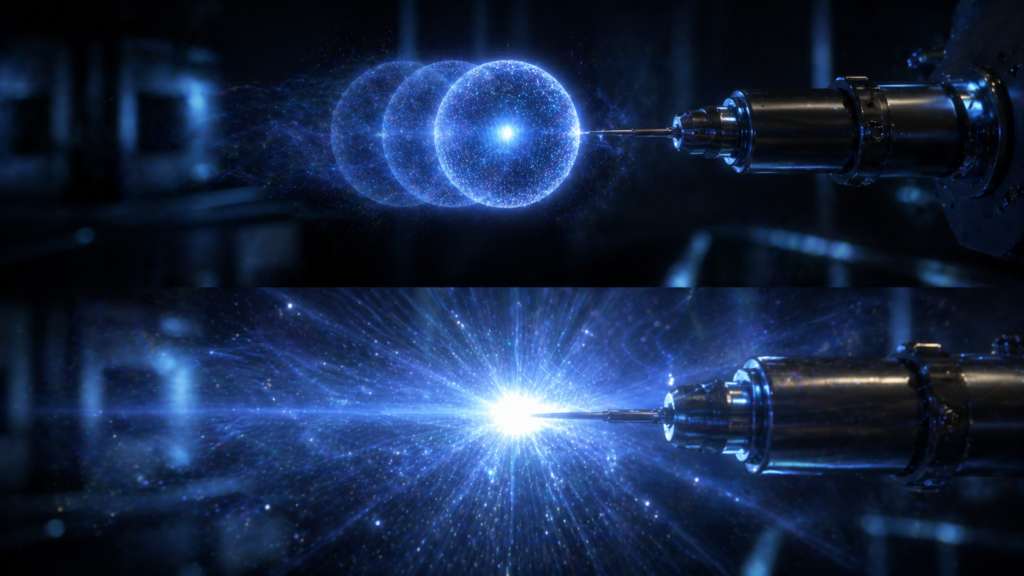
Let us walk through what happens during a quantum measurement, step by step.
The Born rule is one of the most well-tested rules in all of science. It correctly predicts measurement probabilities to extraordinary precision in millions of experiments.
Wave function collapse is the term physicists use to describe what happens to the quantum state after a measurement. Before measurement, the wave function spreads out over many possible values like a ripple spreading across a pond. After measurement, it collapses to a single point, the result that was actually found.
The word ‘collapse’ can be misleading. It does not mean the wave function physically shrinks in space. It means that the superposition of possibilities is replaced by a single definite state. All the other possibilities that existed before the measurement simply vanish from the picture.
This collapse is instantaneous in standard quantum mechanics. It does not travel at the speed of light. It is not caused by any physical force. It is a fundamental feature of how quantum information updates when a measurement is made.
Why does the wave function collapse happen? This is one of the deepest open questions in physics. Several interpretations of quantum mechanics try to explain it, the Copenhagen interpretation, the Many Worlds interpretation, and others, but none is universally accepted. As of 2026, the measurement problem remains one of the most important unsolved questions in foundational physics.
Electron spin is one of the clearest examples of quantum measurement in action. Spin is a quantum property with no exact classical equivalent. For our purposes, think of it as an internal arrow that can point either up or down along any direction you choose to measure.
Suppose you prepare an electron in a superposition of spin-up and spin-down. You then pass it through a Stern-Gerlach device, a magnet designed to deflect the electron based on its spin. The electron hits a detector on one side or the other
Before the measurement, the electron was genuinely in both spin states. After the measurement, it is definitely in one. If you measure the same electron immediately again in the same direction, you will always get the same result. The superposition has collapsed.
Now, if you then measure the spin in a perpendicular direction, say horizontally instead of vertically, the electron enters a new superposition again. The measurement in one direction erases the definite information about the perpendicular direction. This is the Heisenberg uncertainty principle in action: some pairs of properties cannot be simultaneously known with perfect precision.
This is not a measurement error. It reflects a deep truth about quantum reality: some properties of a particle simply do not coexist as definite values at the same time.
Here is something that surprises many beginners: if you measure a quantum system and then immediately measure the same property again, you always get the same answer the second time.
Why? Because the first measurement collapsed the wave function into the state corresponding to your result. The system is now in a definite state. The second measurement finds it exactly there.
This is called the projection postulate. It is one of the core rules of quantum mechanics. It tells us that quantum measurement is not random noise; it is a reliable process. Once measured, a quantum property stays definite until something else disturbs the system.
This principle is critical for quantum computing. When a qubit is measured, the result is stable and can be read out reliably. The challenge in quantum computing is keeping qubits in superposition long enough to do useful calculations before decoherence forces them into definite states prematurely.
Different quantum systems carry different types of information. Understanding what each system can tell us is key to understanding both fundamental physics and practical technology.
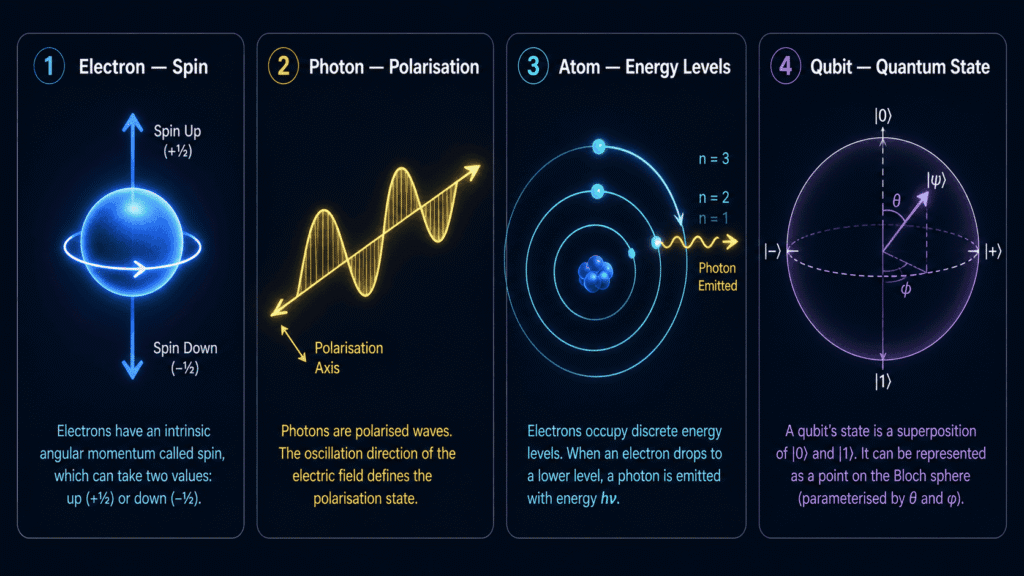
Electrons carry spin, which can point up or down along any chosen axis. Electron spin is used in spintronics, a technology that uses spin states instead of electrical charge to store and process information. Modern hard drives use spin to read and write data at the nanoscale.
Photons, particles of light, carry polarisation. A photon’s polarisation can be horizontal, vertical, or any diagonal in between. Quantum cryptography relies on measuring photon polarisation. The act of eavesdropping on a quantum key changes the polarisation states in detectable ways, making quantum communication provably secure.
Atoms exist in quantised energy levels they can only hold specific amounts of energy, with nothing in between. When an atom absorbs or emits light, it jumps between levels. Atomic clocks measure these jumps with extraordinary precision, making GPS satellites accurate to within a few metres.
A qubit is the basic unit of information in a quantum computer. Unlike a classical bit, which is either 0 or 1, a qubit can be in a superposition of 0 and 1 simultaneously. Measuring a qubit collapses this superposition to a definite 0 or 1. The power of quantum computing comes from manipulating qubits before measurement, allowing many calculations to happen in parallel through quantum interference.
Quantum measurement is not just an abstract concept for physicists. It is the mechanism that connects the quantum world to the classical world we experience. Every detector, every sensor, every piece of quantum technology relies on quantum measurement to extract useful information.
Without quantum measurement, quantum computing would be impossible. Without it, MRI machines would not work. Without it, the atomic clocks that underpin GPS would have no precision. The rules of quantum measurement determine how accurately we can read information from nature at the smallest scales.
Beyond technology, quantum measurement matters for a deeply human reason: it defines the boundary between what can be known and what cannot. It tells us how much information a single photon or electron can carry, and therefore how secure our communications can be. It tells us the fundamental limits of precision in every instrument humans will ever build.
From a researcher’s perspective, quantum measurement is where physics becomes philosophy: it forces us to ask not just ‘what is the world like?’ but ‘what does it mean to observe the world at all?’
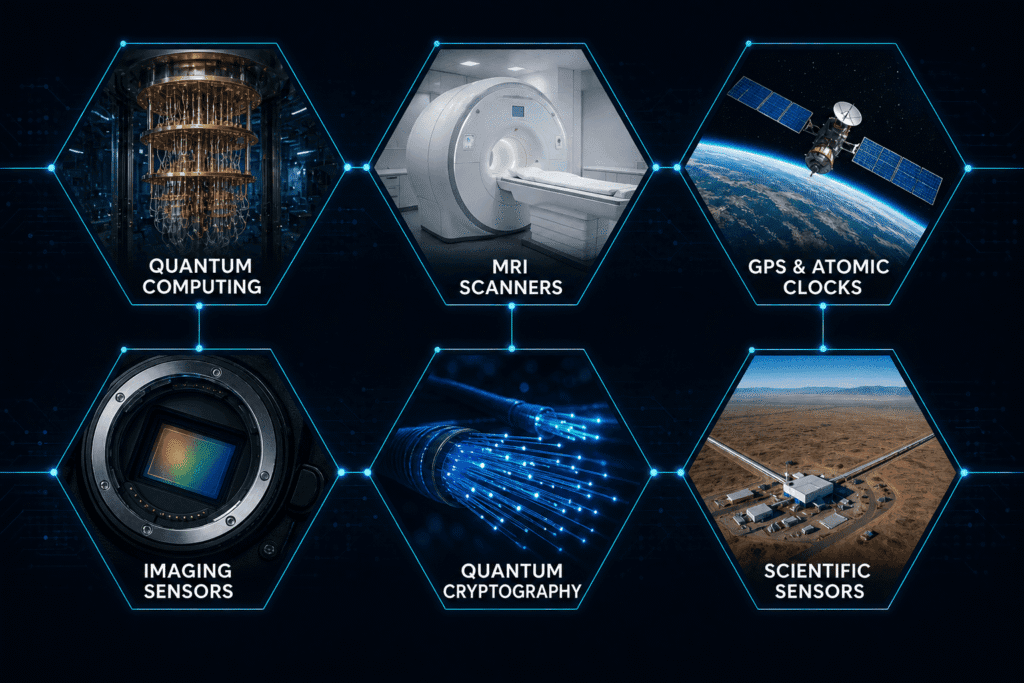
In a quantum computer, qubits are prepared, manipulated through quantum gates, and then measured. The measurement step reads out the result of the computation. All the quantum advantage comes from the superposition and entanglement that existed before measurement. Companies like IBM, Google, and IonQ have built quantum processors where each qubit’s state is measured using microwave pulses or laser light, collapsing the qubit to 0 or 1 and recording the result.
Magnetic Resonance Imaging works by placing the body in a strong magnetic field, which aligns the spin of hydrogen nuclei in water molecules. Radio frequency pulses then disturb this alignment. When the nuclei return to their aligned state, they emit signals that are measured and used to build detailed images of soft tissue. The precision of MRI depends entirely on the quantum mechanical properties of nuclear spin and how those spins respond to measurement.
Atomic clocks measure the frequency at which atoms transition between energy levels. Caesium-133 atoms, for example, oscillate between two hyperfine energy states precisely 9,192,631,770 times per second by definition of the SI second. GPS satellites carry atomic clocks accurate to within a few nanoseconds per day. Without quantum measurement of these atomic transitions, GPS positioning would drift by kilometres within hours.
Digital camera sensors are built from photodetectors that convert individual photons into electrical signals. Each photodetector performs a quantum measurement, absorbing a photon and releasing an electron via the photoelectric effect. The resolution and sensitivity of modern cameras, astronomical telescopes, and medical imaging devices all depend on the efficiency and accuracy of this quantum measurement process.
Quantum key distribution (QKD) uses the measurement rules of quantum mechanics to create provably secure communication channels. In the BB84 protocol, Alice sends photons to Bob in one of four polarisation states. Any eavesdropper who measures the photons changes their polarisation in a detectable way, because quantum measurement disturbs the system. Alice and Bob can detect any interception and discard compromised keys. Several banks and government agencies already use QKD links for secure data transfer.
Quantum sensors exploit the extreme sensitivity of quantum systems to external fields. Atomic magnetometers can detect the faint magnetic fields produced by neural activity in the brain — far too weak for classical sensors. LIGO, the gravitational wave detector, uses quantum measurement techniques to detect spacetime ripples smaller than one-thousandth the diameter of a proton. These achievements are only possible because quantum measurement can extract information at the absolute limits set by physics.
Spintronics is a field of technology that uses electron spin rather than just electrical charge to store, process, and transmit information. The field owes its existence to quantum measurement.
In a spintronic device, the spin state of an electron is read by passing it through a magnetic tunnel junction. The electrical resistance of the junction depends on whether the electron’s spin is aligned or anti-aligned with the magnetic layers. This tiny difference in resistance is the quantum measurement that reads out the binary information stored in the spin.
Modern hard drives use giant magnetoresistance (GMR), a spintronic effect that won the Nobel Prize in Physics in 2007. Without the ability to measure electron spin states precisely at the nanoscale, data storage density would be far lower than it is today. Emerging spintronic technologies aim to use spin currents without any charge flow at all, promising dramatically lower energy consumption for future computing devices.
Polarisation is a property of light that describes the direction in which the electric field oscillates. A photon’s polarisation is a quantum degree of freedom, it can be in a definite state (horizontal, vertical) or in a superposition of polarisation directions.
When a photon passes through a polarising filter, a quantum measurement occurs. The filter projects the photon onto the filter’s polarisation axis. If the photon’s polarisation perfectly matches the filter, it passes with certainty. If it is perfectly perpendicular, it is absorbed with certainty. For any angle in between, the photon passes with a probability given by the cosine-squared of the angle, a result called Malus’s Law.
This quantum measurement of polarisation is the foundation of quantum cryptography protocols. It is also the reason that 3D cinema glasses work, each lens allows only one polarisation of light through, and your brain combines the two slightly different images into a three-dimensional scene.
Optical fibres used in telecommunications carry information encoded in the polarisation of laser pulses. Maintaining polarisation stability over long distances is an active engineering challenge, directly tied to keeping quantum information intact before it is measured at the receiver.
Beyond spin and polarisation, quantum systems also carry phase information, a kind of internal timing or orientation of the wave function that is invisible to a single measurement but reveals itself through interference.
Quantum interference occurs when two quantum paths combine and their wave functions either reinforce or cancel each other. The famous double-slit experiment demonstrates this: a single electron fired at two slits produces an interference pattern on a screen, as if it passed through both slits simultaneously. But if you place a detector at one slit to measure which way the electron went, the interference pattern disappears instantly.
This is one of the most vivid demonstrations of quantum measurement’s role in determining physical reality. The act of measuring which path the electron took destroys the phase relationship between the two paths, and with it, the interference pattern. Measuring forces a choice. Leaving the electron unmeasured allows both paths to coexist and interfere.
Phase relationships are central to quantum computing. Quantum algorithms like Shor’s algorithm for factoring large numbers work by carefully arranging interference so that correct answers reinforce and wrong answers cancel, all before the final measurement is made. The measurement at the end reads out the amplified correct answer.
The measurement problem is the central unresolved puzzle of quantum mechanics. It asks: why does a quantum system, which can exist in a superposition of many states, always produce a single definite result when measured?
Quantum mechanics describes the evolution of a system using the Schrödinger equation. This equation is deterministic and smooth, it says the superposition simply grows and spreads over time. But measurement is not smooth or deterministic. It is sudden, random, and irreversible. The equations of quantum mechanics do not, on their own, explain this jump from superposition to single outcome.
Several interpretations have been proposed. The Copenhagen interpretation says the wave function is simply a tool for calculating probabilities, and collapse is what happens when a measurement is made, no further explanation needed. The Many Worlds interpretation says collapse never actually happens: every possible outcome occurs in a separate branch of reality. Decoherence theory explains how quantum systems lose their superposition by interacting with their environment, without invoking any special collapse mechanism.
As of 2026, no interpretation has been experimentally ruled out. The measurement problem remains a genuine open question, not just a philosophical debate, but one with implications for the foundations of quantum computing, quantum gravity, and our understanding of physical reality at its deepest level.
From my research perspective, the measurement problem is not a failure of quantum mechanics. It is an invitation to think more deeply about what measurement, knowledge, and reality actually mean.
Sometimes the best way to grasp a new idea is through a familiar comparison. Here are three analogies that capture the spirit of quantum measurement without distorting the physics.
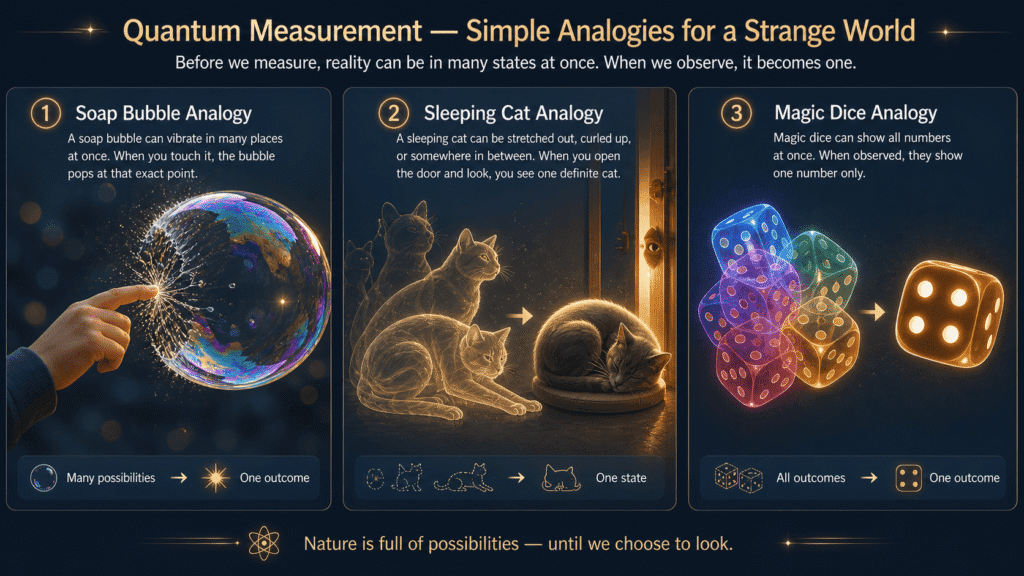
A soap bubble exists as a shimmering sphere. The moment you touch it, it pops, it does not just stop being a bubble, it becomes something entirely different (a splash of soapy water). Quantum measurement is similar: the act of touching the system transforms it irreversibly.
Before you check on a sleeping cat, you do not know if it is curled up, stretched out, or sitting up. All possibilities are open. The moment you open the door and look, you see a definite posture. The difference in quantum mechanics is that the cat was not secretly in one posture all along, all the postures were genuinely present in the wave function until the moment you observed it.
Imagine dice that do not show a number until they stop rolling. Classical dice have a definite face pointing up, but even while rolling, we just cannot see it. Quantum dice genuinely show all faces at once while rolling. The number only becomes real when the dice come to rest, and you look. This captures the non-classical randomness of quantum measurement outcomes.
Quantum measurement is at the centre of several emerging technologies that will shape the next decade.
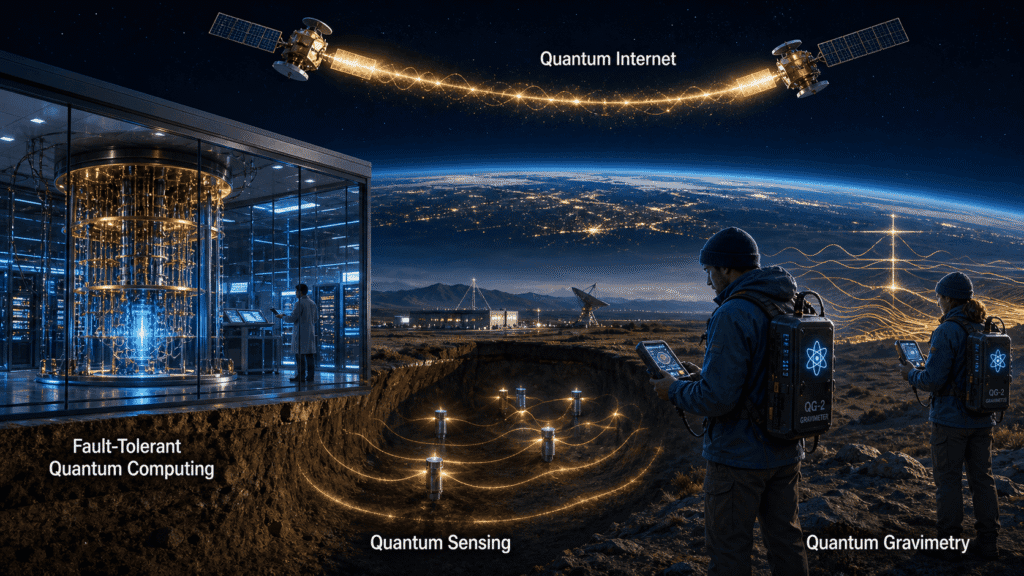
Quantum-enhanced sensors exploit entanglement and superposition to measure physical quantities with precision beyond any classical limit. Quantum gravimeters will map underground structures with centimetre precision, revolutionising civil engineering, mineral exploration, and earthquake monitoring.
As quantum computers scale up, the precision of quantum measurement becomes critical. Fault-tolerant quantum computers require error-correcting codes that repeatedly measure stabiliser operators, multi-qubit observables that detect errors without collapsing the logical qubit state. Achieving this reliably at scale is the central engineering challenge of quantum computing in 2026.
A quantum internet would use entangled photons to transmit quantum information between distant nodes. Quantum measurement plays the key role in quantum teleportation protocols, where measuring one particle of an entangled pair instantly updates the state of the other, regardless of distance. China’s Micius satellite has already demonstrated entanglement-based communication over thousands of kilometres.
Future experiments will push quantum measurement to test the limits of quantum mechanics itself. Experiments placing increasingly large objects into superposition will probe whether there is a scale at which quantum mechanics breaks down and classical physics takes over. These tests may reveal entirely new physics that neither quantum mechanics nor general relativity currently describes.
Quantum measurement is one of the most surprising and profound ideas in all of science. It tells us that the act of observing a quantum system is not passive it is participatory. Measurement creates the definite reality we see from the indefinite possibilities that existed before.
For beginners, the key takeaway is this: quantum systems exist in superpositions of possible states until measured, measurement collapses that superposition to one definite outcome, and the rules that govern this process are precise, well-tested, and deeply counterintuitive.
For engineers and technologists, quantum measurement is the bridge between quantum physics and practical devices. Every quantum computer, every quantum sensor, every quantum-secured communication channel depends on our ability to extract information from quantum systems with precision and reliability.
For all of us, quantum measurement is a reminder that the universe does not reveal all its secrets until asked in exactly the right way, and that asking the question changes the answer. That is not a limitation. It is one of the most beautiful and humbling truths about nature.
Quantum measurement is the process of extracting information from a quantum system, like an electron or a photon, by interacting with a detector. Before measurement, the system exists in a superposition of possible states. The measurement picks one of those states, and the system takes on a definite value.
In a quantum computer, the actual answer to a calculation only appears when the qubits are measured. All the quantum advantage, the parallelism and interference, happens before measurement. The final measurement collapses the qubits to classical bits (0s and 1s) that can be read and used. Without precise, reliable measurement, quantum computers cannot output results.
Yes. This is one of the defining features of quantum measurement. Measuring a quantum system causes its wave function to collapse from a superposition of possibilities to a single definite state. The system after measurement is in a different state than it was before. This is not due to imperfect instruments, it is a fundamental feature of quantum mechanics.
Quantum measurement underlies MRI scanners (measuring nuclear spin), GPS (measuring atomic energy transitions in atomic clocks), digital cameras (measuring individual photons), quantum cryptography (measuring photon polarisation to secure communications), and quantum computers (measuring qubit states to read out results).
The practical rules of quantum measurement, how probabilities work, how collapse happens, how to use it in technology, are extraordinarily well understood. But the deeper question of why measurement produces definite outcomes from indefinite quantum states (the measurement problem) remains unresolved. It is one of the most actively debated questions in the foundations of physics as of 2026.
Enjoyed this guide? Dive deeper into the concepts that power quantum measurement