

The first time I came across Schrödinger’s equation in a physics textbook, I remember staring at it thinking: this can’t possibly describe reality. A symbol for a “wave function.” Probability clouds instead of definite positions. A cat that’s somehow alive and dead until you peek inside a box.
After I learned more about it, I realised I wasn’t alone in that confusion, even the physicists who built quantum mechanics argued bitterly about what it all meant. But here’s the thing: beneath the strangeness, the Schrödinger equation is telling us something genuinely profound about the nature of reality. And once you get the core idea, the weirdness stops feeling like nonsense and starts feeling like wonder.
So let me walk you through it, the equation, the cat experiment, what “superposition” really means, and why any of it matters outside a laboratory. No calculus required. I promise.
Erwin Schrödinger was an Austrian physicist born in 1887 who became one of the founding architects of quantum mechanics. In 1926, a year that changed physics forever, he published the equation that now bears his name. His book Schrödinger, What Is Life? (1944) later crossed the border from physics into biology, inspiring a generation of scientists to think about living systems in terms of molecular information. Francis Crick, co-discoverer of the DNA double helix, cited it as a direct influence.
His contribution was to take the emerging idea that particles behave like waves and give it a precise mathematical home. Before his equation, quantum mechanics was a patchwork of clever but disconnected rules. After it, physicists had a single framework they could actually calculate with.
Think of dropping a pebble into a still pond. Ripples spread outward, not as a single point, but as a pattern of peaks and troughs that tells you where the disturbance is likely to be found. Now imagine a particle, an electron, say, behaving the same way. The Schrödinger equation is the rule that governs how that ripple evolves and spreads through space and time.
The central character in this story is something called the wave function, written as Ψ (the Greek letter psi). The wave function doesn’t tell you exactly where a particle is. Instead, it encodes the probability of finding it in any given location if you were to measure it. Before measurement, the particle doesn’t have a definite position, it exists as a spread of possibilities, like a ripple that hasn’t yet hit the shore.
Here’s the basic form of the equation, just so it doesn’t feel mysterious:
Don’t panic. The left side asks: “how is the wave function changing in time?” The right side, Ĥ (the Hamiltonian operator), represents the total energy of the system. The equation is saying, in essence: the way a quantum system changes over time is determined entirely by its energy. That’s it at the core.
This is where many explainers gloss over something genuinely useful, so let me be clear about it.
The Schrödinger time-dependent equation describes a quantum system that is actively changing, evolving, moving, interacting. You use it when the situation is dynamic. An electron accelerating through a field. A photon travelling through space. Something is happening.
The time-independent Schrödinger equation applies when the system has settled into a stable energy state — like an electron sitting in a fixed orbit around an atom. Nothing is changing. You’re asking: what are the allowed energy levels of this system?
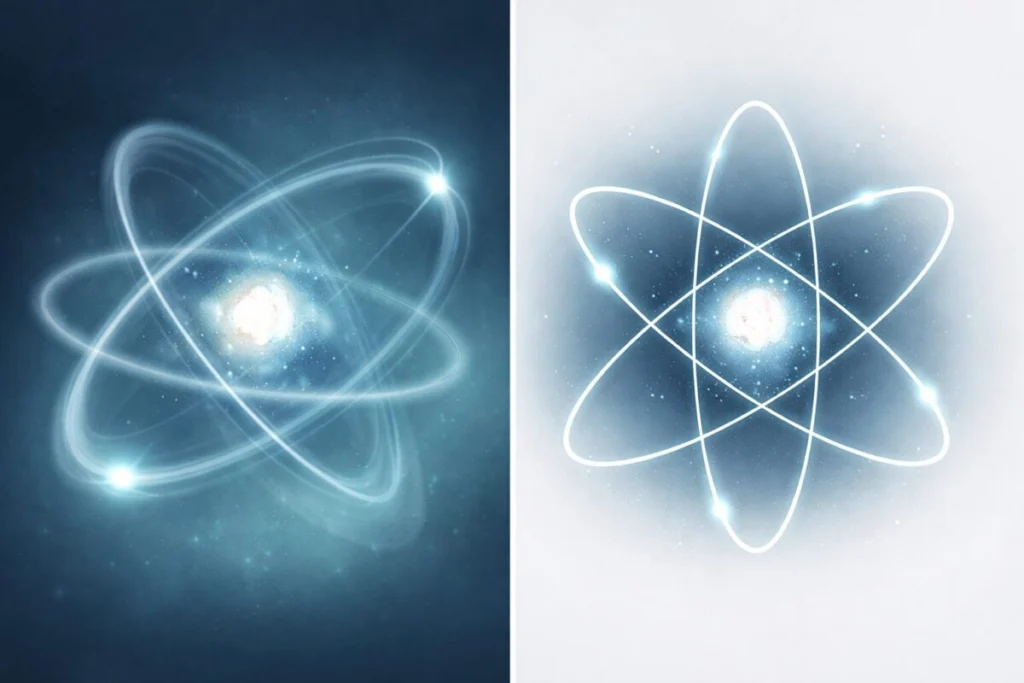
The Schrödinger wave equation time-dependent form is the full, general version. The time-independent form is a useful simplification you can derive from it when the energy doesn’t change. Chemistry students encounter the time-independent version constantly, it’s how we calculate the shape of atomic orbitals and predict chemical bonds.
Imagine a sealed steel box. Inside is a cat, a tiny vial of poison gas, a Geiger counter, and a single radioactive atom. The atom has a 50/50 chance of decaying within one hour. If it decays, the Geiger counter triggers a hammer, shattering the vial, releasing the poison, and the cat dies. If it doesn’t decay, the cat lives. You seal the box and wait an hour. Now: is the cat alive or dead?

Common sense says: the cat is definitely one or the other. We just don’t know which because we haven’t looked. But here’s what quantum mechanics says, and this is the part that keeps physicists awake, before observation, the radioactive atom genuinely exists in a superposition of “decayed” and “not decayed” simultaneously. If the atom is in both states, then by the logic of the equation, the cat is also in both states. Alive and dead. Not just unknown, both.
The moment you open the box (measure the system), the superposition collapses into one outcome. You get a definite answer. But the question Schrödinger was really poking at is: at what point does the quantum fuzziness of the atom become the classical definiteness of a dead or alive cat? Where exactly does the quantum world hand off to the everyday world?
That question still doesn’t have a universally agreed answer.
Superposition is the principle that a quantum system can exist in multiple states at once, until it’s measured. My favourite way to think about it after years of studying this material is the spinning coin analogy.
Flick a coin onto a table and let it spin. While it’s spinning, it’s not heads or tails, it’s genuinely both possibilities, overlapping. The moment it falls flat and you read the result, it becomes one. Superposition is like that spinning state, except for quantum systems it’s not just a metaphor for our ignorance. The math says the particle genuinely occupies multiple states simultaneously.

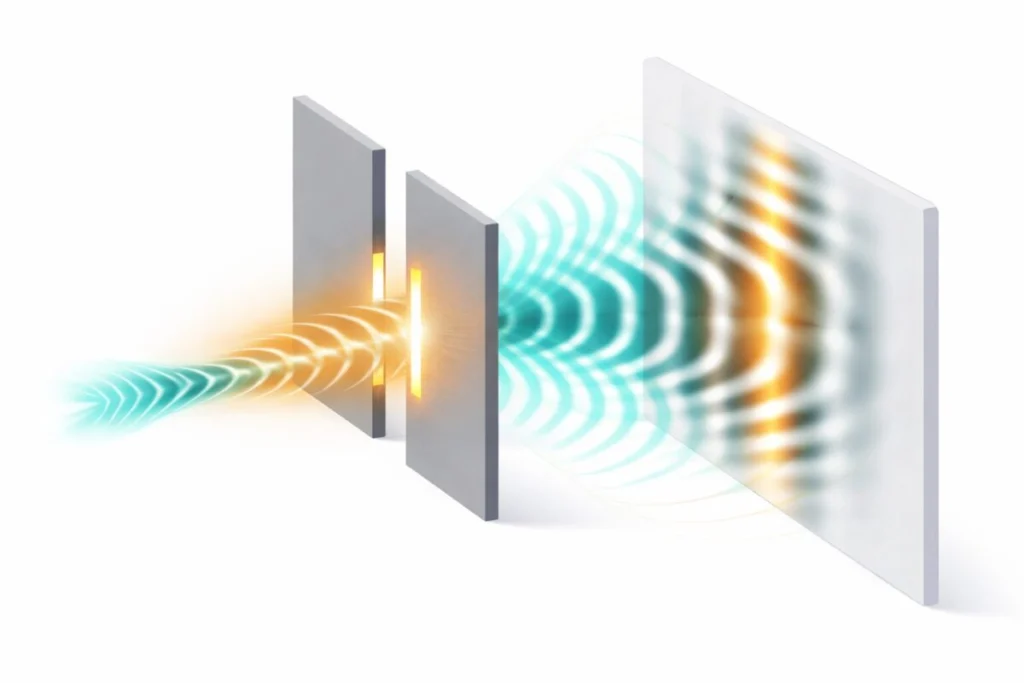
Light does something related in the famous double-slit experiment. Fire photons at two slits, and they produce an interference pattern, proof that each photon interferes with itself, passing through both slits as a wave simultaneously. Only when you try to catch it at a slit does it behave like a particle.
Schrödinger wasn’t trying to make a case for cats having quantum crises. He was doing the opposite, he was criticising the dominant Copenhagen interpretation of quantum mechanics, championed by Niels Bohr.
The Copenhagen interpretation says, roughly: quantum systems exist in superposition until measured, at which point the wave function “collapses” into a definite state. Schrödinger found this deeply unsatisfying. His thought experiment was designed to show that if you apply the Copenhagen logic consistently, you end up with the absurd conclusion of a simultaneously alive-and-dead cat at the macroscopic level. “This is ridiculous,” was basically his argument. “There must be something missing from our interpretation.”
He was right that something was missing. We’re still working out what.
The cat is not literally in two biological states. Schrödinger knew this. The point is not about cats, it’s about the measurement problem: the tension between quantum mechanics (which allows superposition) and classical mechanics (which does not).
The honest answer from modern physics is: we’re not entirely sure. The process called “decoherence”, where quantum systems interact with their environment and lose their quantum properties very quickly, is the leading explanation for why large objects seem classical. But the philosophical question of what “measurement” really means is still fiercely debated.
Here’s where all this abstract physics becomes something you might actually care about in your lifetime.
Classical computers use bits, each is either a 0 or a 1. Quantum computers use qubits, which exploit superposition to be 0, 1, or both simultaneously. Because of this, a quantum computer with just 300 qubits can represent more states simultaneously than there are atoms in the observable universe.

The time-dependent Schrödinger equation governs how quantum gates, the logic operations of a quantum computer, actually work. Without it, there is no quantum computing.
In reality, macroscopic objects decohere almost instantly, the cat never meaningfully exists in a quantum superposition. The experiment is a conceptual illustration of a theoretical problem, not a literal physical claim.
Truth: Superposition is real, but only at quantum scales, far below what our senses can detect.
The Schrödinger equation is entirely deterministic, it perfectly predicts how the wave function evolves. The apparent randomness only appears at the moment of measurement.
Truth: Quantum mechanics is arguably the most precisely tested theory in all of science. Its predictions match experiments to more than 10 decimal places.
Quantum specifically means “discrete”, energy comes in packets (quanta), not continuous flows. That’s a very specific, measurable, well-understood claim.
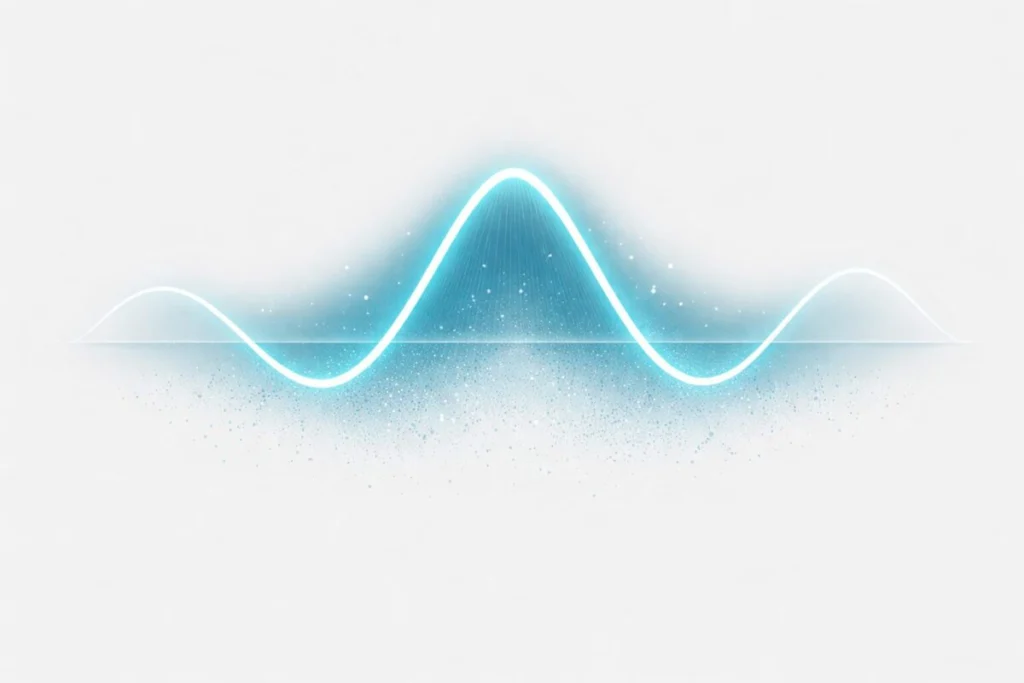
A water wave doesn’t exist at one point, it’s spread across space. The height of the wave at any location tells you the “amplitude.” The Schrödinger wave function works the same way: its magnitude squared at any point gives you the probability of finding the particle there. High amplitude = high probability. Flat water = particle unlikely to be found here.
While a coin spins on a table, it hasn’t chosen heads or tails. Both possibilities are active and coexisting. Quantum superposition is formally like this — except the “spinning” isn’t just ignorance on our part. The math says both states are genuinely present, with weights determined by the wave function.
Shine light through two narrow slits and you see alternating bright and dark bands on a wall behind, an interference pattern. This only happens if light passes through both slits simultaneously as a wave. Individual photons, fired one at a time, still build up this pattern, which means each photon is genuinely going through both slits. The Schrödinger equation describes exactly this kind of wave-like behaviour for all quantum particles.
It’s the rule that governs how quantum systems, electrons, atoms, photons, evolve over time. Instead of giving you a definite position, it gives you a wave function (Ψ) that encodes the probability of finding a particle in any given location. It’s to quantum mechanics what Newton’s laws are to classical mechanics: the core equation that makes everything else calculable.
The time-dependent Schrödinger equation describes how quantum systems change over time, it’s the general, complete version. The time-independent form is a simplified version used when a system has settled into a stable energy state (like electrons in an atom). Think of it as: the full movie versus a single freeze-frame.
It’s a thought experiment devised by Erwin Schrödinger in 1935 to critique how quantum mechanics was being interpreted. A cat in a sealed box is linked to a quantum event (radioactive decay), making the cat’s fate theoretically dependent on a quantum superposition. It highlights the tension between quantum-scale physics and the everyday, classical world we live in.
No, not in any literal biological sense. Large objects decohere almost instantaneously due to their interaction with the environment, collapsing any quantum superposition long before it could affect something as complex as a cat. The experiment is a conceptual challenge to physics interpretations, not a description of a real experimental setup.
Quantum computers use qubits that exploit superposition, a direct consequence of what the Schrödinger equation describes. The time-dependent form governs how quantum gates (the operations in a quantum computer) manipulate quantum states. Without understanding the Schrödinger equation, there is no theoretical foundation for quantum computing.
It is the foundation of all of modern quantum physics. It explains the structure of atoms, the behaviour of electrons in semiconductors (making computers possible), chemical bonding, laser operation, MRI machines, and the principles behind quantum cryptography and quantum computing. Nearly every technology that defines modern life has the Schrödinger equation somewhere in its theoretical ancestry.
The Schrödinger equation, whether in its time-dependent form describing evolving systems or its time-independent form describing stable ones, is the engine of the quantum world. What begins as a ripple in a mathematical pond ends up explaining everything from why atoms hold together to how a quantum computer can solve problems a classical machine never could.
The cat experiment isn’t about cats. It’s a mirror held up to our deepest assumptions about reality: that things have definite properties whether or not we look at them. The Schrödinger equation says: not necessarily. And the fact that this strange, counterintuitive idea produces the most accurate scientific theory ever devised should give us genuine pause.
From Schrödinger, What Is Life? to the qubits being tested in labs today, his framework has never stopped being relevant. We’ve only found more questions hiding inside the answers.
“Where exactly is an electron right now?” Ask this question, and quantum mechanics will give you the strangest possible answer: it’s not really anywhere, until you look.