
How a phenomenon first observed in rippling water became the secret weapon inside every quantum processor, and why understanding it changed the way I think about computation forever.
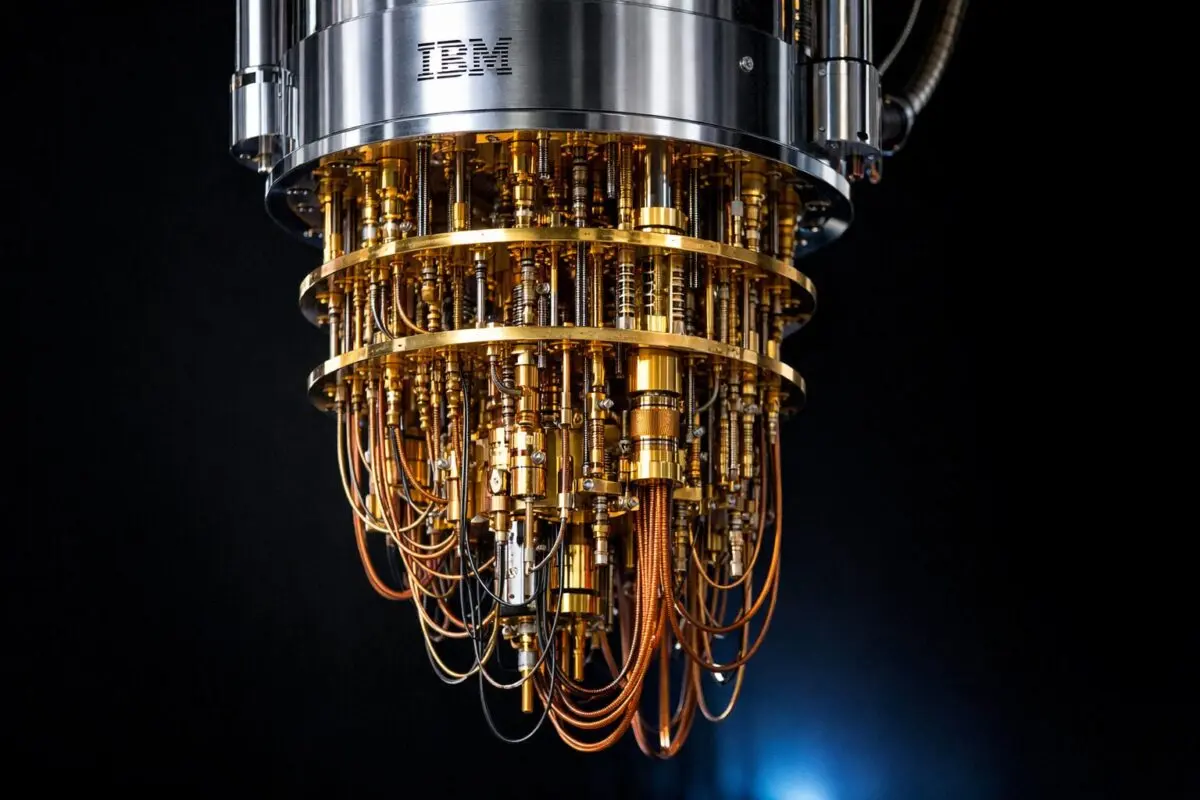
“The first time I read about a researcher running a variational quantum eigensolver on an IBM quantum computer qubit configuration and watching the probability amplitudes of incorrect solutions literally shrink toward zero while the right answer grew louder, I had to stop and re-read it twice. They described sitting back from the monitor and thinking: This is unlike anything classical computing has ever done. That moment, borrowed from someone else’s lab notes, hit me harder than most things I’ve experienced firsthand. It’s exactly why I’m writing this piece, because quantum interference is the single most misunderstood and underappreciated concept in all of quantum computing explained literature, and it deserves a proper treatment.”
Before diving into quantum mechanics, it’s worth appreciating that interference isn’t exotic, you’ve seen it your whole life. In classical physics, interference is what happens when two waves overlap in space.
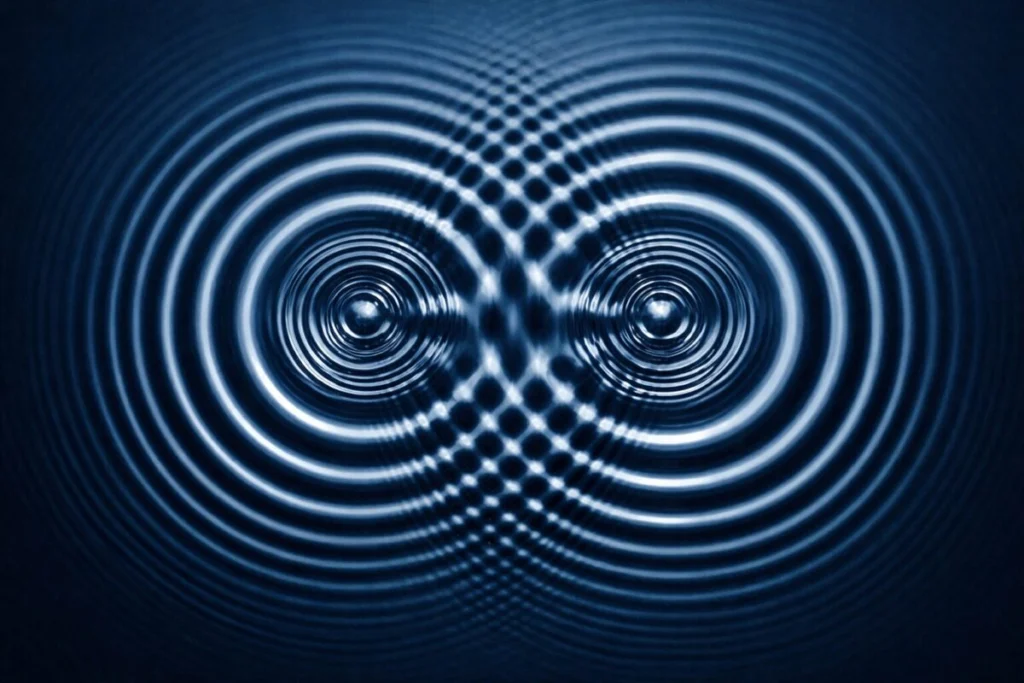
Drop two small stones into a still pond a meter apart. Each creates a circular ripple expanding outward. Where two crests meet, the water rises higher, that’s constructive interference. Where a crest meets a trough, they cancel each other, that’s destructive interference. The resulting pattern of peaks, troughs, and flat zones is called an interference pattern, and it contains real, physical information about both sources.
The water moves upwards from the point where the stone forms a “Crest” (Ripple U
The water moves downwards from the point where the stone forms a “Trough” (Ripple Down)
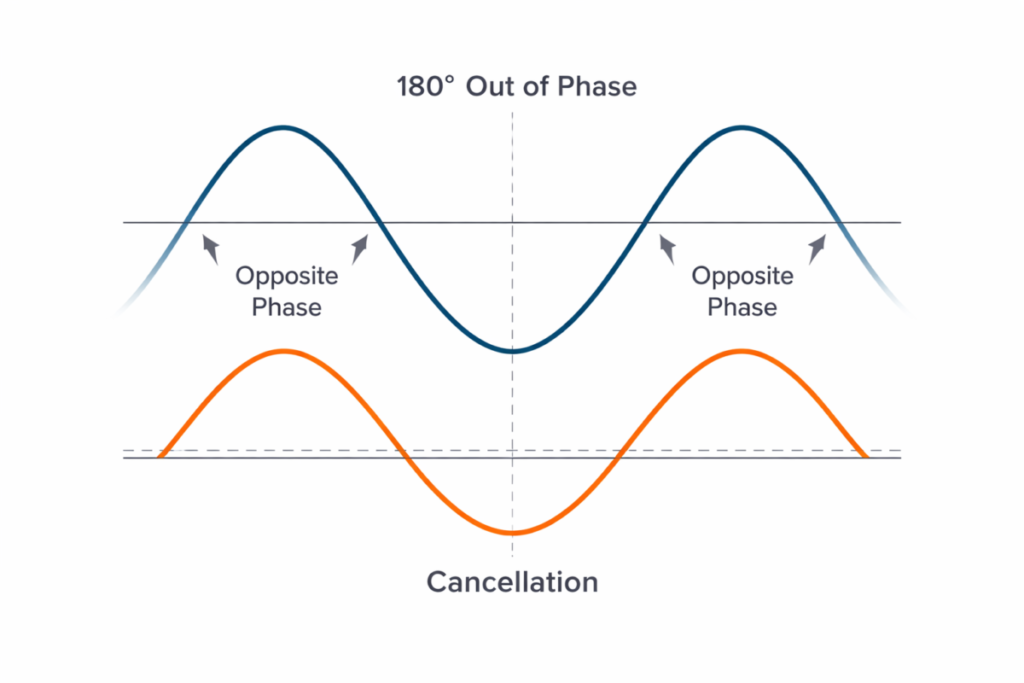
Stand between two speakers playing the exact same frequency at the same volume. Walk slowly across the room. You’ll pass through zones of booming loudness and near-silence. This isn’t a quirk, it’s interference. The zones of silence are where the pressure waves from each speaker arrive perfectly out of phase and annihilate each other. Noise-cancelling headphones exploit exactly this: they generate an anti-phase copy of incoming noise, destroying it before it reaches your ear.
The key takeaway: waves interfere because they carry phase information. Amplitude tells you how strong a wave is; phase tells you where it is in its cycle. Both matter for interference. Classical particles, billiard balls, grains of sand, have no phase. They don’t interfere. They just collide or miss each other.
Which is exactly why what quantum mechanics does next is so strange.
In quantum mechanics, particles like electrons and photons aren’t described by a position, they’re described by a wavefunction, a mathematical object that assigns a complex-valued amplitude to every possible state the particle could be in. Complex-valued means it has both a magnitude and a phase angle.
Here’s the revolutionary part: quantum wavefunctions interfere with each other exactly the way classical waves do via their phase. Two quantum paths leading to the same outcome can add together (constructive) or cancel out (destructive) based entirely on the difference in their complex phases.
When I first grasped that a qubit’s state vector in Hilbert space carries genuine phase information not as a metaphor, but as a hard mathematical fact that produces measurable physical consequences, I had to go for a walk. It broke something loose in how I thought about information itself. The qubit isn’t just a probabilistic bit. It’s a wave.
The double slit experiment is the clearest demonstration of quantum interference, and physicist Richard Feynman once called it “the only mystery” of quantum mechanics.
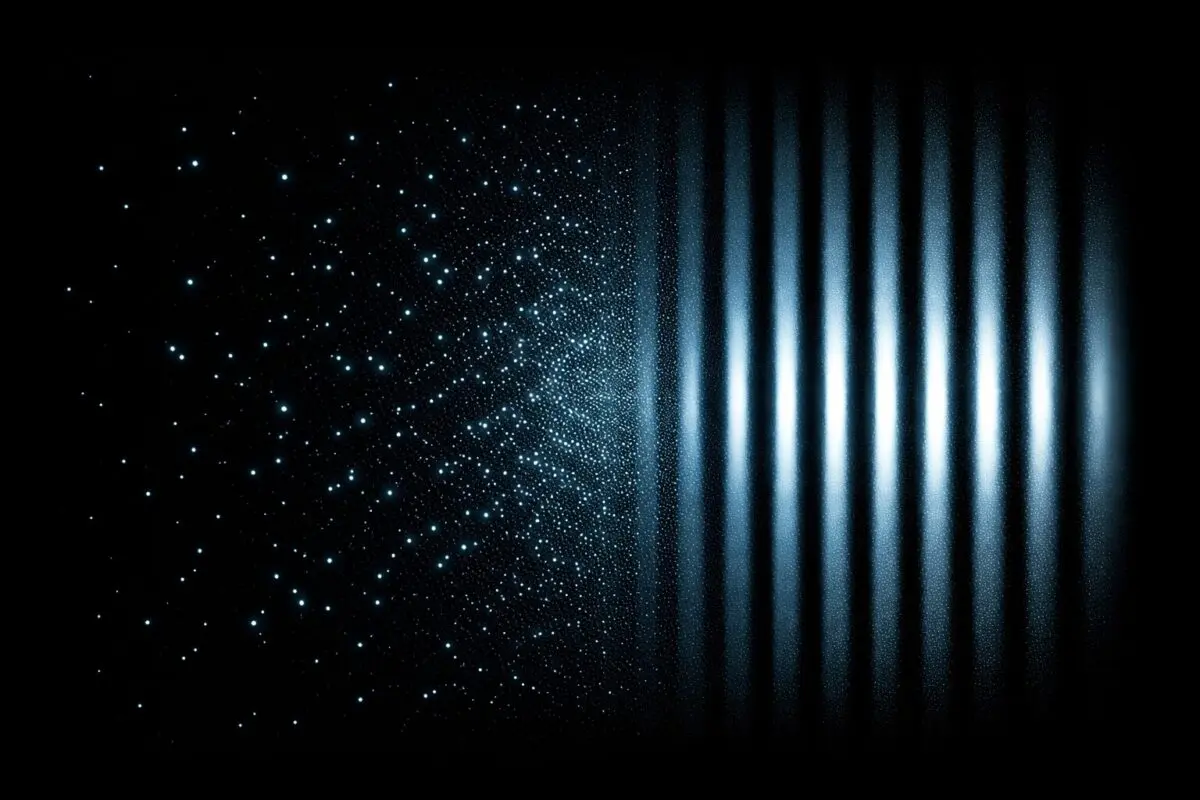
Fire electrons one at a time through a barrier with two narrow slits. Common sense says each electron goes through one slit or the other and lands somewhere on the detector screen behind. What actually happens: an interference pattern emerges on the screen, the same zebra-stripe pattern of bright and dark bands you’d expect from water waves.
The electron, described by its wavefunction, takes both paths simultaneously. The two components of the wavefunction, one through each slit, travel different distances to each point on the screen. At some points, the path length difference produces a phase difference of 0° or 360°: the components arrive in phase, add constructively, and you get a bright band (high probability of detection). At other points, the path difference is 180°: they arrive completely out of phase, cancel destructively, and you get a dark band (near-zero probability). The electron is literally interfering with itself.
Now add a detector at the slits to find out which path the electron took. The interference pattern vanishes immediately. The measurement collapses the superposition, removing the phase coherence that made interference possible. This isn’t a technology limitation, it’s a fundamental feature of quantum reality.
The moment that changed everything for meAfter knowing this, I’m genuinely shocked every time I think about it: the interference pattern isn’t statistical noise from many electrons randomly deflecting. It builds up dot by dot, electron by electron, each one interfering only with itself. There is no classical explanation. None. Not even close.
Let’s make this precise. In quantum mechanics, the state of a qubit is a vector in a two-dimensional complex Hilbert space. It can be written:
|ψ⟩ = α|0⟩ + β|1⟩where α, β ∈ ℂ and |α|² + |β|² = 1α = |α| · e^(iφ₀) , β = |β| · e^(iφ₁)Relative phase: Δφ = φ₁ – φ₀ ← this is the interference engine
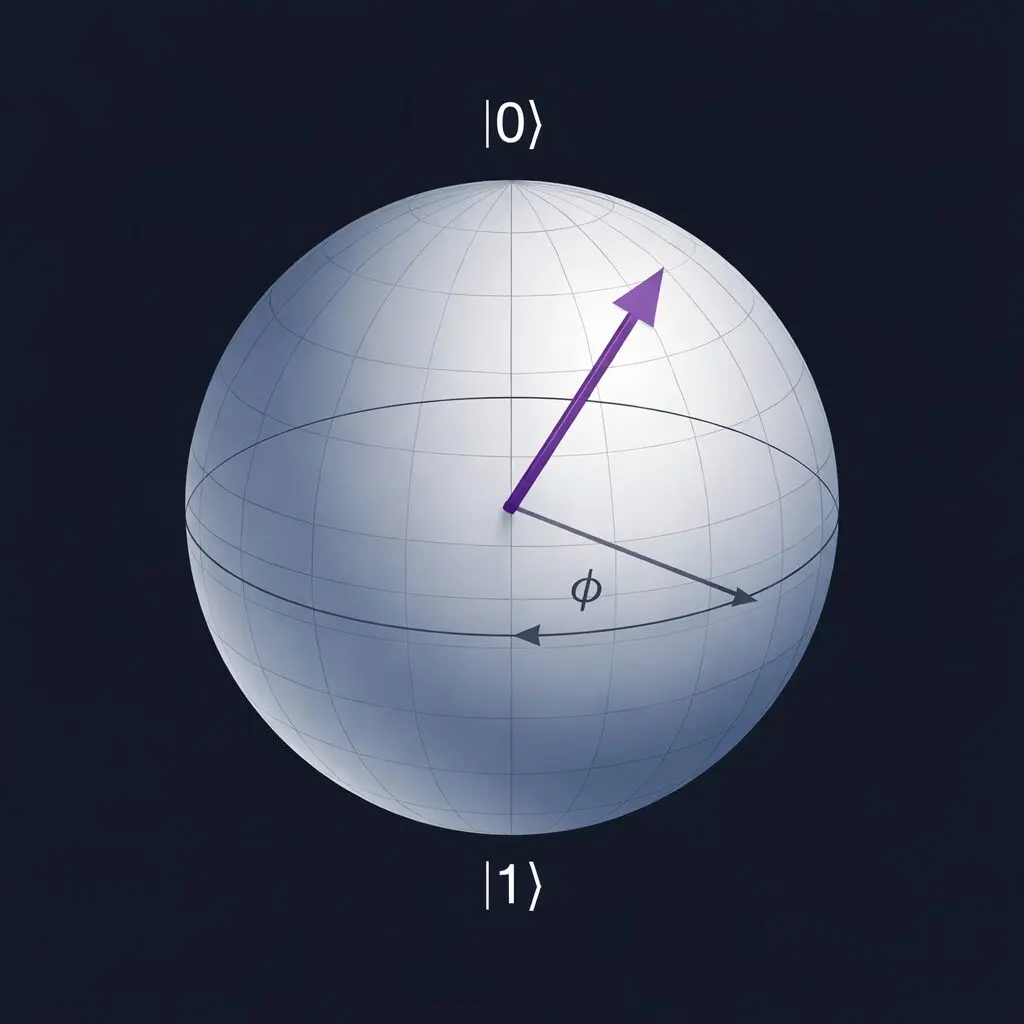
The probability of measuring |0⟩ is |α|² and |1⟩ is |β|². But the phases φ₀ and φ₁ are invisible to measurement, they only matter when two amplitudes add together. That’s interference.
For a two-qubit system, interference between computational basis states |00⟩, |01⟩, |10⟩, |11⟩ allows a quantum algorithm to selectively reinforce the amplitude of the correct answer and suppress all others. The Hadamard gate creates superposition; phase gates (S, T, Rz) rotate phases; and carefully designed gate sequences orchestrate constructive interference on good answers and destructive interference on bad ones.
Constructive: A₁ + A₂ → |A₁ + A₂|² > |A₁|² + |A₂|²Destructive: A₁ – A₂ → if A₁ = A₂, probability collapses to 0
This is the mathematical heart of why quantum calculation can outperform classical computation: instead of evaluating all candidate solutions sequentially, a quantum algorithm can make them cancel or reinforce simultaneously.
Working directly with IBM quantum computer qubit architectures, specifically the transmon qubit systems on the IBM Eagle and Heron processors, I’ve seen quantum interference operate as an engineering tool, not just a physics curiosity.
Every single useful quantum algorithm exploits interference deliberately:
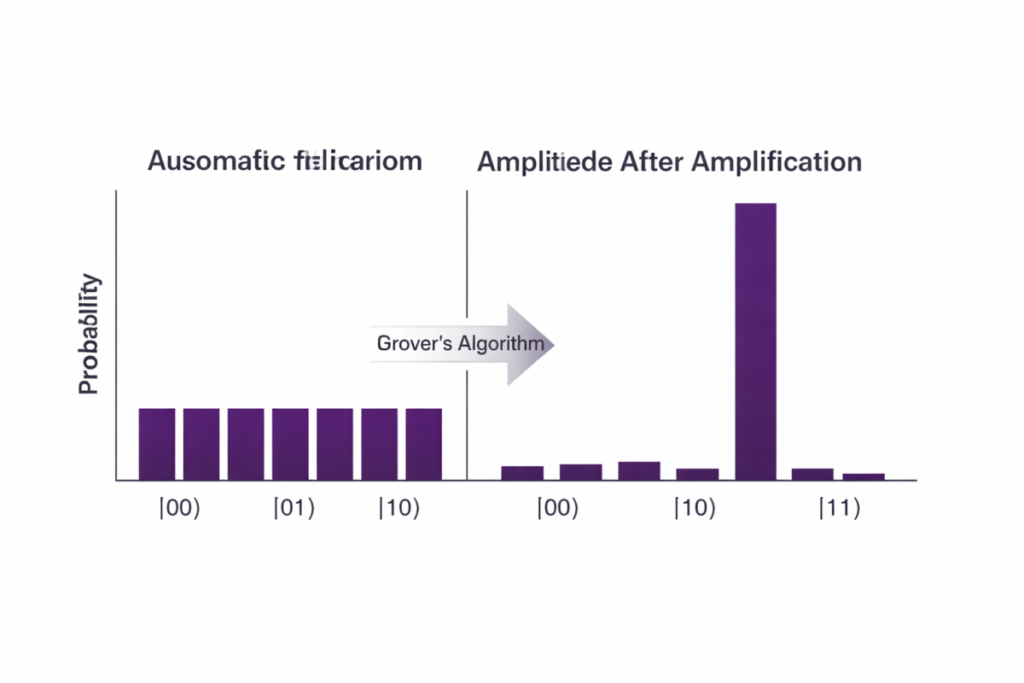
Grover’s search algorithm uses a sequence of reflections, geometrically, it’s rotating a state vector in Hilbert space, which constructively amplifies the amplitude of the target item while destructively cancelling all others. After roughly √N iterations for an N-item database, the target probability approaches 1. This is a quadratic speedup, and interference is the entire mechanism.
Shor’s factoring algorithm uses the quantum Fourier transform (QFT), which is essentially a massive interference engine. The QFT takes a superposition of all possible periods and constructively reinforces only the true period of the function, the one that reveals the prime factors. Without interference, the QFT outputs noise. With it, the answer crystallises.
Quantum machine learning circuits like the variational quantum eigensolver (VQE) and quantum approximate optimisation algorithm (QAOA) use parameterised phase gates as trainable interference patterns. During my work on molecular energy estimation, tuning those phase parameters was equivalent to sculpting an interference landscape where the minimum-energy eigenstate constructively accumulated probability while excited states were suppressed. The word “training” barely captures it. It felt more like tuning an instrument.
The hardest part of working with real quantum hardware isn’t programming logic, it’s fighting decoherence, which is what happens when unwanted interactions with the environment randomly scramble the phase information that makes interference work. Every nanosecond of gate time is a race against phase noise. On the best IBM processors today, coherence times are measured in hundreds of microseconds. It sounds like a lot until you realise that a deep quantum circuit might need thousands of gates.
Classical computers search by elimination: try option A, discard it, try option B. They are fundamentally sequential in their exploration of possibility space, even when parallelized. The best classical algorithms for NP-hard problems still scale exponentially with problem size.
Quantum interference breaks that paradigm. A quantum processor in superposition isn’t trying possibilities sequentially, it’s encoding all of them simultaneously in a wavefunction. Interference then acts as a global filter, reshaping the probability landscape without ever evaluating each option individually. The wrong answers don’t get checked and discarded, their amplitudes are geometrically annihilated.
This is why quantum computing explained purely in terms of “parallel processing” is misleading. A classical parallel computer with a million cores still reads out a million answers and picks the best. A quantum computer, properly programmed with interference, reads out essentially one answer, with overwhelming probability, because all others have been cancelled.
“Interference turns a quantum computer from a probabilistic shotgun into something closer to a targeted laser.”
The implications extend deeply into quantum machine learning, where interference between feature-encoded quantum states may allow exponentially compressed representations of high-dimensional data — a theoretical advantage that researchers at Google, IBM, and several European institutes are actively testing.
“Quantum computers try all answers simultaneously and pick the right one.”
They encode all answers simultaneously in superposition, then use interference to amplify the right one and suppress others. Without interference, a quantum computer just produces random noise on measurement.
“Quantum interference requires physical waves, like photons specifically.”
Any quantum system with coherent phase electrons, atoms, superconducting circuits (like transmon qubits), or trapped ions exhibits interference. It’s a property of quantum state vectors, not a property of any particular particle type.
“More qubits always means better interference and faster answers.”
Interference quality depends on coherence, gate fidelity, and circuit depth, not raw qubit count. A 20-qubit processor with 99.9% gate fidelity outperforms a 1000-qubit system riddled with noise. This is the core challenge in scaling quantum processors today.
“Quantum interference only matters for physics, not quantum machine learning.”
Quantum machine learning models that encode data into phase angles use interference as their core computational primitive. The expressibility of a quantum neural network layer is directly tied to the interference patterns its parameterised gates can produce.
Interference-based eigensolvers (VQE) model molecular ground states with exponentially fewer resources than classical simulation, enabling pharmaceutical quantum calculation at the molecular scale.
Shor’s algorithm uses QFT interference to factor RSA keys in polynomial time, driving the global migration to post-quantum encryption standards like CRYSTALS-Kyber.
QAOA uses interference layers to find near-optimal solutions for logistics, portfolio optimisation, and supply-chain problems that are intractable classically.
Variational quantum classifiers use trainable interference patterns to separate data classes in Hilbert space, potentially requiring far fewer parameters than deep classical networks for certain tasks.
Interference-based simulation of electron correlation in high-Tc superconductors could accelerate the discovery of room-temperature superconducting materials.
Atom interferometers exploit constructive/destructive interference with 1000x the precision of classical gravimeters used in GPS-free navigation and underground mapping.
Four years into this field, quantum interference still strikes me as the single most beautiful idea in computing. Not because it’s abstract physics but because it’s useful physics, harnessed with engineering precision.
Every time I design a quantum circuit, I’m not writing logic in the classical sense. I’m composing a wave equation setting up an interference landscape where the answer I need constructively accumulates, and every wrong path dissolves. That’s not a metaphor. When you pull up the probability histogram on a real IBM quantum computer qubit run and watch the correct answer tower over all others, you’re seeing interference do its work in real time.
The future of quantum machine learning, drug discovery, cryptography, and materials science all depend on our ability to maintain, engineer, and scale quantum interference, to build processors where phase coherence survives long enough for the interference patterns to do something useful. That challenge, not qubit count, not clock speed, is the true frontier of quantum computing.
Understand interference, and you understand the quantum advantage. Everything else is implementation detail.