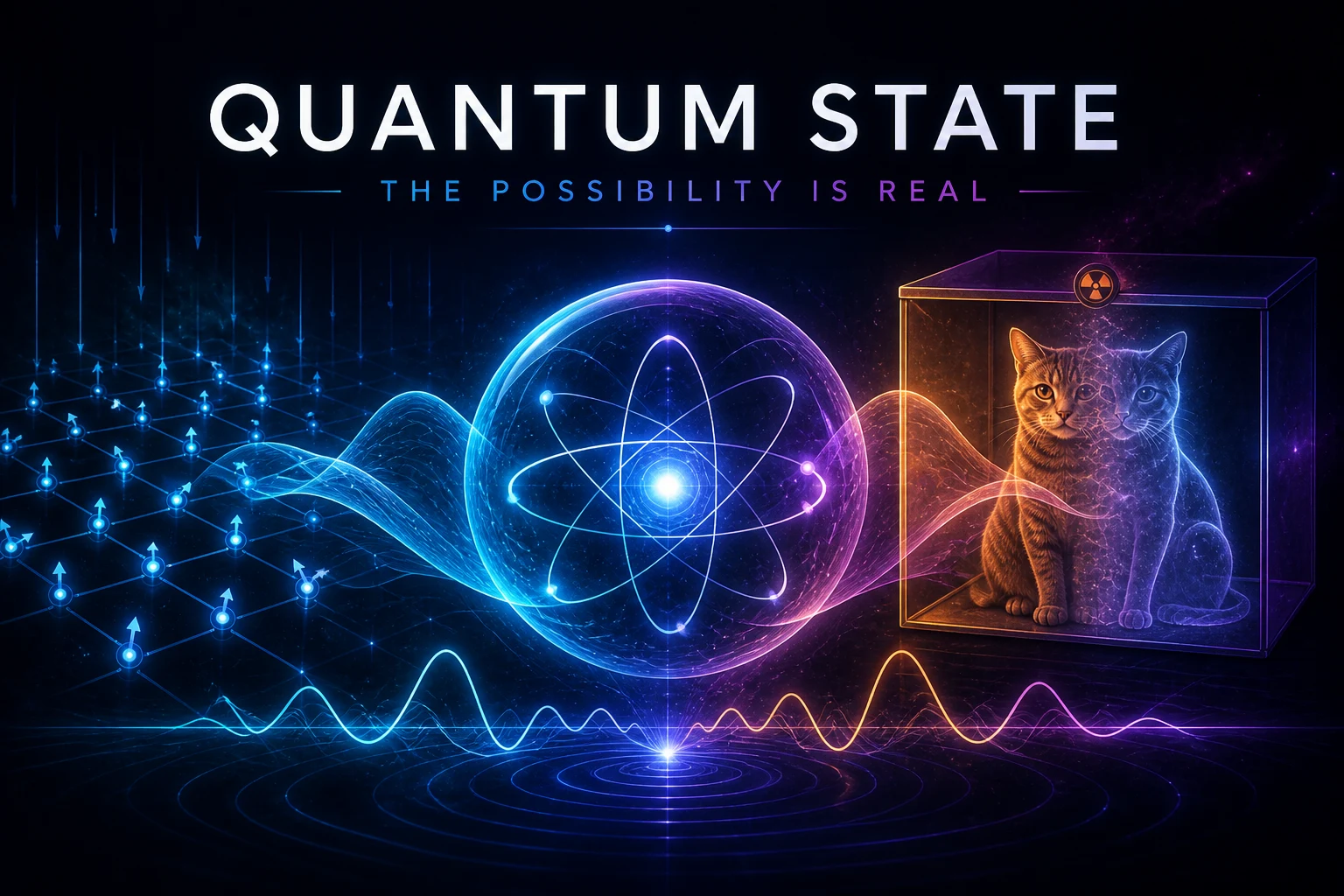
Quantum States Explained: A Beginner-Friendly Guide to Understanding Quantum Physics
A quick note from me: When I first stumbled onto the phrase “quantum state,” I genuinely didn’t know where to start. What I learned, and what surprised me most, is that these ideas are far more logical than they sound. This guide walks you through everything, step by step, without unnecessary jargon.
What Are Quantum States? (Simple Explanation) for beginners
Quantum state meaning:
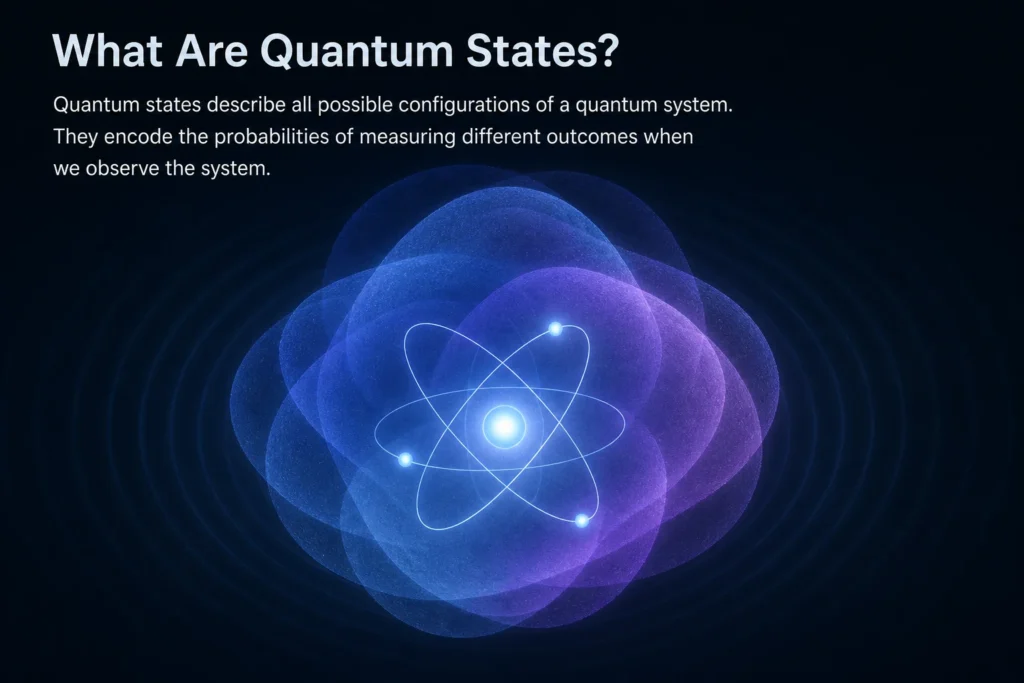
A quantum state describes the condition of a system (like an electron, atom, or photon) in terms of probabilities rather than definite values.
Think of it like a full profile. If someone asked you to describe a friend, you’d list their height, voice, mood, habits, everything together. A quantum state does the same for a particle: it bundles every measurable detail, position, energy, and spin into one description.
The key difference from everyday physics? A particle doesn’t always have one fixed answer for each property. It can exist in a superposition, a combination of multiple possibilities, until something measures it.
Why Quantum States Matter in Physics and Quantum Computing explained simply
Quantum states are not just textbook abstractions; they’re the reason quantum technology works.
In classical computing, a bit is either 0 or 1. A qubit is powered by quantum states, it can be 0, 1, or both simultaneously. This superposition allows quantum computers to process enormous numbers of possibilities in parallel.
Quantum states also underpin quantum cryptography, where the state of a single photon creates unbreakable encryption. And in quantum sensors, the extreme sensitivity of quantum states enables measurements of the brain activity, gravitational fields, and molecular structures that classical instruments simply cannot achieve.
Explre how Quantum Qubit works in simple terms
How Quantum States Are Represented
Wave Function (Ψ): A beginner-friendly guide
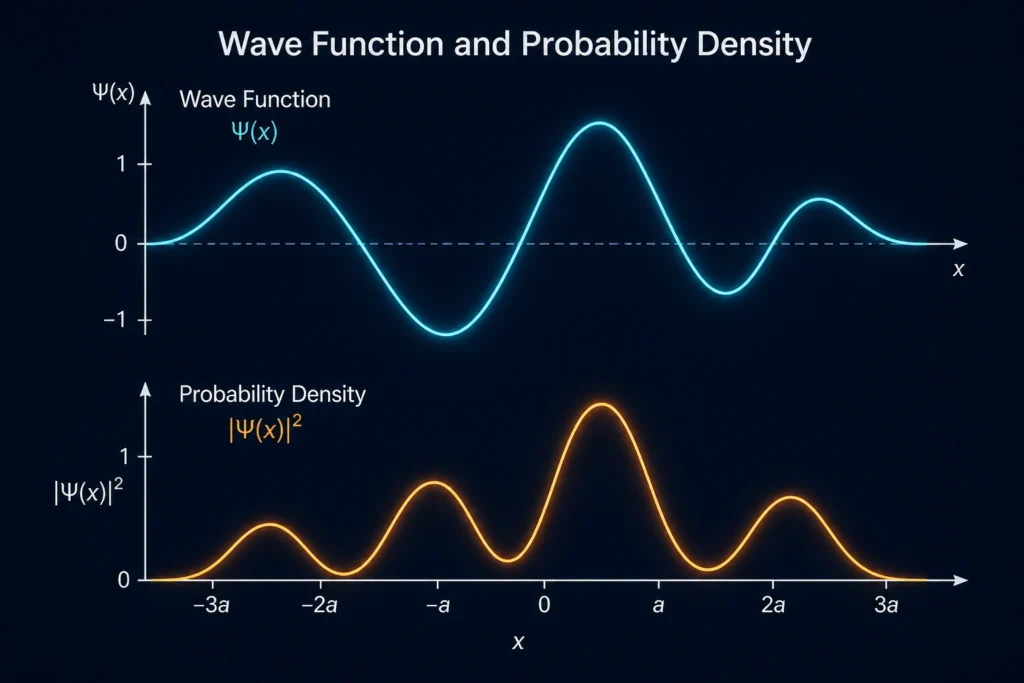
The wave function, written as Ψ (Psi), is the mathematical expression of a quantum state. Its most important property: the square of Ψ gives the probability of finding a particle at a specific location.
Think of it as a probability map, not a position tracker. Where Ψ is large, the particle is likely. Where Ψ is small, it probably isn’t.
State Vectors in Quantum State
In a more abstract framework, a quantum state is written as |ψ⟩, called a state vector in Dirac notation.
A state vector is like an arrow pointing in a multi-dimensional space. Different directions represent different quantum states. The math behind this lives in a structure called Hilbert space.
Expectation Values in Quantum Mechanics
You can’t always predict the exact result of a quantum measurement. But you can calculate the expectation value in the average result over many identical measurements.
Analogy: Roll a fair die many times. You can’t predict each roll, but you know the average is 3.5. An expectation value will work the same way. It’s the statistically predicted centre of all your measurement outcomes, calculated directly from the wave function.
Types of Quantum States (Easy Breakdown)
Pure Quantum States
A pure quantum state means you have complete quantum knowledge of the system. It can be described by a single wave function with no additional uncertainty about how it was prepared.
Example: An electron freshly prepared with a known spin direction is called a pure state.
Mixed Quantum States
A mixed quantum state adds a layer of classical uncertainty on top of quantum uncertainty. It’s a probabilistic mixture of several pure states that will not be because of superposition, but because of incomplete knowledge.
Analogy: A bag of coins, some heads-up, some tails-up, but you don’t know which you’ll pull out. In quantum terms, that’s a mixed state.
Coherent States (Simple Explanation)
A coherent state is a special quantum state that behaves as classically as quantum mechanics allows.
Originally developed to describe laser light, coherent states have minimum quantum uncertainty, and position and momentum are as balanced as nature permits. They form a bridge between the quantum and classical worlds, which is why laser beams are so predictable and stable compared to ordinary light sources.
Stationary States in Quantum Mechanics
A stationary state is a quantum state where all measurable properties remain constant over time, even though the wave function itself may still oscillate.
These states have a definite, fixed energy, so they are the allowed energy levels of quantum systems. They’re also called energy eigenstates.
Every stable electron orbit in an atom is a stationary state. When an electron jumps between stationary states, it releases or absorbs a photon with a precise energy, producing the spectral lines that identify every element in the universe. This is why atoms are stable and don’t collapse.
Famous Thought Experiment: Schrödinger's Cat explained simply
In 1935, physicist Erwin Schrödinger designed a thought experiment to expose an uncomfortable implication of quantum mechanics.
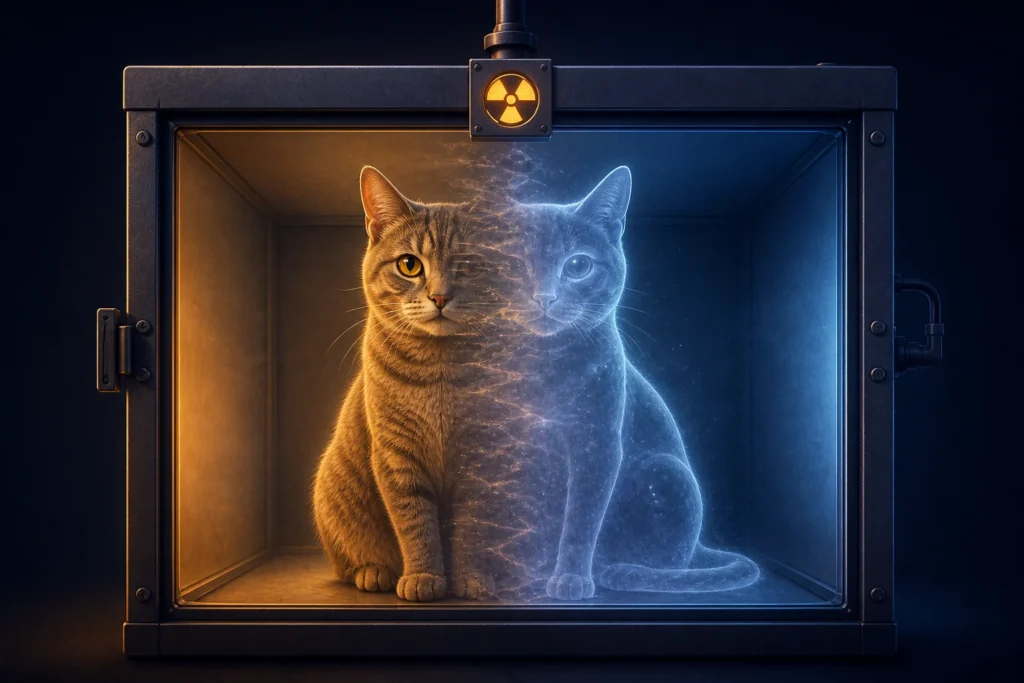
Here’s the scenario: A sealed box contains a cat, a radioactive atom, a Geiger counter, a hammer, and a vial of poison. If the atom decays (a quantum event), the counter triggers the hammer and breaks the vial and kills the cat. If not, the cat lives.
The quantum twist: the atom exists in a superposition state, decayed and not-decayed simultaneously, until observed. So what about the cat? Is it both alive and dead?
Schrödinger’s cat theory was never meant as a literal claim. It was a critique highlighting the absurdity of applying microscopic quantum rules to macroscopic objects. The real insight it gives us: quantum superposition is experimentally real at the particle level, but something called decoherence prevents cats (and all large objects) from existing in superposition. Where exactly that boundary lies is still an open question in physics.
Quantum States in Exotic Systems Explained
Quantum Hall Effect Explained Simply
Take a thin 2D layer of electrons and apply a strong magnetic field at very low temperatures. You’d expect the electrical resistance to change smoothly. Instead, it jumps in precise, quantised steps — this is called the quantum Hall effect.
Those resistance values are so exact that they now serve as an international measurement standard for electrical resistance. It won Klaus von Klitzing the 1985 Nobel Prize and launched the entire field of topological quantum matter
Fractional Quantum Hall Effect
At even stronger magnetic fields and colder temperatures, something stranger happens. The resistance takes values corresponding to fractions, like 1/3 or 2/5, of the standard quantum unit.
The fractional quantum Hall effect occurs because electrons stop acting individually and form a collective quantum state that behaves as if they carry a fraction of an electron’s charge. These fractional excitations, called anyons, are now central to research in fault-tolerant quantum computing.
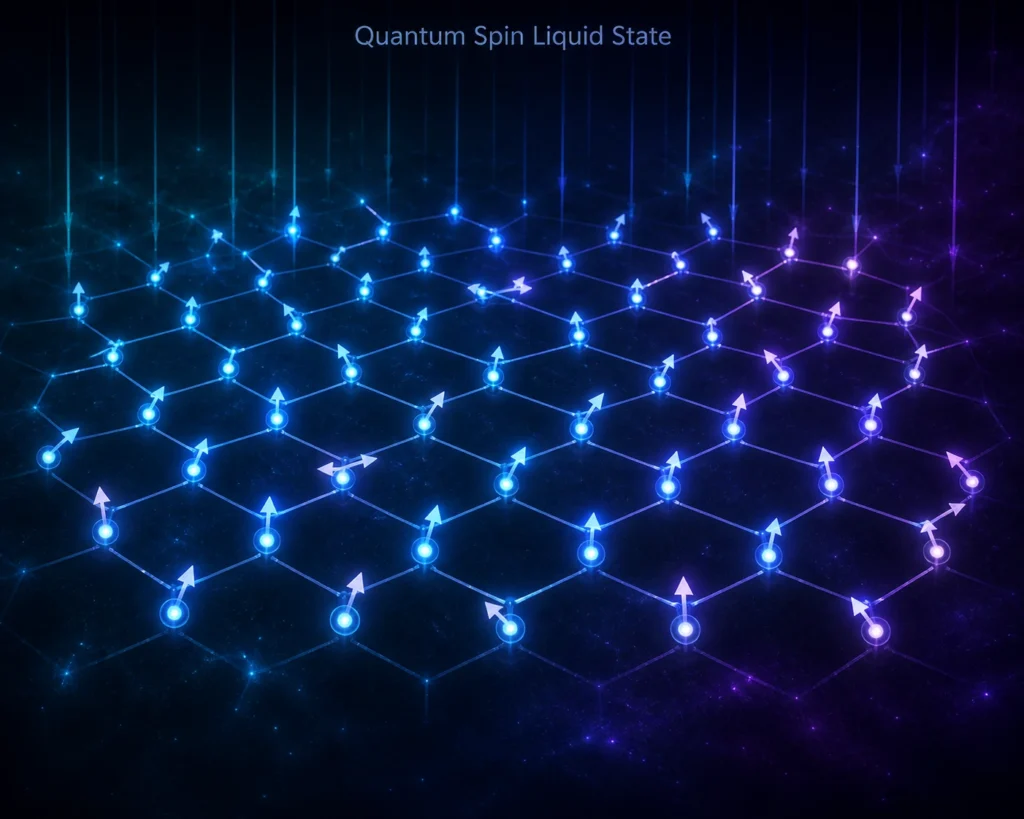
Quantum Spin Liquid (Beginner Explanation)
Normally, when you cool a magnetic material to near absolute zero, its atomic spins freeze into an ordered pattern. A quantum spin liquid defies this completely.
In a quantum spin liquid, the spins remain in constant quantum fluctuation and are endlessly entangled, never settling even at the coldest temperatures physically possible. It’s a liquid, but for magnetic order rather than atoms.
What it makes exciting for researchers: quantum spin liquids support exotic fractionalised particles (Majorana fermions) that could enable inherently error-protected quantum computing. Finding real-world materials that display this behaviour is one of the hottest challenges in condensed matter physics today.
Measurement and Collapse of Quantum States
Before you measure a quantum system, it can exist in a superposition, which means possibilities at once, all encoded in the wave function.
The moment measurement happens, that superposition collapses to one definite outcome. You get a single result, not multiple
This is wavefunction collapse. Critically, measurement doesn’t just reveal a pre-existing answer in quantum mechanics; the act of measurement is understood to determine the outcome (within the limits of probability). Why this happens remains one of the deepest unresolved questions in physics, explored through competing interpretations like Many-Worlds and Copenhagen.
Common Misconceptions About Quantum States in simple terms
"Particles are always waves."
Particles don’t become waves. Their wave function describes probability distributions. The particle is still detected as a particle, and the wave describes where it’s likely to appear.
"Observation requires a human watching."
No. In quantum mechanics, “observation” means any physical interaction that causes the system to exchange information with the environment, such as a detector, a stray photon, or even a passing electron. No human consciousness required.
"Schrödinger's cat proves nothing is knowable."
It’s a conceptual illustration, not a proof of universal uncertainty. Decoherence prevents macroscopic objects from maintaining superpositions, and that’s why the everyday world looks classical.
Real-Life Applications of Quantum States
Quantum Computing: Qubits exploit quantum states, superposition and entanglement to process calculations far beyond classical limits. Drug discovery and materials science are early application areas.
Quantum Cryptography: Single photon quantum states create encryption keys that are physically impossible to intercept without detection. China’s Micius satellite demonstrated this over 1,200 km.
Quantum Cryptography: Single-photon quantum states create encryption keys that are physically impossible to intercept without detection. China’s Micius satellite demonstrated this over 1,200 km.
Quantum Sensors: Quantum state sensitivity enables the detection of brain magnetic fields, gravitational variations, and molecular-level disease markers impossible with classical instruments.
MRI Machines: Standard MRI already uses the quantum spin states of hydrogen atoms in your body to build detailed 3D anatomical images.
Atomic Clocks: The world’s most precise clocks are accurate to one second in 300 million years. They measure transitions between specific stationary states of caesium atoms.
FAQs
What is a quantum state in simple words?
A quantum state is the complete description of a quantum system, such as position, energy, spin, and more. Often expressed as a set of probabilities rather than fixed values. It’s nature’s way of encoding everything knowable about a particle before you measure it.
What is the difference between pure and mixed quantum states?
A pure state gives complete quantum knowledge, and only quantum uncertainty exists. A mixed state adds classical uncertainty on top, like not knowing which of several pure states was actually prepared. Real-world systems interacting with their environment are almost always in mixed states.
What is a stationary state and where do we see it?
A stationary state has definite energy and stable measurable properties. Electron orbitals in atoms are stationary states and stable levels electrons occupy without losing energy. When electrons jump in between them, they emit light at specific wavelengths, creating the spectral signatures of every element.
What are expectation values in quantum mechanics?
An expectation value is the predicted average measurement result, calculated from the wave function before any experiment. It tells you the central tendency of outcomes if you repeat the measurement many times on identical systems, which is similar to knowing a die averages 3.5 over many rolls.
Why is Schrödinger's cat important to modern physics?
It will frame the measurement problem of why quantum superpositions collapse to definite classical outcomes. It also opened research into decoherence, and modern experiments are now creating real superpositions of increasingly large molecules, testing exactly where the quantum-to-classical boundary lies.
What is the quantum Hall effect in simple terms?
When a 2D electron system is placed in a strong magnetic field at low temperature, its electrical resistance becomes quantised and jumps in precise, fixed steps instead of varying smoothly. These exact values are now used as a global measurement standard for electrical resistance.
What is a quantum spin liquid and why does it matter?
A quantum spin liquid is a material where atomic spins never settle into an ordered arrangement, even at absolute zero temperature; they remain in constant quantum fluctuation. It matters because it hosts exotic particles that could enable naturally error-protected quantum computers.
Conclusion
From the probability clouds of the wave function to the precisely quantised steps of the quantum Hall effect, quantum states are nature’s way of encoding reality at its deepest level.
What I learned through studying all of this is that the strangeness of quantum mechanics isn’t a barrier to understanding. It’s an invitation. The counterintuitive rules at the quantum level give us lasers, MRI machines, quantum computers, and unbreakable cryptography.
If this guide gave you clarity, the natural next steps are exploring quantum entanglement, quantum decoherence, and quantum field theory, each of which builds directly on the quantum state concepts covered here.
Written by Siva Prakash: Quantum Physics & Quantum Comuting Enthusiast All content is researched from peer-reviewed physics literature and foundational quantum mechanics texts.