
Here is the uncomfortable truth: nobody knows. Not you, not the best physicist alive, not the most powerful computer on Earth. And this is not a failure of science. This is science working exactly as it should, because the electron itself does not know where it will land until the very moment it does.
This is not poetry. This is the probability interpretation of the wave function, and in my work in quantum mechanics, I can tell you that no single idea has challenged human intuition more profoundly, or held up more brilliantly under experimental testing.
Let me walk you through what I know, what the physics actually says, and most importantly, why the deep problems underneath this idea still keep researchers like me up at night.
Before we talk about probability, we need to understand what a wave function actually is, because most beginner explanations get this part wrong.
The wave function, written as ψ (the Greek letter psi), is a mathematical object that describes the complete quantum state of a particle, an electron, a photon, or an atom. When I say “complete,” I mean it contains everything that can be known about that particle’s quantum behaviour.
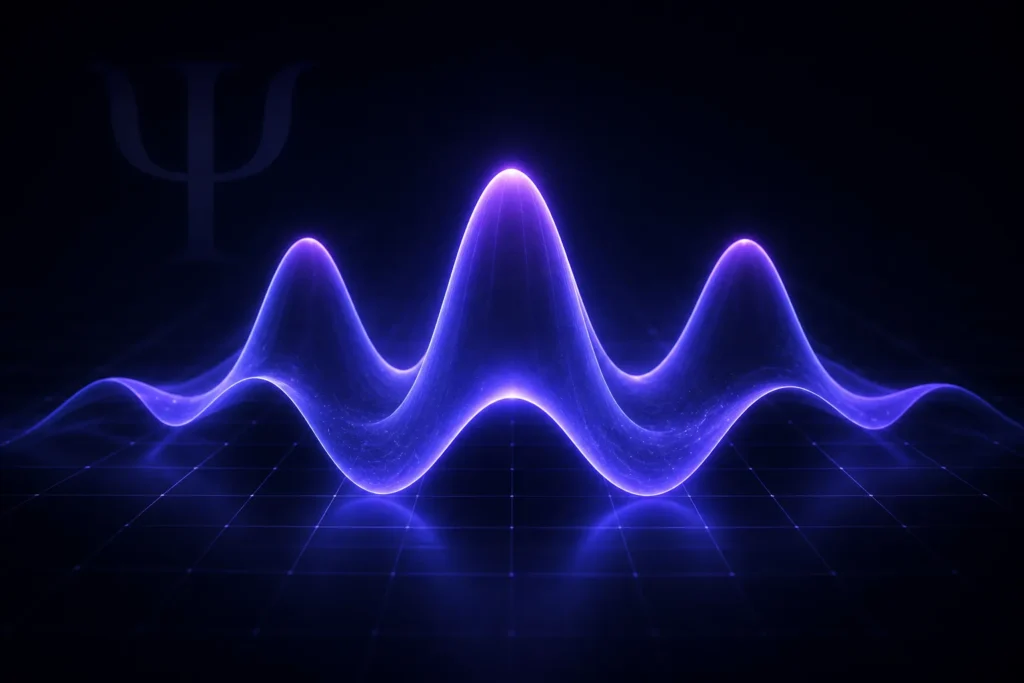
But here is where things immediately become strange. The wave function is not a position. It is not a trajectory. It is not a path. It spreads out through space like a ripple on water, overlapping with itself, interfering with itself, and carrying within it a hidden message about where the particle might be.
Think of it this way: imagine you misplaced your phone somewhere in your flat. You do not know where it is, but based on your habits, you might say there is a 70% chance it is on the kitchen counter, a 20% chance it is on the sofa, and a 10% chance it fell behind the bed. That mental map that spreads possibilities is loosely analogous to what a wave function does for a particle.
Except in quantum mechanics, the particle is genuinely, physically in all those possibilities at once until you look.
This is where Max Born’s insight changes everything. What I find remarkable, even after years of studying this, is how elegant the answer turned out to be.
P(x) = |ψ(x)|²
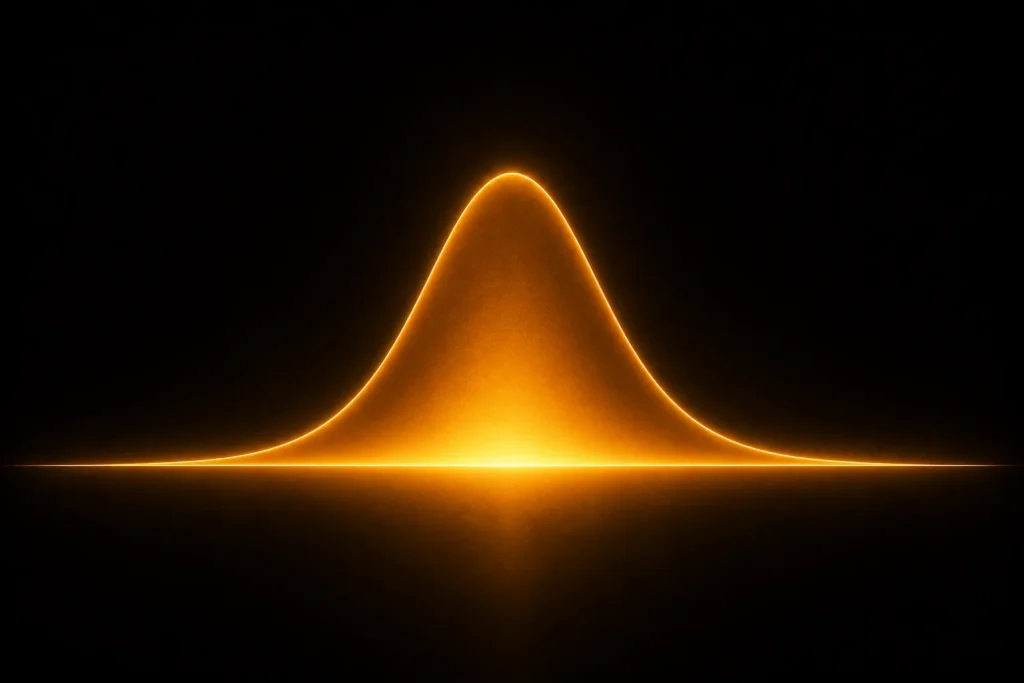
The probability of finding a particle at position x is equal to the square of the absolute value of the wave function at that point.
Let me unpack that in plain English. The wave function ψ is often a complex number, it has a real part and an imaginary part. When you square its absolute value, you get a real, positive number. That number is the probability density, a measure of how likely the particle is to be found at that location.
Wherever |ψ|² is large, the particle is more likely to appear. Wherever |ψ|² is small or zero, the particle rarely shows up there.
This is the probability interpretation of the wave function in quantum mechanics, and it is, without exaggeration, one of the most experimentally confirmed principles in all of science.
What I learned from studying this is that Born did not just give us a formula. He gave us a bridge, a way to connect the abstract mathematical world of ψ to the concrete, measurable world of laboratory detectors and particle counts.
Classical physics, the physics of Newton, the physics that works for cars and bridges and planets, is completely deterministic. If you know the position and velocity of an object and all the forces acting on it, you can calculate exactly where it will be at any future moment.
Quantum mechanics throws that out entirely.
With my knowledge of how this field developed, I can say that the Born Rule was not just surprising; it was philosophically violent. It told scientists that the universe, at its most fundamental level, does not operate on certainty. It operates on probability.
And not the kind of probability that comes from ignorance. If I flip a coin, I get heads or tails, I just do not know which because I cannot track all the air currents and muscle forces precisely. That is classical uncertainty. That is a knowledge problem.
Quantum probability is different. Even with perfect knowledge of the wave function, even knowing ψ exactly, you still cannot predict where a single electron will land. The randomness is not in our ignorance. According to the Born Rule, it is in nature itself.
Einstein famously resisted this. He believed “God does not play dice.” What I find interesting is that experiments have consistently shown that, in a very real sense, the universe does play dice, and it plays them fairly, exactly as the Born Rule predicts.
Now we reach the part of this topic that, in my research, I find most intellectually compelling, and most unsettling.
Here is the core problem: the wave function ψ describes a particle as spread across many possible positions simultaneously. This is called quantum superposition. The particle is not secretly in one place while we are not looking; according to quantum mechanics, it genuinely occupies multiple states at once.
Then you measure it. And suddenly, the particle appears at one specific location.
This is the wave function collapse, and it is the measurement problem in quantum mechanics. The mathematics of the Schrödinger equation, the equation that governs how wave functions evolve, is perfectly smooth, deterministic, and continuous. Nothing in that equation tells you when or why the wave function should suddenly “collapse” to a single outcome.
With my knowledge of both the mathematics and the experimental side of this field, I can tell you honestly: this problem has no universally agreed solution. It is one of the most debated questions in the foundations of physics today.
Here is a concrete way to feel the strangeness. Imagine ψ predicts:
You run the experiment. The electron lands on the left. You run it again with an identical electron prepared in an identical state. It lands on the right.
Same wave function. Same setup. Different outcomes. And no deeper physical law, according to standard quantum mechanics, that explains why.
There is a second problem layered underneath the first, and it is more philosophical, though no less important.
In everyday life, probability is a tool for managing ignorance. I say there is a 30% chance of rain because I do not have perfect information about every air molecule in the atmosphere. If I somehow had all that information, I could predict rain with certainty.
Quantum mechanics suggests something different. Even with complete information, the exact wave function, the outcome of a single measurement is still genuinely undetermined. The probability, according to the Born Rule, is not a placeholder for missing knowledge. It is the deepest description of reality available.
What I have come to understand through my research is that this distinction, between practical uncertainty and fundamental uncertainty principle, is not just philosophical hairsplitting. It has real consequences for how we think about free will, causality, and the nature of reality itself.
Some researchers have tried to restore determinism by proposing that there are “hidden variables”, unknown quantities beneath quantum mechanics that determine outcomes in advance. What I learned from studying Bell’s theorem and its experimental tests is that certain classes of hidden variable theories are ruled out by experiment. Nature appears to be genuinely, irreducibly probabilistic at the quantum scale.
This brings us to a third problem that I find personally fascinating: what is the wave function?
Is ψ a real physical wave spreading through space, the way a water wave is real? Or is it purely mathematical, a tool that lives in abstract space and tells us about probabilities without itself being a physical thing?
This question is called the ontological status of the wave function, and it divides researchers.
If ψ is real, then before measurement, something physical is genuinely spread across space. That physical spread then has to somehow collapse instantaneously when you measure, which raises its own problems about faster-than-light influences.
If ψ is just information, a compact encoding of our knowledge about a particle, then the “collapse” is simply an update to our knowledge, like correcting a weather forecast. But then, where does the randomness come from?
These are not idle puzzles. They connect directly to the probability interpretation of the wave function and shape how we interpret every quantum experiment.
Given these deep problems, what are the best answers science has to offer? With my knowledge of the current landscape, here are the major frameworks:
The Copenhagen Interpretation is the oldest and most widely used in practical quantum mechanics. It says: the wave function represents possibilities, measurement selects one of those possibilities, and we should not ask what happens “between” measurements. For calculation purposes, this works flawlessly. Philosophically, it sidesteps more than it solves.
Many Worlds Interpretation takes a different approach entirely. It says the wave function never collapses. Instead, at each measurement, the universe branches, and every possible outcome happens in a separate branch of reality. What I find striking about this interpretation is that it preserves the determinism of the Schrödinger equation, but at the cost of an almost unimaginably large multiplicity of universes.
Bohmian Mechanics (also called Pilot Wave Theory) restores determinism differently. It says particles always have definite positions, they are guided through space by the wave function, which acts like an invisible pilot wave. The probability interpretation of the wave function then emerges from our ignorance of exact initial conditions. What I find compelling here is that it reproduces all Born Rule predictions exactly, while maintaining a completely deterministic underlying theory.
Decoherence Theory offers what I consider the most practically powerful modern contribution. It shows that when a quantum system interacts with its large, complex environment, quantum superpositions become effectively invisible at the macroscopic scale extremely quickly. This explains why we never see electrons in two places at once in everyday life, the environment constantly “measures” everything, destroying quantum superposition through entanglement. Decoherence does not completely solve the measurement problem, but it explains the classical appearance of our world far better than earlier approaches.
Here is what I want every student and curious reader to take away from this: the problems I have described above are foundational and philosophical. They do not undermine the practical power of the Born Rule.
In every application of quantum mechanics, semiconductor design, quantum computing, quantum cryptography, MRI machines, laser physics, and chemical bonding calculations, the Born Rule is the computational backbone. The probability density |ψ|² predicts measurement outcomes with a precision that no other framework in physics matches.
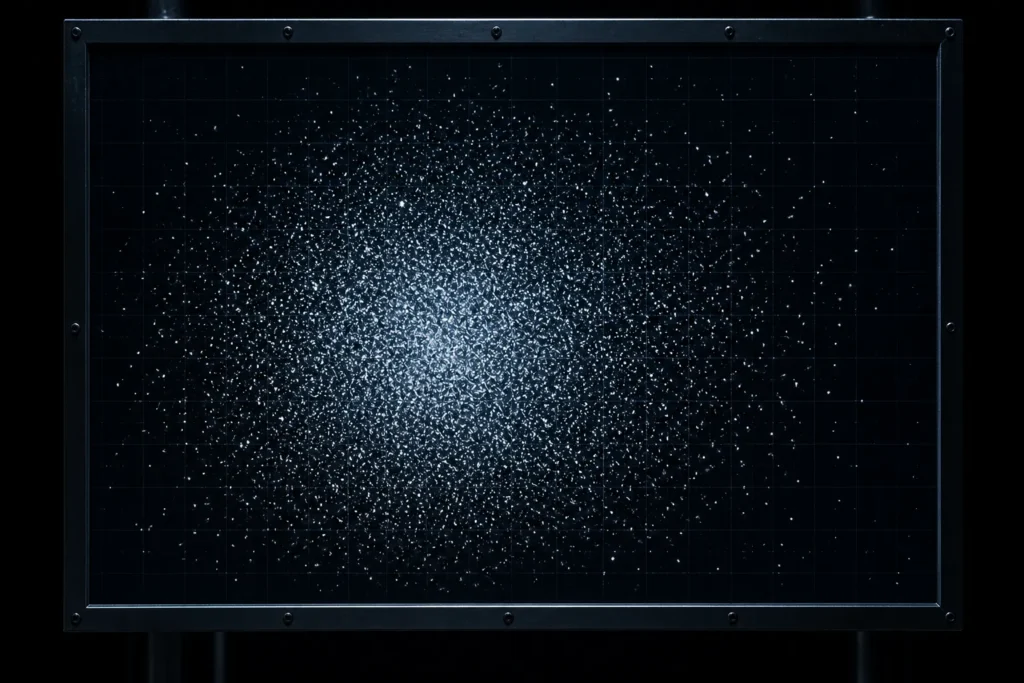
What I learned from working with quantum experiments is that you can run a large number of identical measurements and the distribution of outcomes will match Born Rule predictions with extraordinary accuracy, every single time.
A simple illustration: imagine preparing 1000 identical electrons in the same quantum state and sending each one to a detector. Born Rule predictions might say 65% will appear on the left, 25% in the middle, 10% on the right. Run the experiment, and that is what you will get, within statistical fluctuation. For a single electron, the outcome remains unpredictable. For a large ensemble, the Born Rule is as reliable as any law in physics.
With my knowledge of both the technical and philosophical dimensions of this field, I want to offer one broader reflection.
The probability interpretation of the wave function is not just a calculation trick. It forces us to confront something genuinely strange about the universe: that at the most fundamental level we can probe, reality does not consist of objects with definite properties following deterministic paths. It consists of possibilities, described by wave functions, that crystallise into specific outcomes through the process of measurement.
Whether this means the universe is fundamentally random, or whether it branches into many worlds, or whether there is a deeper deterministic layer we have not yet found, these questions are open. Researchers continue to work on them. What I find most intellectually honest is to sit with that openness, rather than pretend any one interpretation is settled.
Not necessarily. Incompleteness would mean there is a deeper theory waiting to be found. With my knowledge of Bell’s theorem experiments, I can say that any “more complete” theory faces severe constraints; it cannot be local and realistic in the classical sense. Many physicists consider the probabilistic nature fundamental rather than a gap to be filled.
According to the Copenhagen Interpretation, yes, it is instantaneous across space. This bothered Einstein greatly because it seemed to conflict with relativity. In practice, decoherence explains most of the observable features of collapse through very fast but finite physical processes, without requiring instantaneous action at a distance.
The Born Rule itself is tested every time a quantum experiment is run. So far, it has passed every test. There are active efforts by researchers to look for deviations from Born Rule predictions in exotic quantum systems, but none have been found.
Every quantum particle, electron, photon, neutron, even large molecules, is described by a wave function. For systems with many particles, the wave function becomes much more complex and lives in a high-dimensional abstract space rather than ordinary three-dimensional space, but the Born Rule still applies.
It explains the appearance of a classical world, why measurements have definite outcomes in practice, why superpositions are invisible at human scales, and why quantum computing is so hard (because decoherence destroys the fragile quantum states we are trying to preserve). It is not a complete answer, but it is an enormously useful one.
The probability interpretation of the wave function transformed physics. It took a mysterious mathematical object – ψ – and connected it to something measurable: the probability density |ψ|² that governs where particles appear.
But it also opened doors onto some of the deepest questions in science. Why probability? Why does one outcome emerge? What is the wave function, really?
What I have learned as a researcher is that these questions are not signs of a failing theory. They are signs of a theory so deep that it is still teaching us something new about what reality is. The Born Rule is not a temporary fix waiting to be replaced; it is one of the most precise and successful principles ever discovered.
For students beginning their journey into quantum mechanics for beginners, let this be the first lesson: quantum physics does not just describe a strange world. It invites you to question whether your intuitions about the world were ever correct in the first place. And that, I would argue, is exactly what good science should do.