Grover's Algorithm: The Quantum Search Algorithm Explained Simply
📖️ 12 min read | 10 Jun 2026 | Written by G Siva Prakash
What If You Could Search a Million Records in About 1,000 Steps?
Imagine you’ve misplaced your car keys, and they’re hidden somewhere inside a room with one million sealed boxes. One by one, you open each box. In the worst case, you’d check all million before finding the right one. A classical computer faces exactly this kind of problem when searching through an unsorted database, it checks items one at a time, and on average must look through half the list before striking gold.
Now imagine a wildly different approach: instead of checking boxes sequentially, you could somehow make the correct box glow brighter and brighter, until it was impossible to miss. You’d locate it in roughly 1,000 steps instead of 1,000,000. That’s not magic, that’s Grover’s algorithm, one of the most celebrated ideas in quantum computing.
WHAT YOU WILL LEARN
By the end of this guide, you’ll understand what Grover’s algorithm is, how it actually works step by step, why it’s faster than anything a classical computer can do for unstructured search, and what real-world problems it could eventually helps to solve all without needing a physics degree.
What Is Grover's Algorithm?
Grover’s algorithm is a quantum search algorithm that finds a specific item in an unsorted list of N items using approximately √N steps, rather than the N steps a classical computer requires.
It was invented in 1996 by Lov Grover, a computer scientist at Bell Labs. Grover was working on the fundamental question: can quantum mechanics give us any practical advantage when searching data? His answer turned out to be a landmark yes.
Before Grover’s work, many researchers believed quantum computers would mainly excel at exotic number-theory problems. Grover showed that even the most ordinary computational tasks to finding one item among many becomes significantly faster on a quantum machine. That insight made his algorithm one of the first genuinely practical demonstrations of quantum advantage, and it remains a cornerstone of quantum computing education today.
Why Classical Search Gets Slow
Before appreciating the quantum solution, it’s worth understanding the classical problem clearly.
Structured vs. Unstructured Search
When data is sorted or indexed, think of a phone book ordered alphabetically finding an entry is fast. You can jump straight to the right section and narrow down quickly. Computer scientists call this structured search.
But a huge number of real problems involve unstructured search: data with no inherent ordering. Think of checking whether a specific password matches a hash, scanning a database with no index, or finding a solution to a puzzle. There’s no shortcut. A classical computer must check items one by one.
In technical terms, this is called linear search with O(N) complexity — meaning the number of steps grows in direct proportion to the size of the database. Double the database, double the work.
Concrete Example
Suppose you’re looking for one specific password among 1,000,000 possibilities. A classical computer checks them one by one. On average, it will find the correct one after 500,000 checks. In the worst case? All 1,000,000. Grover’s algorithm, on a quantum computer, narrows this down to roughly 1,000 steps.
The Quantum Secret Behind Faster Searching
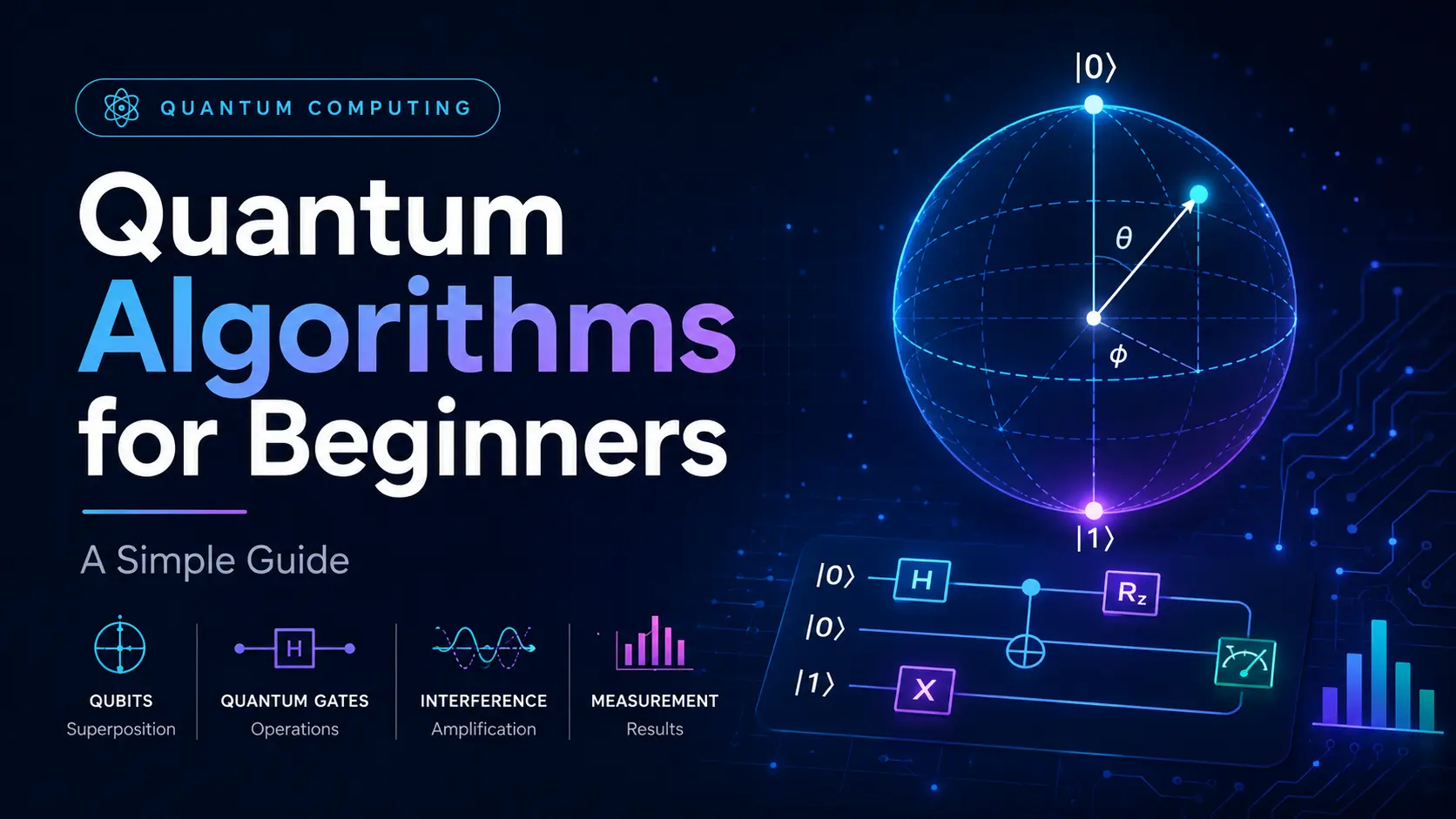
A quantum computer isn’t just a faster classical computer — it works on fundamentally different principles. Three ideas are at the heart of Grover’s algorithm: qubits, superposition, and quantum interference.
Qubits: Why They're Needed for Grover's Algorithm
A classical bit holds a single value — either 0 or 1. A qubit (quantum bit) can hold 0, 1, or any combination of both simultaneously, thanks to a quantum property called superposition. This isn’t a metaphor. The qubit genuinely exists in multiple states at once until it’s measured.
With just 20 qubits in superposition, a quantum computer can represent over one million states simultaneously. This is why qubits are essential for Grover’s algorithm — they allow the machine to work with all possible answers at the same time rather than evaluating each one separately. As the database grows larger, more qubits are required, but the relationship is efficient: searching a database of N items requires only about log₂(N) qubits.
Superposition
Imagine spinning a coin. While it’s spinning, it’s neither heads nor tails — it’s both at once. A qubit in superposition is similar: it holds a mix of 0 and 1 simultaneously. Only when you stop the coin (measure the qubit) does it settle into one definite state.
Quantum Interference
Quantum states are described by probability amplitudes. Numbers that behave like waves. Two waves can add together (constructive interference) or cancel each other out (destructive interference). Grover’s algorithm is cleverly designed to constructively amplify the probability of the correct answer while destructively reducing the probability of all wrong answers. This is the core mechanism that makes it faster than anything classical.
Classical Bit
Qubit
How Does Grover's Algorithm Work? A Step-by-Step Breakdown
Here’s the complete picture before we dive into each step. Grover’s algorithm works by first putting all possible answers into equal superposition, then using a two-part trick — an oracle and amplitude amplification — repeated roughly √N times, to make the correct answer overwhelmingly likely when you finally measure.
set to |0⟩
for all items
of target item
probability
of correct item
repeats
Initialize the Qubits
Set all qubits to the starting state |0⟩ — essentially zeroing everything out, the same way you clear a whiteboard before working on a new problem.
Apply Hadamard Gates — Create Equal Superposition
A Hadamard gate transforms each qubit into a superposition of 0 and 1 simultaneously. After this step, every possible answer in the database has exactly equal probability of being measured. The algorithm is now "aware" of all possibilities at once.
Oracle Marks the Correct Answer
An oracle is a specialized quantum operation that can recognize the answer you're looking for. It doesn't reveal the answer outright — instead, it flips the sign of the correct answer's amplitude, marking it as special. Think of a teacher who can grade your answer sheet instantly, circling the right answer without telling you what it is yet.
Amplitude Amplification — Make the Right Answer Louder
A second operation called the diffusion operator (or Grover diffusion) reflects all amplitudes around their average. Since the marked answer has a flipped (negative) amplitude, this reflection increases its magnitude significantly while reducing all others. It's like turning a spotlight toward one item in a dark room.
Repeat the Oracle + Diffusion Loop
Steps 3 and 4 are repeated approximately √N times. Each repetition further boosts the correct answer's probability while suppressing wrong ones. Over-iterating past this optimal count actually decreases accuracy, so precision matters.
Measure
After √N iterations, the correct answer has a probability close to 1. Measuring the qubits almost always yields the right answer — the algorithm has done its job.
A Simple Four-Item Example
Suppose your database has four entries: A, B, C, and D. You’re looking for C.
- After the Hadamard step, each entry has a 25% chance of being the answer.
- The oracle marks C by flipping its amplitude sign.
- Amplitude amplification shifts probability toward C — now C has roughly 100% probability.
- Measuring yields C. Done in just 1 iteration instead of checking all 4.
The Treasure Hunt Analogy
Picture 100 treasure boxes lined up in a field. Only one contains gold. Everyone else uses a classical search: pick a box, open it, repeat. On average you’ll find the gold after opening 50 boxes. Worst case? All 100.
Grover’s algorithm is like having a magical compass that slowly points more and more strongly toward the gold box each time you sweep through the field. After about 10 sweeps (√100), the compass is pointing almost perfectly at the right box. You then walk straight to it. You didn’t open every box — you changed the probability landscape until the answer was unavoidable.
Why Is Grover's Algorithm Faster? The Quadratic Speedup
The speedup comes from replacing O(N) classical steps with O(√N) quantum steps. This is called a quadratic speedup. It’s not exponential — Grover didn’t break all of computer science — but it’s still genuinely dramatic, especially at scale.
| Database Size | Classical Search | Grover’s Algorithm | Speedup Factor |
|---|---|---|---|
| 4 items | 4 steps | 2 steps | 2× |
| 100 items | 100 steps | 10 steps | 10× |
| 10,000 items | 10,000 steps | 100 steps | 100× |
| 1,000,000 items | 1,000,000 steps | 1,000 steps | 1,000× |
| 1 trillion items | 1,000,000,000,000 steps | 1,000,000 steps | 1,000,000× |
The pattern is clear: as databases get larger, the advantage of quantum search becomes increasingly massive. For today’s cybersecurity systems, this has real implications — a brute-force key search that would take billions of years classically could be reduced to a feasible operation on a sufficiently large quantum computer.
Applications of Grover's Algorithm
It would be easy to assume Grover’s algorithm is purely theoretical, but its potential applications span multiple industries.
- Cryptography and Cybersecurity: Grover’s algorithm effectively halves the security of symmetric encryption keys. A 128-bit key becomes as vulnerable as a 64-bit key would be classically. This is why security agencies are already recommending 256-bit encryption as a quantum-resistant standard.
- Password Recovery Research: In forensic and authorized security auditing contexts, a quadratic speedup on brute-force password searches is significant.
- Database Searching: Any large, unindexed dataset — genomic databases, medical records, financial records — could benefit from quantum search when hardware matures.
- Machine Learning and AI: Many ML optimization tasks involve searching high-dimensional solution spaces. Grover-style amplitude amplification can accelerate certain subroutines in quantum machine learning.
- Optimization Problems: Logistics, scheduling, and route-finding often reduce to large search problems. Grover’s algorithm can speed up certain classes of these.
- Pattern Matching: Detecting specific patterns in large datasets — cybersecurity threat detection, signal processing — maps naturally onto quantum search.
- Scientific Computing: Simulating molecular structures or solving complex physics problems can involve searching large solution spaces where quadratic speedup is meaningful.
⚠️ Realistic Limitations
Grover’s algorithm requires fault-tolerant quantum computers with many error-corrected qubits — hardware that doesn’t yet exist at practical scale. Current quantum computers are noisy and error-prone. Additionally, constructing the oracle for a specific problem can itself be technically challenging. The algorithm’s advantage is quadratic, not exponential, meaning classical computers will remain competitive for many tasks even after quantum hardware matures.
Shor's vs. Grover's Algorithm: What's the Difference?
Both algorithms are quantum milestones, but they solve fundamentally different problems and offer different kinds of speedup.
Grover's Algorithm
Solves unstructured search. Achieves a quadratic speedup (√N steps). Uses amplitude amplification. Broadly applicable: anywhere you need to find one item among many.
Shor's Algorithm
Solves integer factorization. Achieves an exponential speedup. Uses the Quantum Fourier Transform. Primarily threatens RSA and public-key cryptography.
| Property | Grover’s Algorithm | Shor’s Algorithm |
|---|---|---|
| Problem type | Unstructured search | Integer factorization |
| Speedup class | Quadratic (O(√N)) | Exponential |
| Core technique | Amplitude amplification | Quantum Fourier Transform |
| Cryptographic impact | Weakens symmetric encryption | Breaks RSA / public-key crypto |
| Application breadth | Very broad | Specific to factorization |
Use Grover’s algorithm when you need to find something in an unsorted space. Use Shor’s algorithm when you need to factor large numbers — which is a much more targeted (and frankly, more alarming) capability.
Advantages and Limitations
Advantages
- Provably optimal for unstructured quantum database search — no quantum algorithm can do better than O(√N) for this problem.
- Elegantly general: the oracle abstraction means the algorithm applies to any search problem where you can verify a solution efficiently.
- Foundational: amplitude amplification techniques derived from Grover’s work power a whole family of quantum algorithms.
- Hardware-agnostic: it can be implemented on any quantum computing platform.
Limitations
- Requires fault-tolerant quantum hardware that doesn’t yet exist at scale.
- Oracle design can be complex — knowing whether a solution is correct isn’t always trivial to implement as a quantum circuit.
- The speedup is quadratic, not exponential — classical computing remains competitive for many real-world workloads.
- Sensitive to quantum noise; errors in the oracle or diffusion step can degrade accuracy significantly.
- Over-iterating (running more than ~√N iterations) actually decreases the probability of success.
Frequently Asked Questions
What is Grover's algorithm?
Grover’s algorithm is a quantum search algorithm invented by Lov Grover in 1996. It finds a target item in an unsorted database of N items in approximately √N steps, compared to the N steps required by classical computers. It achieves this through superposition and amplitude amplification, making it the optimal quantum algorithm for unstructured search.
Why is it called a quantum search algorithm?
It’s called a quantum search algorithm because it uses quantum mechanical properties — specifically superposition and interference — to search through possibilities faster than any classical approach. Unlike classical algorithms that check one item at a time, Grover’s algorithm evaluates all possible answers simultaneously, then uses interference to amplify the correct one.
What is amplitude amplification?
Amplitude amplification is the quantum technique at the heart of Grover’s algorithm. After an oracle marks the correct answer by flipping its probability amplitude, a diffusion operator reflects all amplitudes around their average — effectively increasing the correct answer’s probability while decreasing all others. Repeating this cycle makes the right answer overwhelmingly probable.
How many qubits are needed for Grover's algorithm?
To search a database of N items, Grover’s algorithm requires approximately log₂(N) qubits to represent all items in superposition, plus additional ancilla (helper) qubits for the oracle. For example, searching one million items (~2²⁰) needs roughly 20 qubits, plus overhead for the oracle circuit. The exact number depends on the specific problem and oracle design.
Can Grover's algorithm break passwords?
Grover’s algorithm can theoretically speed up brute-force password attacks quadratically. A 128-bit key that would take 2¹²⁸ classical operations to crack could be broken in about 2⁶⁴ quantum operations. This is why NIST now recommends 256-bit symmetric keys for post-quantum security. However, this threat requires large-scale fault-tolerant quantum computers that don’t yet exist.
What is the difference between Shor's and Grover's algorithm?
Grover’s algorithm solves unstructured search with a quadratic speedup (O(√N)), while Shor’s algorithm solves integer factorization with an exponential speedup. Grover uses amplitude amplification; Shor uses the Quantum Fourier Transform. Shor’s is a more catastrophic threat to current cryptography — specifically RSA — while Grover’s weakens symmetric encryption by effectively halving key lengths.
Can Grover's algorithm run on today's quantum computers?
Simple demonstrations of Grover’s algorithm have been run on current quantum hardware, but these are proof-of-concept runs with tiny databases. Practical, large-scale use requires fault-tolerant quantum computers with many error-corrected logical qubits — a milestone that is likely years away. Current quantum hardware is too noisy for meaningful real-world applications.
Does Grover's algorithm search everything simultaneously?
Not exactly, this is a common misconception. Grover’s algorithm places all possibilities in superposition so the oracle can be applied to all of them at once. But you can’t simply read all results simultaneously; measurement collapses the state to one outcome. The cleverness is in using interference to make the correct outcome overwhelmingly probable before that measurement.
Key Takeaways
- Grover’s algorithm is the optimal quantum algorithm for unstructured search problems.
- It achieves a quadratic speedup: O(√N) steps instead of O(N).
- Qubits and superposition allow all possible answers to be considered simultaneously.
- The oracle marks the correct answer; amplitude amplification makes it increasingly likely.
- Approximately √N iterations are needed — over-iterating hurts accuracy.
- Applications span cryptography, AI, optimization, database search, and scientific computing.
- Grover’s and Shor’s algorithms are complementary: search vs. factorization, quadratic vs. exponential speedup.
- Large-scale practical use requires fault-tolerant quantum hardware not yet available.
Why Grover's Algorithm Matters for the Future
Grover’s algorithm is important not just for what it does, but for what it proves: quantum mechanics isn’t only useful for narrow, exotic mathematical problems. Finding one item in a large, unordered dataset is one of the most universal operations in computing, and Grover showed that quantum machines handle it fundamentally better than their classical counterparts.
For students and researchers, Grover’s algorithm is the ideal entry point into quantum computing. It introduces qubits, superposition, and interference in a concrete, purposeful context — not as abstract physics, but as engineering tools that produce a measurable, provable advantage.
For the security industry, it’s a reminder that the post-quantum transition isn’t hypothetical. Cryptographic standards are already changing in anticipation of algorithms like Grover’s running on real hardware.
And for anyone thinking about the long arc of computing history, Grover’s algorithm represents something beautifully rare: a completely new kind of reasoning about search. Not faster hardware doing the same thing — a genuinely different computational idea.
Looking Ahead
As quantum hardware continues to mature and error-correction improves, Grover’s algorithm may become one of the first quantum techniques deployed for real-world search problems that classical computers cannot tackle efficiently at scale. Understanding it now — while the hardware is still catching up — is the right time to prepare.