Quantum Algorithms for Beginners: A Simple Guide
📖 11 min read | 7 Jun 2026 | Written by G Siva Prakash
What they are, how they work, and why they might change everything, explained without the physics degree.
Introduction
Imagine solving a problem that would take today’s fastest supercomputers thousands of years — in just a few minutes. That sounds like pure science fiction. But it is exactly the promise driving billions of dollars in research, attracting some of the world’s sharpest minds, and reshaping how we think about what computers can do.
At the heart of this promise are quantum algorithms — a fundamentally new kind of instruction set, designed not for ordinary computers but for machines that harness the strange rules of quantum physics. They are not simply faster versions of what we already have. They work in an entirely different way.
When I first started learning about quantum algorithms, the sheer strangeness of the concepts was genuinely disorienting. But once the foundations click, the ideas become not just understandable but fascinating. This guide is designed to give you exactly that foundation — no physics background required.
By the end of this article you will understand what quantum algorithms are, how they work, how they compare to classical algorithms, and what real-world problems they are being designed to solve.
What Are Quantum Algorithms?
// Direct Answer
A quantum algorithm is a set of step-by-step instructions designed specifically for a quantum computer. Unlike classical algorithms, quantum algorithms exploit quantum mechanical properties — superposition, entanglement, and interference — to process information in ways ordinary computers cannot.
A classical algorithm is a recipe. You give a computer a problem, it follows a precise sequence of steps, and it arrives at an answer. Think of solving a maze by trying one path at a time — methodical, sequential, reliable. A quantum algorithm is more like being able to explore all paths through the maze simultaneously, and using the laws of physics to make the wrong paths cancel out while the right one becomes more visible. That is a rough analogy, but it captures something real.
Quantum algorithms are not universally faster than classical ones. That is one of the most common misconceptions beginners encounter, and it matters to address it upfront. They offer dramatic speedups for specific types of problems — particularly those involving enormous search spaces, pattern finding, and mathematical structure. For many everyday computing tasks, a classical algorithm is perfectly fine and far more practical.
Quantum Computing Basics You Need to Know First
Before quantum algorithms can make sense, four concepts need to click into place. None of them require a physics degree — just a willingness to sit with something genuinely strange.
What Is a Qubit?
Classical computers store information as bits — each one is either a 0 or a 1. A qubit (quantum bit) can be 0, 1, or a combination of both at the same time. This is not an error in the system — it is a fundamental feature of quantum physics. A qubit can hold far more information than a classical bit, but only until you measure it, at which point it collapses to a definite 0 or 1.
What Is Superposition?
Superposition is what allows a qubit to be in multiple states simultaneously. The classic analogy is a spinning coin — while it is in the air, it is neither heads nor tails, it is both. A qubit in superposition holds the potential of multiple states at once, which allows a quantum computer to process many possibilities in parallel rather than one at a time.
What Is Quantum Entanglement?
Entanglement is a quantum connection between two qubits such that the state of one instantly influences the other, no matter how far apart they are. A simple analogy: imagine a pair of gloves separated into two boxes. The moment you open one box and find the left glove, you instantly know the other box contains the right glove. Entangled qubits have a deeper, quantum version of this relationship — and it allows quantum computers to coordinate information across many qubits simultaneously.
What Are Quantum Gates?
Just as classical computers use logic gates (AND, OR, NOT) to manipulate bits, quantum computers use quantum gates to manipulate qubits. Quantum gates rotate and transform qubit states, create superpositions, and produce entanglement. They are the building blocks of every quantum algorithm.
// Foundation Summary
Qubits + Superposition + Entanglement + Quantum Gates = The foundation of every quantum algorithm. Understand these four ideas and the rest of quantum computing becomes significantly clearer.
How Quantum Algorithms Work
Every quantum algorithm, regardless of how complex it becomes, follows the same essential four-step process. Understanding this structure makes everything else far easier to follow.
Prepare the Qubits
All qubits start in a known state — typically |0⟩. This is the clean starting point for every computation, analogous to clearing a whiteboard before writing.
Create Superposition
Quantum gates place qubits into superposition, allowing the system to represent many possible inputs simultaneously. A single quantum processor with 50 qubits in superposition can represent over one quadrillion states at once.
Apply Quantum Operations
Further gates manipulate the qubits through carefully designed sequences. These operations use quantum interference — amplifying states that lead to correct answers and cancelling states that do not. This is where the "intelligence" of the algorithm lives.
Measure the Result
Measurement collapses each qubit to a definite 0 or 1. Because the algorithm amplified the correct answer during step 3, the final measurement has a high probability of landing on the right result. The output is now classical information — readable by any normal computer or display.
A useful way to visualise this: imagine searching for one name in a phone book of one million entries. A classical algorithm checks names one at a time — up to one million checks in the worst case. A well-designed quantum algorithm can find the name in roughly one thousand checks, because it searches multiple entries simultaneously and steers the measurement toward the correct result.
Classical vs Quantum Algorithms
One of the most important things to understand early is that quantum algorithms are not simply better versions of classical algorithms. They operate on completely different principles and excel at completely different tasks.
| Feature | Classical Algorithms | Quantum Algorithms |
|---|---|---|
| Information unit | Bit (0 or 1) | Qubit (0, 1, or both) |
| Processing style | Sequential, one step at a time | Parallel possibilities simultaneously |
| Speed potential | Limited by sequential logic | Exponential speedup for specific problems |
| Hardware | Standard silicon processors | Superconducting, photonic, or trapped-ion chips |
| Strengths | Reliable, widely applicable, mature ecosystem | Cryptography, search, simulation, optimisation |
| Limitations | Cannot efficiently solve certain complex problems | Noise-sensitive, early-stage, limited qubit counts |
| Typical use cases | Most everyday computing tasks | Specialised scientific and mathematical problems |
A point worth emphasising: quantum computers will not replace classical computers for most tasks. Sending an email, editing a document, or streaming video does not benefit from quantum processing. The value of quantum algorithms comes from a small but enormously important class of problems — particularly those that are computationally hard for classical machines but structurally suited to quantum approaches.
- ✓ Web & app software
- ✓ Video & media processing
- ✓ Everyday data management
- ✓ Cryptography & encryption
- ✓ Molecular simulation
- ✓ Large-scale optimisation
// ALGORITHM 01
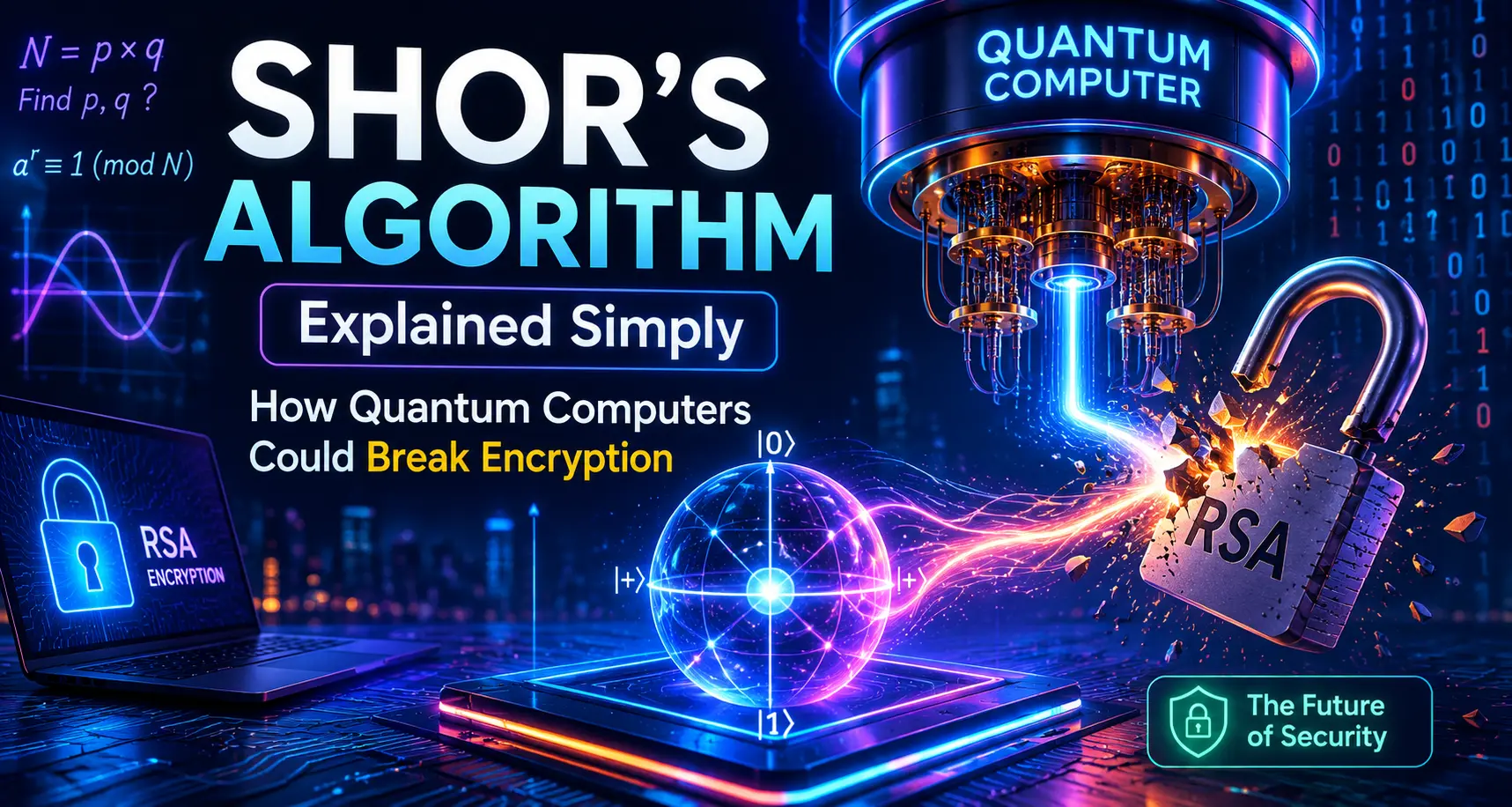
Shor's Algorithm
What it does: Shor’s algorithm solves the problem of factoring large numbers into their prime components — a task that grows exponentially hard for classical computers as numbers get bigger.
Why it matters: Most of today’s internet encryption (including RSA, which protects your bank account and private messages) relies on the fact that classical computers cannot factor very large numbers in any practical timeframe. Shor’s algorithm, running on a sufficiently powerful quantum computer, could do it efficiently — which is why its development is one of the driving forces behind post-quantum cryptography research.
Simple example: Finding that 15 = 3 × 5 is trivial. Finding the two prime factors of a 2,048-digit number is computationally impossible for classical machines. Shor’s algorithm uses quantum Fourier transforms and period-finding to make it tractable.
→ Shor’s algorithm deserves a full deep-dive. A dedicated article covering its mathematical structure and circuit design is coming to QuantumLearny.
// ALGORITHM 02
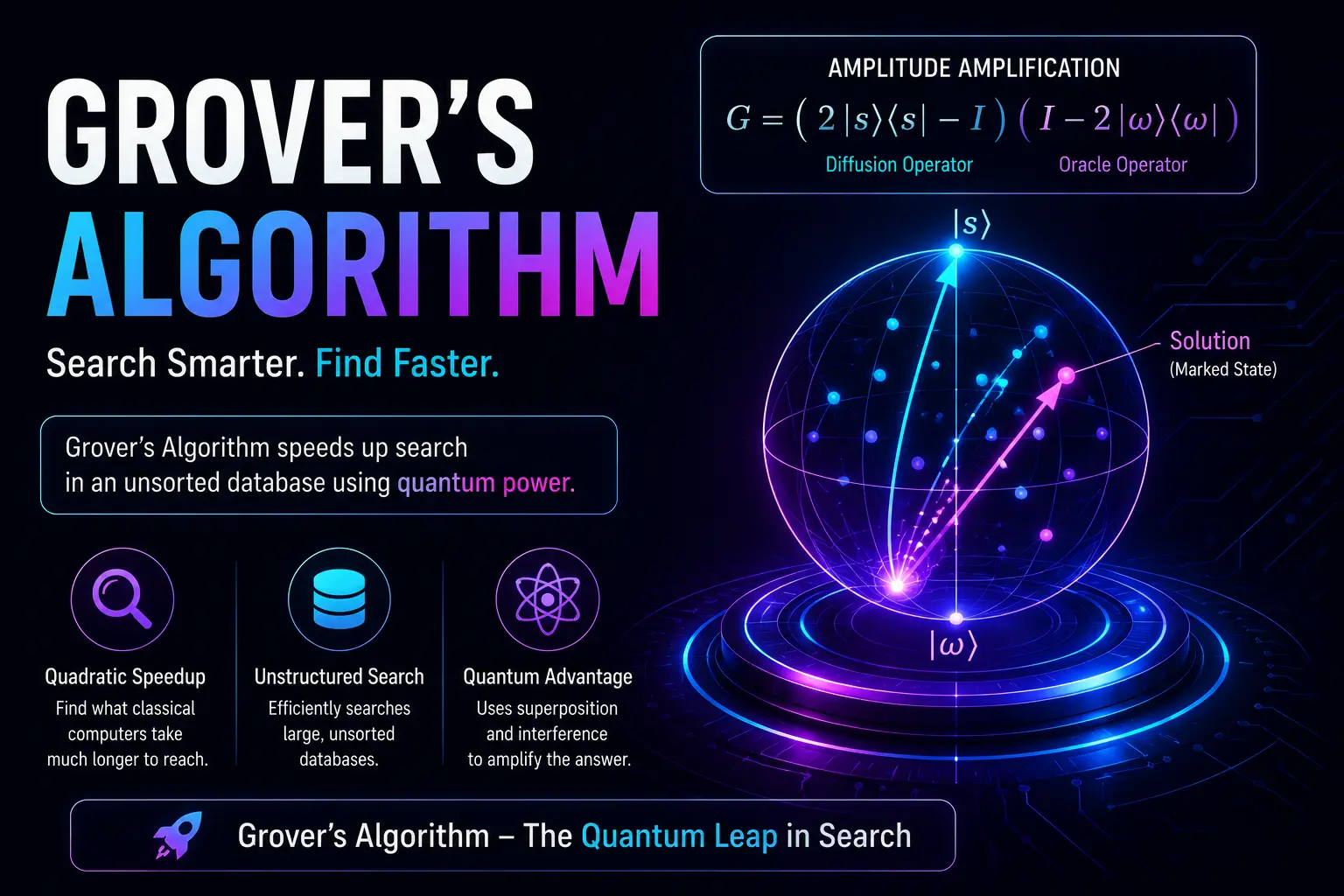
Grover's Algorithm
What it does: Grover’s algorithm provides a quantum speedup for searching through an unsorted database. A classical computer searching N entries takes, on average, N/2 checks. Grover’s takes roughly √N checks — a quadratic speedup that becomes dramatic at large scale.
Why it matters: Database search underlies almost every area of computing — from finding a record in a patient database to optimising a logistics network. A quadratic speedup may not sound revolutionary, but at the scale of millions or billions of entries, it is significant.
Simple example: Searching one million entries classically takes up to 500,000 checks. Grover’s algorithm finds the answer in roughly 1,000 — using quantum amplitude amplification to make the correct entry increasingly likely to appear on measurement.
→ Grover’s algorithm is a beautiful piece of quantum design. A dedicated beginner-friendly breakdown will be published on QuantumLearny soon.
// ALGORITHM 03
Deutsch-Jozsa Algorithm
What it does: This algorithm determines whether a function is constant (always outputs the same value) or balanced (outputs 0 half the time and 1 the other half). Classically, in the worst case, you need to check half of all inputs. The Deutsch-Jozsa algorithm answers in a single query.
Historical importance: Published by David Deutsch and Richard Jozsa in 1992, this was one of the first algorithms to demonstrate a clear, provable quantum advantage over classical computation. It is not practically useful on its own, but it was a landmark proof of concept — showing that quantum parallelism is real and exploitable. Every quantum computing researcher knows this algorithm.
→ The Deutsch-Jozsa algorithm is a great starting point for understanding quantum interference. A focused tutorial is planned for QuantumLearny.
// ALGORITHM 04
Quantum Fourier Transform (QFT)
What it does: The Quantum Fourier Transform is the quantum analogue of the classical Discrete Fourier Transform — a mathematical tool that decomposes a signal into its component frequencies. The QFT does this exponentially faster than any classical method.
Why it matters: QFT is not useful on its own — it is a subroutine used inside other algorithms. Shor’s algorithm, for instance, relies critically on QFT to find the periodic structure that makes factoring efficient. It appears in many quantum algorithms for simulation and signal processing.
→ The Quantum Fourier Transform is fundamental to advanced quantum algorithms. A detailed explanation will be published in QuantumLearny’s algorithm series.
Applications of Quantum Algorithms
The most exciting thing about quantum algorithms is not the mathematics — it is where they lead. Here are the areas where researchers believe quantum computing will have the most transformative impact.
Cybersecurity
Drug Discovery
Artificial Intelligence
Finance
Logistics
Materials Science
ALGORITHMS
Current Challenges of Quantum Algorithms
Anyone who tells you quantum computing is just around the corner without acknowledging its challenges is not being fully honest. The field is genuinely exciting — and genuinely hard. Here is what stands between current research and the practical applications described above.
Quantum Noise and Errors
Qubits are extraordinarily sensitive. Heat, electromagnetic interference, and even cosmic rays can flip qubit states and corrupt calculations. This is called quantum noise, and it is the central engineering challenge of the field. Unlike classical computers, which handle bit errors through robust hardware and redundancy, quantum systems require sophisticated error correction schemes that consume enormous numbers of physical qubits just to produce a single reliable logical qubit.
Scalability
The most powerful quantum processors available today have a few hundred to a few thousand physical qubits. Running Shor’s algorithm against real-world RSA encryption would require millions of fault-tolerant qubits. The gap between where we are and where we need to be is large — though research progress over the past decade has been substantial.
Cost and Access
Quantum computers require cooling to near absolute zero and extensive electromagnetic shielding. The hardware is extraordinarily expensive to build and operate. Cloud access through platforms like IBM Quantum, Google, and Amazon Braket has democratised experimentation significantly — but physical ownership and large-scale deployment remain prohibitively costly for most organisations.
What Surprised Me Most About Quantum Algorithms
The thing that struck me hardest when I first seriously engaged with this topic was this: quantum algorithms do not work by being faster versions of classical algorithms. They work by being structurally different. A classical speedup means doing the same thing more efficiently. A quantum speedup means doing something fundamentally different — something that has no classical equivalent at all.
The second surprise was how narrow the advantage actually is. Beginners often imagine a quantum computer as a magical machine that solves everything instantly. The reality is more interesting and more humble: quantum speedups exist for a relatively small set of problem types, but for those problems, the advantage is not incremental — it is exponential.
A third insight that took time to appreciate: quantum algorithms are not just a different way of writing code. They require understanding the mathematical structure of the problem well enough to design quantum interference that naturally steers toward the answer. That is genuinely deep — and genuinely beautiful once you see it working.
Common Beginner Mistakes When Learning Quantum Computing
"Quantum computers will replace classical computers"
Not true. Quantum computers are specialised tools for specific problem types. Classical computers will remain the right choice for the vast majority of computing tasks for the foreseeable future.
"Quantum computers are always faster"
Quantum algorithms offer speedups only for specific mathematical structures. For many problems, a classical algorithm is equally fast or faster. Quantum advantage is selective, not universal.
"Quantum computers can instantly solve any problem"
This confuses "exponentially faster" with "instantaneous." Even with a quantum speedup, hard problems still take time. And many problems have no known quantum advantage at all.
"You need advanced physics before getting started"
The foundations of quantum computing — superposition, entanglement, gates — can be understood conceptually without advanced physics. Quantum programming languages like Qiskit and Cirq let beginners run real quantum circuits today.
The Future of Quantum Computing Algorithms
The honest answer is that we are still in the early days — similar to where classical computing was in the 1950s. Current quantum hardware is powerful enough to demonstrate quantum effects and run small-scale algorithms, but not yet powerful enough to deliver practical advantages over classical supercomputers on real-world problem sizes.
What makes the next decade compelling is the convergence of better hardware, improved error correction, and smarter algorithm design. IBM’s quantum roadmap targets fault-tolerant operations within this decade. Google has published experimental results suggesting quantum advantage in narrow domains. Microsoft is pursuing topological qubits that may be inherently more stable.
For beginners entering the field now, the timing is remarkable. Quantum software developers, quantum algorithm researchers, and quantum hardware engineers are in growing demand — and the foundational knowledge needed to enter those careers is more accessible today than ever before.
Supremacy Claim
Quantum (Target)
Frequently Asked Questions
What are quantum algorithms in simple words?
How do quantum algorithms work?
Can quantum algorithms run on regular computers?
What industries benefit most from quantum algorithms?
Are quantum algorithms difficult to learn?
Key Takeaways
- Quantum algorithms are instructions designed for quantum computers, exploiting superposition, entanglement, and interference to solve specific problems exponentially faster.
- They do not replace classical algorithms — they extend what is computationally possible for a narrow but critically important class of problems.
- Shor’s Algorithm (factoring), Grover’s Algorithm (search), Deutsch-Jozsa, and QFT are the four most important foundational algorithms to understand first.
- Real-world applications span cryptography, drug discovery, AI, finance, logistics, and materials science.
- Current hardware is real but limited — we are in the NISQ era, with fault-tolerant quantum computing still ahead.
- Quantum noise and error correction remain the central engineering challenges standing between today’s hardware and tomorrow’s applications.
- Beginners can start today — cloud access to real quantum hardware and beginner-friendly frameworks are freely available.