
Nowadays, the most powerful supercomputers struggle to solve some of the biggest challenges in finding solutions, but what if a new kind of computer could solve these problems faster than a supercomputer? This new kind of computer is called the Quantum computer, a future technology.
Today we were using these classical computers, like:
Classical computers process information using bits that exist as either 0 or 1. They follow logical operations to solve problems step by step.

A quantum computer is a new kind of computer that operates on principles of quantum mechanics, the physics that explains how tiny particles like atoms and electrons behave.
Unlike classical bits, quantum computers use something called qubits(quantum bits)
These qubits can be in both 0 and 1 states simultaneously. This is called superposition.
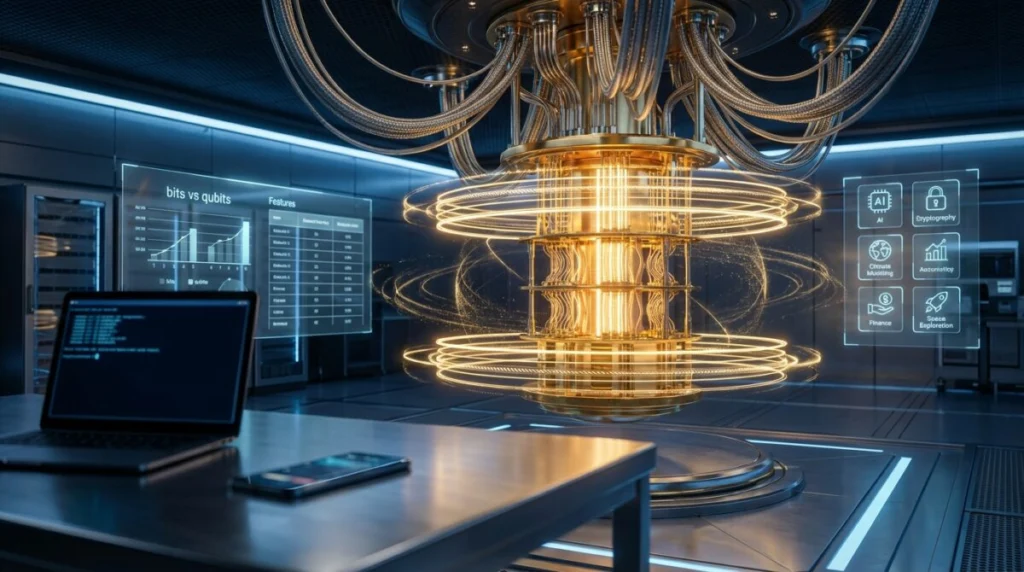
That’s why quantum computers can process many possibilities at a time rather than solve problems step by step.
| Feature | Classical Bit | Quantum Bit (Qubit) |
|---|---|---|
| Possible States | 0 or 1 | 0, 1, or both at the same time |
| Working Principle | Based on classical physics | Based on quantum mechanics |
| Processing Ability | Processes one value at a time | Can process many possibilities at a time |
| Speed | Slower for complex problems | Much faster for certain complex problems |
| Reliability | More stable and less errors | Sensitive to noise and errors |
| Real-world Usage | Using daily life devices | Still in experimental stage |
| Example | Laptops, smartphones | Quantum computers |
| Features | Classical Computers | Quantum Computers |
|---|---|---|
| Basic unit of information | Bit | Qubit |
| Data Processing | Sequential processing | Parallel processing |
| Operational conditions | Room temperature | Requires close to absolute 0°C |
| Applications | Daily computing tasks | Drug discovery, cryptography, AI |
| Cost | Affordable | Extremely expensive |
Now, the supercomputers are giving approximate weather reports.
Quantum computers can:
This will prevent natural disasters before they happen.
Quantum computers could potentially break traditional encryption methods such as RSA and ECC using Shor’s algorithm.
This will lead to:
Banks and governments are preparing for this shift.
Quantum computers can solve:
In the future:
Companies like Volkswagen and DHL are testing quantum logistics.
Quantum Machine Learning (QML) may accelerate training processes for complex AI models in the future.
Future:
The banking sector can use quantum computing for:
Companies JPMorgan Chase and Goldman Sachs are investing heavily in quantum computing.
In the future, quantum computers may help:
Used by the space company NASA
A Hybrid system will use classical computers for control and pre/post processing, while quantum processors solve the complex computational core.
IBM, Microsoft, Google, and D-Wave Systems, these companies are working on hybrid systems.
These algorithms are splitting tasks between classical and quantum processors and making them work together
No, The Quantum computers are not designed to replace classical computers. Rather than, they will work alongside classical systems to solve problems that classical computers can not handle
At present, quantum computers are error-prone and sensitive to room temperature disturbances, which makes them less reliable than classical computers.
Yes, it is expected to play a major role in solving problems that are currently beyond the capabilities of classical computers
The classical computer performs well and is very reliable for daily tasks with bits. But can not solve the complex problems, so the concept quantum computer is introduced, which will work based on the qubits. It will process vast possibilities in parallel for breakthroughs in AI, climate modelling, and cryptography classical systems through hybrids. Big companies like IBM and NASA are paving the way. The future? Their synergy unlocks solutions once thought impossible
Things like quantum qubit, quantum superposition and quantum entanglement are what make modern systems really different, from the ones. This is something that is talked about when people compare computing to quantum computing. Quantum qubits and entanglement and quantum superposition are the key things that make quantum computing special.