
It may sound impossible in our daily world, but at the tiny atomic level, quantum physics suggests that this strange behaviour is real.
Let’s understand it with a simple example.
Imagine you flip a coin into the air. While it is spinning, you cannot clearly say whether it is heads or tails; it is still uncertain.
Only when the coin lands and you look at it, do you see a definite result: heads or tails.
This simple idea helps us understand one of the most powerful principles in quantum mechanics:
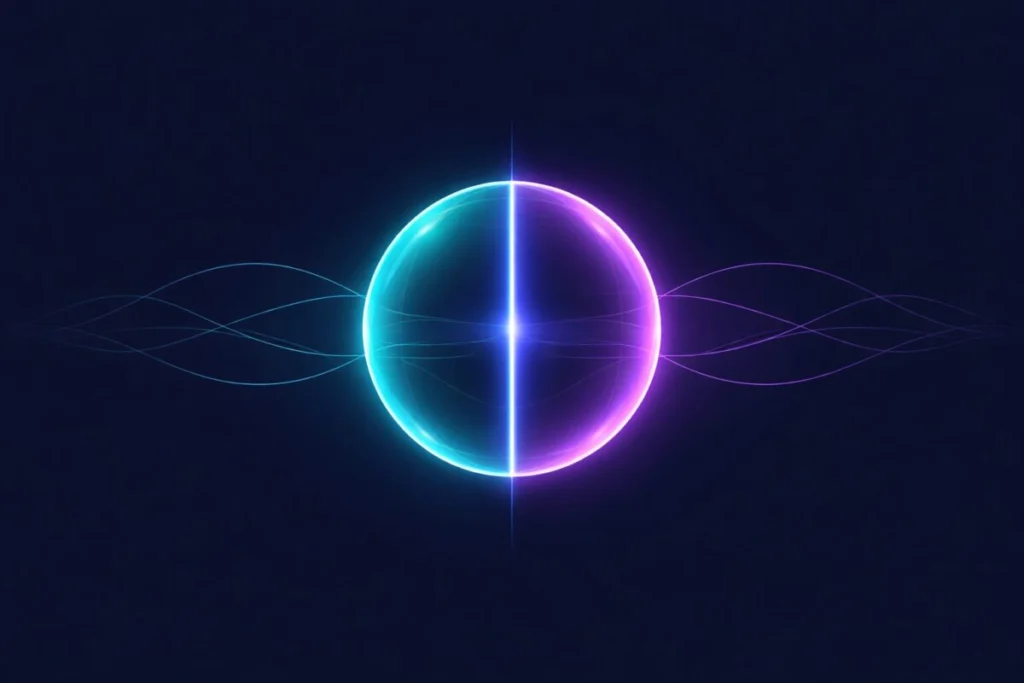
In quantum computing, a qubit does not behave like a normal bit. Instead of being only 0 or 1, a qubit can exist in a quantum combination of both 0 and 1 until it is measured.
This special quantum state is called a superposition.
When we measure the qubit, the superposition collapses, and it becomes either 0 or 1, similar to how the coin becomes heads or tails once observed.
Quantum superposition is a fundamental principle of quantum mechanics that allows a quantum particle to exist in multiple possible states at once.
Classical computers use bits, which are always either:
But quantum computers use qubits, and qubits can represent a superposition of states.
Because of this, quantum computers can process many possibilities in parallel, a concept often called:
Quantum Parallelism
Many researchers believe this technology will transform major industries such as:
As quantum computing advances, understanding superposition becomes increasingly important.
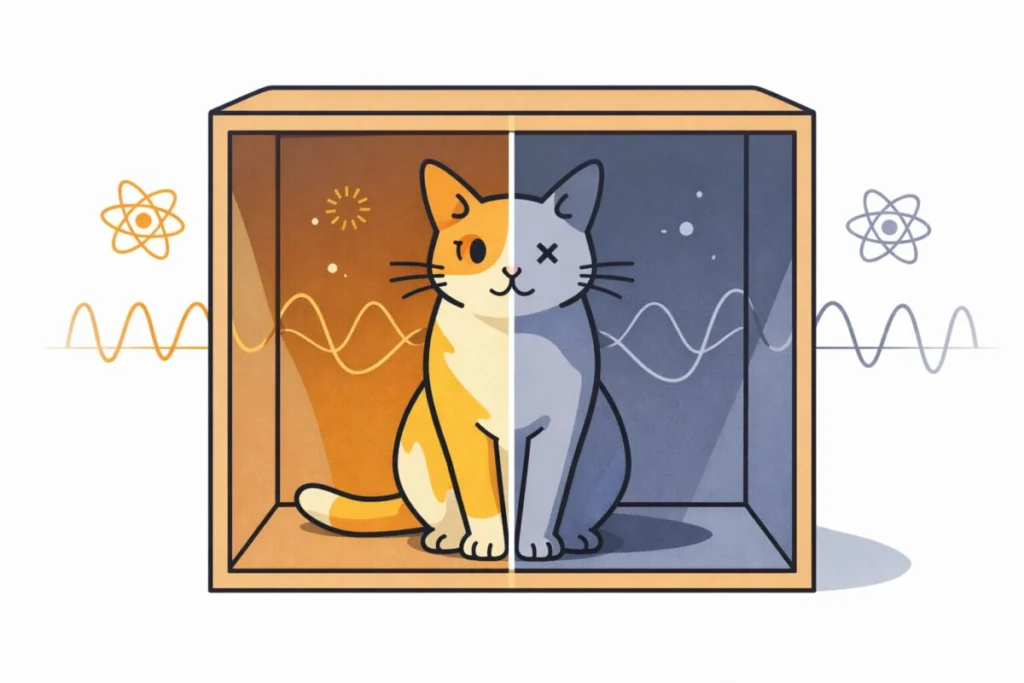
One of the most famous examples used to explain superposition is Schrödinger’s Cat.
This thought experiment is not about harming a real cat, it was designed to show how mysterious the quantum world can be.
Imagine a sealed box. Inside it are:
Now here is the strange part:
According to quantum mechanics, before we open the box, the radioactive particle exists in a superposition, both decayed and not decayed.
Since the cat’s life depends on that particle, the cat is also considered to be in a strange mixed state:
At the same time.
Only when we open the box and observe it, reality seems to “choose” one outcome.
Schrödinger created this example to show that quantum rules work perfectly for atoms, but they feel unbelievable when applied to everyday objects.
Quantum superposition is not just a theory it plays a key role in many emerging technologies.
Here are some important applications:
In classical computing, a bit is only 0 or 1.
But with superposition, a qubit can exist in multiple quantum states simultaneously.
This allows quantum computers to explore many possible solutions at the same time, making them extremely powerful for certain tasks.
Quantum communication uses superposition to transmit data securely.
If someone tries to spy on the communication, the quantum state changes instantly, making hacking detectable.
This could lead to nearly unbreakable security systems.
Developing medicines requires testing millions of molecular combinations.
Quantum superposition helps simulate many molecular states at once, speeding up drug discovery and vaccine design.
Quantum systems can test multiple traffic routes simultaneously.
Future smart cities may use quantum computing to reduce congestion and find the best routes instantly.
Companies like Amazon and FedEx deal with complex logistics.
Quantum computing may allow them to evaluate millions of delivery schedules at the same time, improving efficiency.
Weather systems involve billions of variables.
Quantum superposition helps quantum computers perform massive simulations more efficiently, improving long-term climate prediction.
Quantum sensors based on superposition can detect tiny gravitational changes.
This could create navigation systems more accurate than current GPS, especially underground or underwater.
Quantum imaging may enhance scanning methods like MRI by capturing more detail with less noise.
Future medical scans could become sharper and safer.
Banks and investors deal with thousands of possible outcomes.
Quantum superposition can help analyse many market scenarios simultaneously, improving decision-making and risk management.
Quantum machines can search through huge datasets in parallel.
This could improve fraud detection, artificial intelligence, and data analysis faster than classical computers.
Even though superposition is powerful, maintaining it is extremely difficult.
This is because of a major challenge called:
Decoherence
can destroy the quantum state.
When decoherence happens, the qubit loses superposition and starts behaving like a normal classical bit.
This leads to:
Scientists try to reduce decoherence using:
Decoherence is one of the biggest reasons building large-scale quantum computers is still challenging.
Yes. Superposition has been confirmed through experiments with electrons, photons, and other quantum particles.
Not normally, because large objects lose superposition quickly due to decoherence.
Superposition allows quantum computers to process many possibilities simultaneously, giving them potential advantages over classical computers.
Quantum superposition is one of the most fascinating and powerful ideas in quantum physics.
It means a particle, like a qubit, can exist in a combination of multiple states rather than one definite state.
This unique property gives quantum computers their revolutionary potential, allowing them to explore many solutions at once.
Although maintaining superposition is difficult because of decoherence, it remains the core principle driving the future of quantum technology.
Quantum superposition is not just a theory, it may be the key that unlocks the next era of computing.
Understanding quantum superposition is essential because it works closely with quantum qubits and quantum entanglement, forming the foundation of concepts explained in classical vs quantum computing.
Enjoyed this guide? Dive deeper into the concepts that power quantum measurement